 Open Access



 Open access
 Check for updates


Abstract
A nuclear regulatory body is the instrument through which a State makes sure that nuclear energy and radiation are used without unacceptable risk to people, society and the environment. This narrative review sets out what such a body is expected to do and what it needs in order to do it. Sources, search dates and selection criteria are described in Section 2. It draws on the safety standards of the International Atomic Energy Agency (IAEA), the Convention on Nuclear Safety, the legislation that created the regulators of Bangladesh, Pakistan and India, and the published reports of IAEA Integrated Regulatory Review Service (IRRS) missions to the three countries. Nine functions are discussed: regulations and guides, authorization, review and assessment, inspection, enforcement, emergency preparedness, communication with interested parties, international cooperation, and research and competence management. Four conditions decide whether these functions work in practice: effective independence, competence, resources, and a management system with a sound safety culture. The Bangladesh Atomic Energy Regulatory Authority (BAERA) is examined as a newcomer regulator that has moved through site, construction and commissioning licensing of the Rooppur Nuclear Power Plant (fuel loading began in April 2026 and first criticality was reached in October 2026), and is compared with Pakistan and India on common criteria. Findings of the 2022 IRRS mission to Bangladesh are treated as a 2022 baseline, not as a description of present conditions. Recurring challenges are summarized and seven recommendations are offered, each linked to an identified gap, a lead institution and an indicator of progress. The functions themselves are well defined internationally; the harder task is sustaining the conditions behind them.
Introduction
The use of nuclear energy and radiation brings large benefits in power generation, medicine, industry, agriculture and research. It also carries risks that can last for generations and cross borders. For that reason safety is treated as a matter of continuing public interest, and States set up a regulatory body, separate from those who promote or operate nuclear facilities, to oversee it [1],[2]. The principle underneath the whole system is that prime responsibility for safety rests with the person or organization responsible for a facility or activity. The regulatory body does not take that responsibility over. Its task is to set requirements, verify that they are met, and act when they are not [1].
Being clear about which functions belong to the regulatory body matters for practical reasons. The list shapes the legal mandate and internal structure of the body, it determines the competence and staffing that are needed, and it is the yardstick used in international peer review. For a country beginning a nuclear power programme it also helps avoid two familiar problems: gaps, where an essential function is assigned to nobody, and overlaps, where regulatory and promotional or operational roles become entangled [3],[4].
Bangladesh is at that stage now. The Rooppur Nuclear Power Plant, built by Rosatom, will have two VVER-1200 reactors [5]. The Bangladesh Atomic Energy Regulatory Authority (BAERA), set up under the Bangladesh Atomic Energy Regulatory Act, 2012 (the BAER Act) [6], has issued a site licence (2016), a design and construction licence for unit 1 (2017) and, on 16 April 2026, a commissioning licence that allowed fuel loading of unit 1 [7]-[9]. Section 4.2 explains how these licensing terms are used. It is applying, for the first time and to a nuclear power plant, the full set of regulatory functions described in the standards of the International Atomic Energy Agency (IAEA). Pakistan and India, its neighbours, regulate long-established nuclear power fleets, through the Pakistan Nuclear Regulatory Authority (PNRA) and the Atomic Energy Regulatory Board (AERB) respectively, so a comparison of the three regulators is informative.
This paper reviews the functions of the regulatory body in nuclear regulation. Section 2 describes the review methods, including sources, search dates and selection criteria. Section 3 outlines the governmental and legal basis and Section 4 discusses each core function. Section 5 covers the conditions that decide whether the functions are performed effectively, and Section 6 the interfaces with security, safeguards and other authorities. Section 7 considers Bangladesh, Pakistan and India, compares them on common criteria and sets out what is documented about the status of the 2022 findings. Sections 8 to 10 present challenges, recommendations and conclusions.
Existing material on this subject is mostly of two kinds: IAEA guidance, which describes what a regulatory body should do, and mission reports, which describe how one regulator was found to be doing at one date. This review adds three things. First, it brings the nine functions and four enabling conditions into one framework (Figure 1), so that each IRRS finding can be read against the function or condition it concerns. Second, it compares the regulators of Bangladesh, Pakistan and India against the same criteria and states where the evidence is uneven (Section 7.4). Third, it separates what the 2022 IRRS mission found from what has happened since, using the public record of Rooppur licensing up to October 2026 (Sections 4.2 and 7.5), and it ties each recommendation to a gap, a lead institution and an indicator (Section 9). It is a review of published and official sources and does not offer new empirical data on regulatory performance.
Scope and approach of the review
Review design
This is a narrative review, not a systematic one. Its aim is to organize what international standards and mission reports say a regulatory body must do, and to see how that applies to a newcomer regulator; it does not measure the effect of any intervention. Four kinds of source were used. The first is the set of IAEA safety standards and related publications that define what a regulatory body is expected to do, together with the Convention on Nuclear Safety. The second is the national legislation that created the regulatory bodies of Bangladesh, Pakistan and India. The third is the published reports and press statements of IAEA Integrated Regulatory Review Service (IRRS) missions to the three countries, which give an external, standards-based assessment of each regulator. The fourth is news reporting, used only to date licensing milestones at Rooppur, never to judge safety performance. Information is current to the end of October 2026; the final search was run on 1 November 2026.
Sources and search
IAEA standards and the Convention on Nuclear Safety were taken from the IAEA publications catalogue, and national legislation from government and regulator sources. IRRS reports and statements for the three countries were located through the IAEA review-mission pages and checked against regulator and press coverage. Licensing milestones at Rooppur, and any later developments on the 2022 findings, were searched for on 1 November 2026 by web search, using combinations of the terms BAERA, Rooppur, licence, commissioning, fuel loading, criticality, IRRS Bangladesh, IRRS follow-up and nuclear safety regulations Bangladesh. The searches for Pakistan and India followed the same pattern with PNRA, AERB and IRRS follow-up mission. Peer-reviewed articles were considered where they addressed regulatory functions directly. The search was targeted, not exhaustive.
Selection criteria and source reliability Degradation
A source was included if it (a) defines what a regulatory body must do or what conditions it needs, (b) establishes one of the three regulators in law, (c) reports an IAEA review of one of the three regulators, or (d) dates a licensing step at Rooppur. Opinion pieces, and summaries that could not be traced to an original document, were not used as evidence of regulatory findings. Sources were graded by type. Grade 1 is primary: legislation, IAEA standards and full IRRS reports. Grade 2 is official but summarized: IAEA and regulator press statements and presentations. Grade 3 is news media, used only for dates, and a date is given only where an official document or at least two independent outlets agree. Where grades differed, the higher grade was followed and the difference is noted in the text, as for the site licence date in Section 4.2.
Limitations
Four limitations should be kept in mind. Peer-reviewed literature specific to regulatory functions is limited in volume compared with official guidance, so the review leans on the latter. IRRS findings describe a regulator at one point in time: those for Bangladesh date from December 2022, and later action by BAERA is not reflected unless stated. Absence of a public update is not evidence that a finding remains open: BAERA may have acted without publishing the outcome (Section 7.5). Third, only public documents were used, and internal procedures of the three regulators were not examined. Fourth, the evidence is uneven across the three countries: the full IRRS report is used for Bangladesh, but findings for Pakistan and India come mainly from IAEA statements and press coverage [10]-[13], with the 2014 Pakistan report [14] used for dates and scope. The author is employed by BAERA. The paper relies on published sources only, and the views expressed are the author’s own.
Governmental and legal basis
The IAEA General Safety Requirements Part 1 (GSR Part 1) place the responsibility for establishing and maintaining an effective governmental, legal and regulatory framework for safety on the government [2]. Within that framework the government sets up a regulatory body, gives it the legal authority, competence and resources to discharge its responsibilities, and makes sure it is effectively independent in its safety-related decision making [2]. The same idea appears in the Fundamental Safety Principles, which call for an effective legal and governmental framework including an independent regulatory body [1].
The Convention on Nuclear Safety contains parallel obligations. Article 7 requires each Contracting Party to establish and maintain a legislative and regulatory framework, including national safety requirements, a licensing system, a system of regulatory inspection and assessment, and enforcement of regulations and licence terms, including suspension, modification or revocation. Article 8 requires a regulatory body with adequate authority, competence, and financial and human resources, and an effective separation between its functions and those of bodies concerned with the promotion or use of nuclear energy [15].
A national policy and strategy for safety sits above the legislation. GSR Part 1 expects the government to establish one, applying the fundamental safety principles and a graded approach [2]. Bangladesh approved a Nuclear Power Action Plan in 2001 and had a draft policy on nuclear safety and safety culture under preparation in 2022. The IRRS team observed that the Action Plan is more than twenty years old and focused on power plants, that the draft policy covered only nuclear facilities and activities, and that no comprehensive national policy and strategy for all facilities and activities had been issued. It made this its first recommendation (R1) [16].
Legislation commonly addresses several further points. It defines the mandate and powers of the regulatory body, including the power to authorize, inspect and enforce; it assigns prime responsibility for safety to the authorization holder; it deals with financial provisions and liability; and it allows regulatory decisions to be reviewed or appealed. It also sets out how the regulator interacts with the authorities responsible for the environment, emergency response, health and security [2]. The statutes that created the three regulators discussed here are summarized in Section 7.
Core functions of the regulatory body
The IAEA describes the functions and processes of the regulatory body in detail in the IAEA General Safety Guide GSG-13 [4]. Terminology and internal organization differ from State to State, but the same set of functions recurs. They are shown in Figure 1, discussed below and summarized in Table 1.
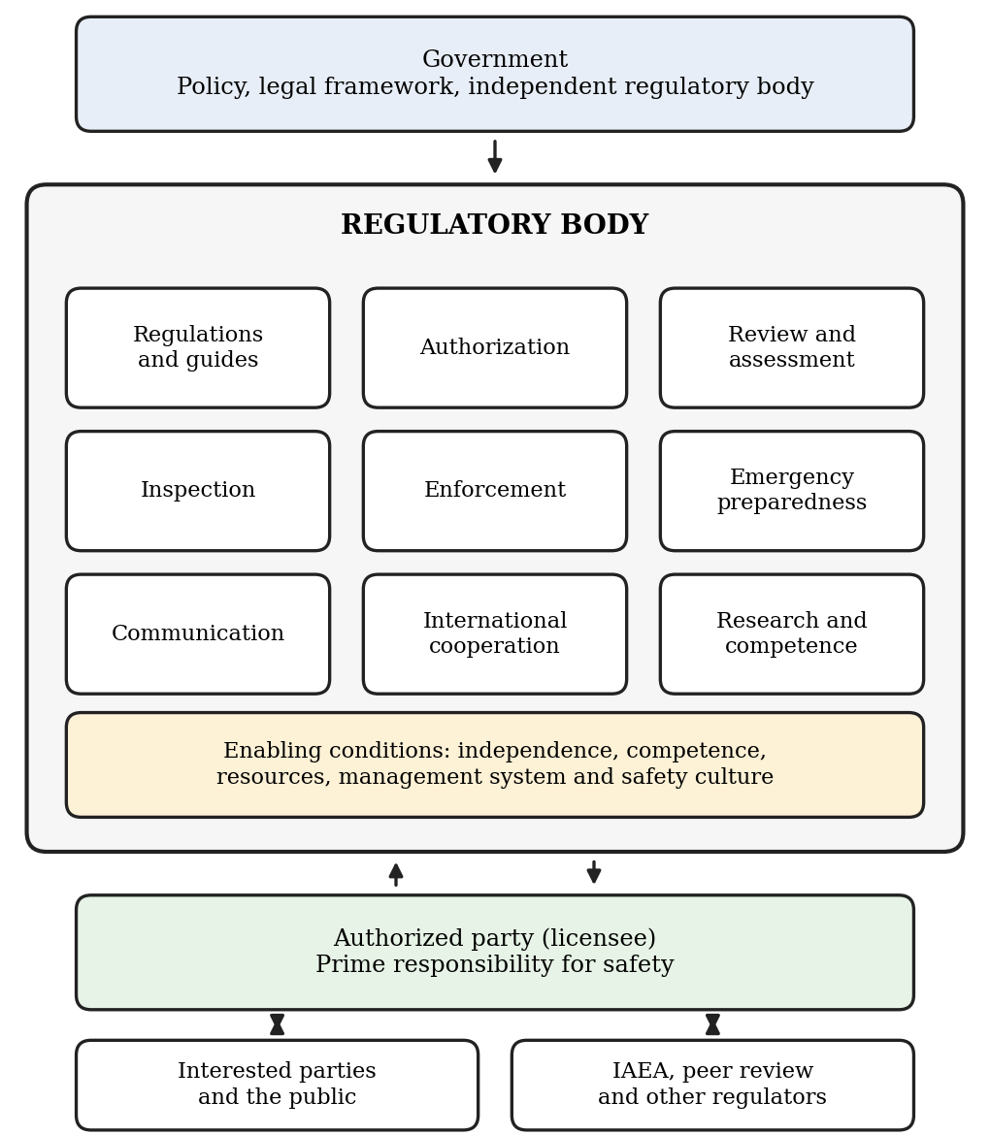
Table 1 | Summary of core regulatory functions. Functions follow the IAEA description [4]; each is discussed in Sections 4.1 to 4.9, in the order shown.
| Function | Purpose | Typical instruments | Reference |
|---|---|---|---|
| Regulations and guides | Turn law into specific, verifiable requirements | Regulations, codes, guides, regulatory positions | [4] |
| Authorization | Permit facilities and activities only when safety is demonstrated | Notification, registration, licences with conditions | [4] |
| Review and assessment | Form an independent judgement on the safety case | Review plans, assessment reports, independent analysis | [4] |
| Inspection | Verify compliance in practice | Inspection programmes, reports, resident inspectors | [4] |
| Enforcement | Secure compliance and correct deficiencies | Notices, restrictions, suspension, penalties | [4] |
| Emergency preparedness | Ensure adequate arrangements and give independent advice | Plan reviews, exercises, advice to authorities | [4] |
| Communication | Maintain accountability and public confidence | Reports, publications, consultations | [4] |
| International cooperation | Learn from and contribute to the global safety regime | Convention reports, IRRS missions, bilateral agreements | [4] |
| Research and competence | Keep staff competence and independent expertise | Competence profiles, training plans, research programmes | [4] |
Establishing regulations and guides
The regulatory body establishes, or proposes to the government, the regulations that turn the legislation into specific, verifiable safety requirements. Guides then describe acceptable ways of meeting them [2],[4]. Requirements should be consistent with the IAEA safety standards, graded to the risk posed by the facility or activity, and reviewed periodically in the light of operating experience and international developments. Consultation with the regulated community and other interested parties improves their quality and acceptance.
Keeping the body of regulations current is a persistent difficulty, as the IRRS missions show. The 2022 mission to Bangladesh noted that the Nuclear Safety and Radiation Control (NSRC) Rules dated from 1997 and referred to superseded IAEA publications, and that no regulations aligned with current IAEA standards had yet been issued [16]. The 2022 follow-up mission in India recommended revising regulations and guides to keep them consistent with the IAEA standards and clarifying the hierarchy of regulatory documents [10].
A newcomer importing a reactor faces a particular question: how far to rely on the design basis and codes of the vendor country. Under the 1997 rules, BAERA may use IAEA guides and standards where its own documents are silent, and may also use the rules and regulations of other countries, mostly the vendor country’s, where its framework has gaps [16]. The use of the vendor country’s codes, standards and regulations was one of the two policy issues discussed with the 2022 IRRS team. [16] The approach is practical in the short term, but it requires the regulator to understand those documents well enough to judge whether they deliver the level of safety its own legislation demands, which is one reason completing national regulations remains a priority.
Notification and authorization
Facilities and activities may not proceed without authorization. The form it takes ranges from notification and registration for lower-risk practices to licensing for higher-risk ones. For nuclear power plants, licences are normally issued stage by stage, covering siting, design, construction, commissioning, operation and decommissioning, often with hold points that the licensee may not pass without regulatory consent [17]. The applicant carries the burden of demonstrating safety; the regulatory body decides whether the demonstration is adequate and attaches the conditions needed to maintain safety. The graded approach is applied so that the effort of both applicant and regulator matches the hazard [2].
The graded approach deserves a separate comment because it runs through every function. It means that the stringency of requirements, the depth of review and the frequency of inspection are matched to the magnitude of the hazard, so that limited regulatory resources go where the risk is greatest [2]. The regulator cannot apply it alone. The 2022 mission to Bangladesh linked BAERA’s difficulty in applying it to the lack of an overarching national policy and legal expectation, and noted that decisions and approvals were often passed to the top of the organization regardless of their risk significance [16].
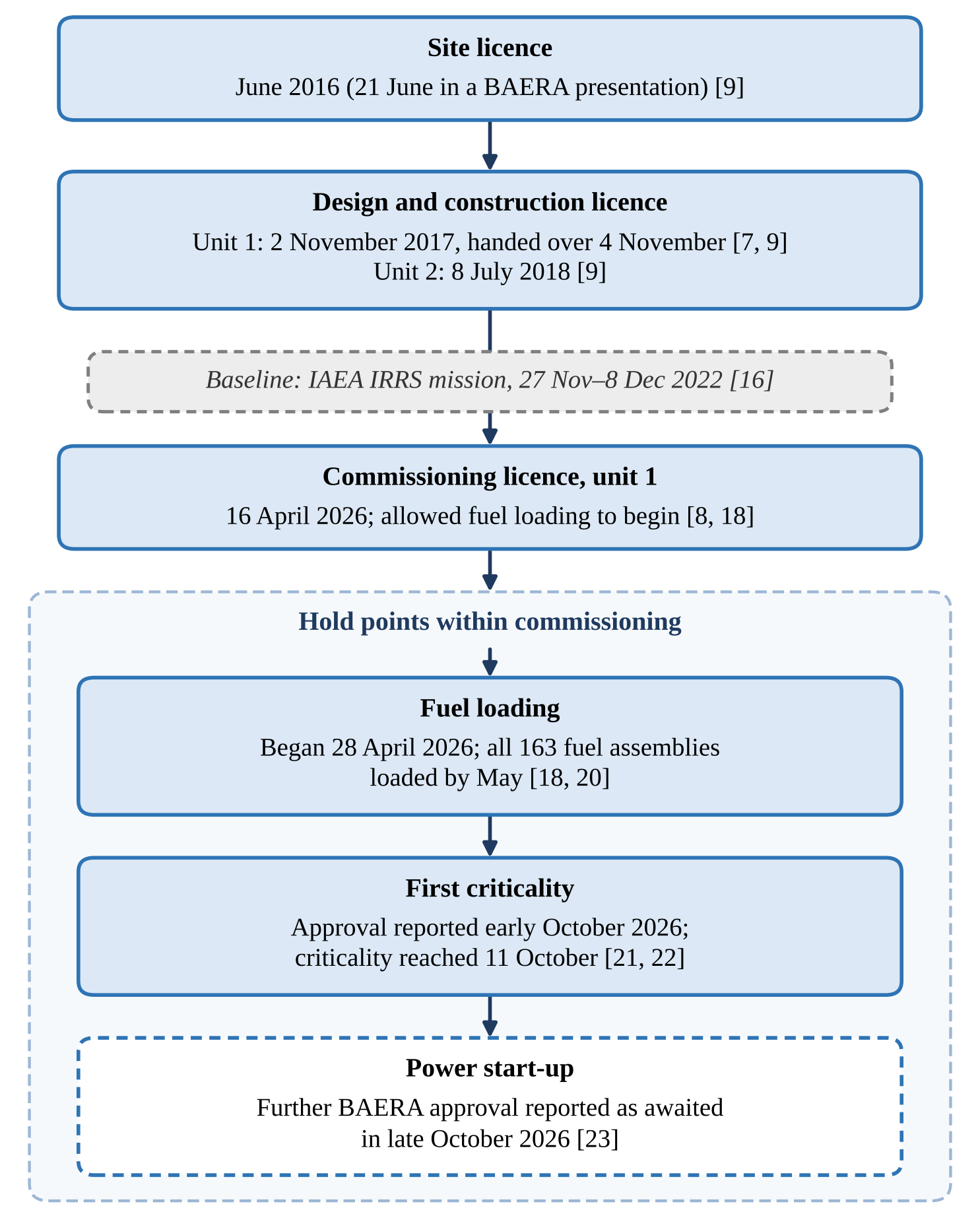
Rooppur illustrates the staged model. BAERA issued the site licence in June 2016 (21 June in a BAERA presentation) and the design and construction licence for unit 1 on 2 November 2017, which was formally handed over on 4 November [7],[9]. A design and construction licence for unit 2 followed on 8 July 2018 [9]. A commissioning licence for unit 1, with personnel authorization, was handed to the Bangladesh Atomic Energy Commission (BAEC) on 16 April 2026 and allowed fuel loading to begin [8],[18]. Press reports in early April 2026 said that fuel loading planned for 7 April had been postponed because the licence had not been issued, with fire-fighting preparedness cited as one open issue [19]. If those reports are accurate, the sequence is an ordinary example of a hold point doing its job: the next stage did not start until the regulator was satisfied. Fuel loading began on 28 April 2026, and all 163 fuel assemblies had been loaded by May [18],[20]. Approval for first criticality was reported in early October 2026, after a technical problem with pressure-relief valves had held it back [21]; the reactor reached criticality on 11 October [22]. In late October, power start-up was reported to be awaiting a further BAERA approval [23].
The licensing terms are used inconsistently in the sources, so they are fixed here. The site licence, the design and construction licence and the commissioning licence are separate authorizations issued by BAERA under the BAER Act. In this paper, commissioning licence means the authorization of 16 April 2026, which Bangladeshi press reports of BAERA’s announcement describe in those words and which allowed fuel loading [8],[18]. Some international outlets called the same step an operating licence [5]. This paper does not follow that usage, because later steps (first criticality, power start-up) were reported as needing further BAERA approval, and no licence for routine power operation has been reported in the sources reviewed. Within commissioning, fuel loading, first criticality and power start-up are treated as separate regulatory hold points. The paper uses published sources only (Section 2), so the licences themselves were not consulted; the dates above rest on regulator statements as reported in the press and on a BAERA presentation [9], and should be read as reported dates, not as quotations from licence documents. The staged sequence is summarized in Figure 2.
Review and assessment
Review and assessment of the submissions made by the applicant or licensee gives the technical basis for authorization decisions. It covers the safety case, the design, the safety analyses, the management system and the competence of the applicant [24]. It continues through the life of the facility as modifications, periodic safety reviews and operating experience are evaluated [25]. The regulatory body needs enough in-house capability to form its own judgement. It may use technical support organizations (TSOs) for specialized analysis, but responsibility for the decision stays with the regulator [4].
Bangladesh relies heavily on this arrangement. The BAER Act lets BAERA draw on the TSO of the vendor country’s regulator, and the IRRS team saw this used to build capability and transfer knowledge. The team also found good performance in BAERA’s use of expert committees: on the soil stabilization at the Rooppur site, BAERA convened national and international experts, assessed their opinions independently, and imposed its own conditions on the licensee. At the same time, no formal documented procedure yet described how BAERA evaluates and uses the TSO’s input [16].
In practice the review turns on a few questions. Does the design meet the safety requirements and the applicable codes? Are the safety analyses complete, conservative where they need to be, and supported by validated tools? Does the design provide defence in depth, with independent layers of protection against failures [24]? Do the operating limits, procedures and management system support the claims made in the safety case? For a newcomer, independent confirmatory analysis is hard without access to the vendor’s models and data, which is one reason TSO support is so common.
Inspection
Inspection is how the regulatory body verifies on the ground that the licensee is complying with the regulations and the conditions of its authorization. Programmes are planned on the basis of risk and performance and include routine and reactive inspections, announced and unannounced [4]. Resident inspectors are common at nuclear power plants. Findings feed back into review and assessment and into enforcement decisions. BAERA deploys resident inspectors at Rooppur, supported by TSO experts, which the IRRS team saw as a way of engaging promptly on emerging issues [16]. The India follow-up mission welcomed an improved inspection programme with better inspector training and stronger inspector powers, but also recommended revising the frequency of planned inspections in line with a graded approach [10].
For a plant under construction the inspection programme looks different from that of an operating plant. It concentrates on construction quality, on conformity assessment of components made by suppliers, and later on the witnessing of commissioning tests. BAERA told the IRRS team that it needed more staff, with the right competence, for inspection during construction and for conformity assessment, and the team added that training for commissioning would be needed as commissioning approached [16].
Enforcement
When non-compliance is found, the regulatory body takes action proportionate to its significance. Measures typically run from formal notices and requirements for corrective action, through restrictions on operation, to suspension, modification or revocation of the authorization and, where the law allows, penalties and prosecution [4],[15]. Enforcement policy should be documented, consistent and predictable. It should also encourage licensees to identify and report problems themselves rather than conceal them.
Emergency preparedness and response
Operating organizations and designated authorities are responsible for emergency arrangements. The regulatory body sets requirements, reviews plans, observes exercises and, in an emergency, provides independent advice and assessment. Its role has to be defined clearly within the national emergency framework [26]. In Bangladesh the BAER Act designates BAERA as coordinator for formulating the national nuclear and radiological emergency plan, and the IRRS team asked BAERA to make sure that operating organizations develop and regularly test their arrangements and that arrangements exist for reviewing and advising on off-site plans [16].
Communication and consultation with interested parties
Regulatory bodies are expected to inform the public, government, media and other stakeholders about the safety of facilities, the regulatory process and its decisions, and to consult them on significant proposals [2]. Openness supports accountability and public confidence, although sensitive information, including security-related information, still has to be protected. For BAERA, the 2022 IRRS report noted a communication manual adopted in 2020 but found no formal mechanism for informing and consulting the public on radiation risks and regulatory decisions, and no formal route for public feedback; it recommended that one be established [16]. With unit 1 moving toward start-up, public information is likely to draw more attention.
International cooperation and peer review
Nuclear safety has a global dimension. Regulatory bodies take part in the review meetings of the Convention on Nuclear Safety, exchange information with foreign regulators, and host IAEA peer-review missions such as the IRRS, which evaluates a national regulatory framework against the IAEA safety standards at the request of the government. The IAEA encourages countries that have hosted an initial IRRS mission to invite a follow-up two to four years later [11]. Bilateral arrangements matter particularly for newcomers importing a reactor technology, because the regulator of the vendor country can share its experience with the design. BAERA has such arrangements with the Russian regulator Rostechnadzor and a related support organization. The IRRS team also asked BAERA to set up a formal process for collecting, analysing and sharing national and international operating and regulatory experience [16].
Research, competence and knowledge management
A regulatory body maintains a programme to develop and keep the competence of its staff, to follow scientific and technical developments, and to preserve institutional knowledge. Where necessary it arranges regulatory research or access to independent technical expertise. The IAEA General Safety Guide GSG-12 expects this to rest on an analysis of the competence needed for each function [27]. The Bangladesh IRRS report described competence profiles and training for staff working on Rooppur, but found no comparable profiles for other regulatory roles, and recommended that they be developed [16].
Conditions for effective performance
Effective independence
Independence has legal, financial and functional dimensions. The regulatory body needs separation from the promotion and use of nuclear energy, a secure budget, and freedom to take technical decisions without undue influence [2]. The report INSAG-17 of the International Nuclear Safety Group treats independence as a matter of how decisions are actually made, not only of where the organization sits on a chart [28]. Independence does not mean isolation: the regulator remains accountable to the government and the public through reporting and legal review.
Independence is the issue most often raised in IRRS reports, for newcomers and for countries with long-established programmes alike. The initial mission to India in 2015 recommended strengthening regulatory independence [12]. In Bangladesh, the 2022 team found strong government support for BAERA as an independent regulator, including full approval of its operational and development budgets. It also noted that BAERA sits within the Ministry of Science and Technology, which is responsible for delivering the Rooppur project, and recommended that the Government take measures to make sure this arrangement cannot compromise BAERA’s decision making (R2) [16]. The 2014 mission to Pakistan described PNRA as independent and competent, with the full scope of regulatory powers and sufficient resources [11].
Competence and staffing
The regulatory body must recruit, train and retain people with the technical skills to evaluate complex facilities, supported by defined competence requirements and qualification programmes [27]. This is a chronic constraint for newcomer countries, where the pool of experienced nuclear specialists is small and competes with the operating organization and the vendor. At the time of the 2022 mission BAERA had an approved complement of 164 posts, of which 147 were filled. The team noted that a high proportion of new recruits, and the absence of succession planning, would become more demanding as the needs of Rooppur grew [16]. The India follow-up mission welcomed updated staff qualification and training programmes [10].
Resources
Human, financial and technical resources need to match the mandate [2]. Many regulators recover part of their costs from licensees through fees, which can give stable funding if the scheme is designed so that it does not compromise independence. BAERA told the IRRS team that about 60% of its funds come from licensing fees and about 40% from government grants, with extra funding for regulatory infrastructure development through a government development project [16].
Management system and safety culture
An integrated management system with documented processes for each regulatory function promotes consistency and continuous improvement [27],[29]. The regulatory body also needs a strong safety culture within its own organization, including a questioning attitude and openness about errors. In Bangladesh, the IRRS team identified BAERA’s Code of Ethics, issued in 2018 after benchmarking against other organizations, as an area of good performance. It also found that the management system manual of November 2021 still lacked much of the supporting process and procedure documentation, and recommended completing it (R11) [16]. PNRA has completed a safety culture self-assessment of its own organization [30].
Assessing regulatory effectiveness
A regulator cannot show that its functions work simply by listing them. Two instruments are in common use. The first is self-assessment. PNRA carried one out with the IAEA’s Self-Assessment of Regulatory Infrastructure for Safety (SARIS) tool [30], and BAERA’s own self-assessment and preliminary action plan formed the advance reference material for the 2022 IRRS mission [16]. The second is external peer review through the IRRS, which assesses the framework against the safety standards and lists recommendations, suggestions and good practices. IRRS reports caution that the number of such findings is not a measure of the state of a country’s regulatory infrastructure and should not be compared between countries [16]. Operational measures such as the timeliness of reviews, the coverage of inspection programmes and staff turnover can complement these instruments, although choosing and interpreting them is a subject for further work.
The four conditions are assessed in this review with the same questions for each regulator, taken from the requirements they come from. Independence: is the regulator legally and functionally separate from the promotion of nuclear energy, with a secure budget and decisions free of undue influence [2],[28]? Competence and staffing: are competence requirements defined for each role, with training and succession plans [2],[27]? Resources: do staffing and funding match the mandate [2]? Management system and safety culture: are processes documented and applied, and is safety culture assessed [27],[29]? Section 7.4 and Table 2 report what the sources say under each heading.
Interfaces with security, safeguards and other authorities
Safety, nuclear security and safeguards share the goal of protecting people and the environment, but in many States they are the responsibility of different bodies. Coordination is needed so that a measure in one area does not weaken another, for example in access control, information protection and design change [2]. The regulatory body must also define its interfaces with the environmental, health, transport, customs and emergency authorities, and with the authority responsible for the State’s safeguards obligations to the IAEA. Memoranda of understanding and joint procedures help avoid both gaps and duplication.
In Bangladesh the BAER Act makes BAERA the regulatory body for safety, security and safeguards for all facilities and activities, which keeps these interfaces inside one organization. [16] Coordination with the Department of Environment on environmental impact assessment runs through a memorandum of understanding, and for Rooppur the government operates a nuclear energy programme implementing organization with a national committee under the Prime Minister [16]. The 2022 IRRS mission did not cover the optional safety-security interface module, because a separate physical protection review was scheduled for 2023 [16].
Country perspectives
Bangladesh
Until 2013 the regulatory functions sat within the Bangladesh Atomic Energy Commission (BAEC). The BAER Act, 2012 created BAERA as the separate regulatory body, leaving BAEC as owner of the Rooppur project, while the Nuclear Power Plant Act, 2015 established the Nuclear Power Plant Company Bangladesh Limited as operator [6],[16]. The Act gives BAERA licensing, review and assessment, inspection and enforcement functions, an Advisory Council, and the power to form expert committees [16].
Bangladesh hosted its first full-scope IRRS mission from 27 November to 8 December 2022. The government had requested it in October 2017, and it was postponed twice before it took place [16]. The team identified good performance in the use of expert committees, the availability of a TSO on the Rooppur site, and the Code of Ethics. [16] Its main areas for improvement concerned national safety policy, independence, regulations, staffing, the management system, dose records, public consultation and emergency arrangements [16]; Table 3 lists them with report references. These are largely the conditions discussed in Section 5. How far they have been addressed since 2022 is not documented in the public sources reviewed here. This absence of a public record should not be read as evidence that any finding remains open. The findings are therefore presented as a 2022 baseline, and Section 7.5 sets them against the developments that are documented.
Pakistan
The Pakistan Nuclear Regulatory Authority (PNRA) was created by the Pakistan Nuclear Regulatory Authority Ordinance of 2001 [31]. Pakistan hosted a full-scope IRRS mission from 28 April to 9 May 2014 [14]. The team described PNRA as independent and competent and recommended, among other things, that the Fundamental Safety Principles be fully incorporated into the national safety framework and that primary responsibility for safety be clearly assigned [11]. A follow-up mission in February and March 2022 found that all 13 recommendations had been implemented and 29 of 31 suggestions adequately addressed. The IAEA reported at that time that Pakistan had five operating power reactors, supplying over 7% of its electricity [13].
India
The Atomic Energy Regulatory Board (AERB) was constituted on 15 November 1983 under Section 27 of the Atomic Energy Act, 1962 [32],[33]. India hosted an IRRS mission in March 2015, the first peer review of AERB, with a scope limited to regulation of nuclear power plants [10],[33]. That mission found strong commitment to safety and good practices, but recommended strengthening regulatory independence [12]. A follow-up mission in 2022, with an extended scope that included radiation sources, found that AERB had acted on all recommendations and suggestions of the 2015 mission. It welcomed an online platform for regulatory processes, an improved inspection programme and a process for regular review of regulations and guides, and made new recommendations on, among other things, the graded approach to inspection frequency and the validity of consents. India then had 22 reactors in operation at seven plants, about 3.3% of its generation [10].
Comparison
Table 2 sets the three regulators side by side against the same criteria: legal basis and age, nuclear power context, scope and date of IRRS missions, the evidence available, and what the missions reported on the four conditions of Section 5 (independence, competence and staffing, regulations and guides, and graded approach). Three differences limit the comparison. Maturity: BAERA has regulated since 2013, PNRA since 2001 and AERB since 1983. Scope: the Bangladesh and Pakistan missions were full scope, whereas the 2015 mission to India covered nuclear power plants only. Timing: the initial missions took place in 2014, 2015 and 2022, with follow-ups in 2022 for Pakistan and India. Two points stand out. All three have been through an IRRS mission, and the recurring themes in the findings are independence, competence, regulations and guides, and graded application of requirements, which are the topics of Sections 4 and 5. The regulators also differ in maturity: PNRA and AERB have completed follow-up missions, whereas BAERA is earlier in its development and is regulating its first nuclear power plant. Because IRRS reports advise against comparing the number of findings between countries [16], Table 2 reports findings descriptively and the comparison is qualitative. An entry reading “not reported” means that the sources reviewed do not cover the point, not that no finding exists.
Table 2 | Comparative overview of BAERA, PNRA and AERB. Regulators are compared on common criteria; R = recommendation and S = suggestion in the 2022 Bangladesh report [16]. “Not reported” means the sources reviewed do not cover the point.
| Feature | BAERA (Bangladesh) | PNRA (Pakistan) | AERB (India) | Reference |
|---|---|---|---|---|
| Founding legislation | Bangladesh Atomic Energy Regulatory Act, 2012 [6] | PNRA Ordinance, 2001 [31] | Constituted under Section 27 of the Atomic Energy Act, 1962 [32] | [6],[31],[32] |
| Established | Act of 2012; regulatory functions separated from BAEC from 2013 [16] | 2001 [31] | 15 November 1983 [33] | [16],[31],[33] |
| Years as regulator (to 2026) | About 13 | About 25 | About 43 | [16],[31],[33] |
| Nuclear power | Rooppur, two VVER-1200 units; unit 1 licensed for fuel loading in April 2026 [5],[8] | Five operating reactors, over 7% of electricity (2022) [13] | 22 reactors at 7 plants, about 3.3% of generation (2022) [10] | [5],[8],[10],[13] |
| Initial IRRS mission | 27 Nov-8 Dec 2022 [16] | 28 Apr-9 May 2014 [14] | March 2015 [33] | [14],[16],[33] |
| Scope of initial mission | Full scope; safety-security interface module not included [16] | Full scope [14] | Nuclear power plants only [10],[33] | [10],[14],[16],[33] |
| IRRS follow-up | None found in sources reviewed | Feb-Mar 2022 [13] | 2022, extended scope [10] | [10],[13] |
| Evidence used here | Full IRRS report [16] | IAEA statements [11],[13]; mission report [14] for dates and scope | IAEA and press statements [10],[12] | [10]-[14],[16] |
| Independence | R2: position within the ministry that delivers Rooppur could compromise decision making [16]; strong government support noted [16] | 2014: described as independent, with full regulatory powers and sufficient resources [11] | 2015: strengthen regulatory independence [12] | [11],[12],[16] |
| Competence and staffing | R7, S3: competence profiles for all roles; balance of new and experienced staff; 147 of 164 posts filled in 2022 [16] | 2014: described as competent [11]; no further detail reported | 2022: updated staff qualification and training programmes welcomed [10] | [10],[11],[16] |
| Regulations and guides | R3: 1997 rules not revised; no regulations aligned with current IAEA standards in 2022 [16] | 2014: Fundamental Safety Principles to be fully incorporated into the national framework [11] | 2022: process for regular review welcomed; hierarchy of regulatory documents to be clarified [10] | [10],[11],[16] |
| Graded approach | R1 and finding on delegation: approvals often escalated to the top of the organization [16] | Not reported | 2022: revise inspection frequency in line with a graded approach [10] | [10],[16] |
| Other findings noted | Good performance: expert committees, TSO on site, Code of Ethics [16]; also R9, R10, R11 on dose register, public consultation and management system [16] | 2022 follow-up: all 13 recommendations implemented, 29 of 31 suggestions adequately addressed [13] | 2022: all 2015 findings acted on; online platform and improved inspection programme welcomed; new recommendations on inspection frequency and validity of consents [10] | [10],[13],[16] |
Status of the 2022 IRRS findings
Table 3 sets the 2022 findings for Bangladesh against developments that can be documented from public sources up to October 2026. Only the licensing chronology at Rooppur could be documented in this way. For the other findings no public update was located. That does not mean they are unresolved: BAERA may have acted without publishing the outcome, and a follow-up IRRS mission, which would report on progress, has not been reported. Section 7.1 should therefore be read as a 2022 baseline.
Table 3 | Status of the 2022 IRRS findings for Bangladesh. “No public update located” means the public sources reviewed (Section 2.2) report no development; it does not mean the finding is unresolved. R and S are the recommendations and suggestions of the report [16].
| Theme | 2022 IRRS finding | Developments in public sources | Evidence status | Reference |
|---|---|---|---|---|
| Commissioning of Rooppur | Resident inspectors and TSO support on site; more staff and commissioning training needed [16] | Commissioning licence 16 April 2026; fuel loading from 28 April; first criticality approved in early October and reached 11 October; power start-up awaiting approval in late October [8],[18],[20]-[23] | Documented in press reports | [8],[16],[18],[20]-[23] |
| National safety policy and strategy (R1) | No comprehensive policy; 2022 draft policy covered nuclear facilities and activities only [16] | None located | No public update located | [16] |
| Independence (R2) | Position within the ministry delivering Rooppur could compromise decision making [16] | None located | No public update located | [16] |
| Regulations (R3) | 1997 rules not revised; no regulations aligned with current IAEA standards [16] | None located | No public update located | [16] |
| Competence (R7, S3) | No profiles for non-Rooppur roles; 147 of 164 posts filled [16] | None located | No public update located | [16] |
| Management system (R11) | Manual of November 2021 lacked supporting processes and procedures [16] | None located | No public update located | [16] |
| Public consultation (R10) | No formal mechanism for informing and consulting the public [16] | None located | No public update located | [16] |
| Operating experience (R6) | No formal process for collecting and sharing experience [16] | None located | No public update located | [16] |
| Follow-up IRRS mission | IAEA usually advises a follow-up two to four years after an initial mission [11] | No follow-up mission found as of 1 November 2026 | No public update located | [11] |
Challenges
The IRRS findings point to a set of recurring challenges, particularly for newcomer regulators. They are drawn from IRRS findings made up to 2022 and from the structure of the task; they describe what regulators face and are not claims about present conditions at any one regulator. The first is establishing genuine functional and financial independence where the nuclear programme has high national priority. The Bangladesh and India examples are given in Section 5.1.
The second is building a critical mass of qualified specialists in parallel with the construction and commissioning schedule, and keeping them, including for oversight of facilities other than the power plant [16]. The third is completing a body of regulations and guides aligned with current IAEA standards and compatible with the reactor design and the vendor country’s requirements. Section 4.1 discusses the use of the vendor country’s codes.
The fourth is coordination among safety, security, safeguards and emergency authorities. The fifth is keeping transparency and public communication while protecting sensitive information [16]. The sixth is gaining independent access to design information and analysis tools, so that the regulator can verify a safety case it did not produce [4]. The last is putting in place a documented management system and a graded approach so that decisions are taken at a level that matches the risk (Section 4.2).
Recommendations
Each recommendation in Table 4 is tied to a gap identified in Sections 4 to 8, names the institution best placed to lead it, gives a priority and offers an indicator by which progress could be checked. The institutions and priorities are the author’s judgement, based on the roles in the BAER Act and the 2022 IRRS report [6],[16], and are proposals for discussion, not findings. High priority means the item bears directly on the next licensing decisions at Rooppur or on a 2022 recommendation; medium means it is needed to sustain the regulator over the plant’s life. Where a gap has since been closed, the recommendation should be read as one to maintain and verify, not to start.
Table 4 | Recommendations linked to gaps, lead institutions, priorities and indicators of progress.
| No. | Gap addressed | Recommendation | Lead (support) | Priority and indicators of progress | Reference |
|---|---|---|---|---|---|
| 1 | No published follow-up to the 2022 IRRS mission was located; the IAEA usually advises a follow-up two to four years after an initial mission [11],[16]. | Assess the regulatory body against the IAEA standards at regular intervals; request an IRRS follow-up mission and publish a status report on each 2022 recommendation and suggestion [10],[13]. | Government (request); BAERA (self-assessment, action plan) | High. Follow-up mission requested and held; public status report with one entry per 2022 finding. | [10],[11],[13],[16] |
| 2 | 1997 rules not revised and no regulations aligned with current IAEA standards in 2022 (R3) [16]. | Complete and maintain a hierarchy of regulations and guides, with a documented process for revision and stakeholder consultation. | BAERA; Government (approval of regulations [16]) | High. Share of planned regulations and guides issued, each checked against current IAEA standards; revision cycle documented and followed. | [16] |
| 3 | Competence profiles only for Rooppur roles; 147 of 164 posts filled; no succession planning (R7, S3) [16]. | Adopt a competence framework and a long-term training and succession plan covering all core functions, not only the nuclear power plant. | BAERA; Ministry of Science and Technology and BAEC (national human resource plan [16]) | High. Profiles approved for all regulatory roles; training completed against plan; vacancy rate; named successors for senior posts. | [16] |
| 4 | Graded approach not applied systematically; approvals escalated to the top of the organization (R1) [16]. | Document the graded approach, enforcement policy and inspection strategy, apply them consistently, and delegate decisions to a level that matches the risk. | BAERA; Government (national policy and strategy) | Medium. Graded-approach strategy and delegation scheme adopted; share of routine decisions taken below Chairman level. | [16] |
| 5 | Operating organizations to develop and test emergency arrangements, and off-site plan advice to be arranged [16]; coordination relies on agreements and the NEPIO mechanism [16]. | Formalize interfaces with security, safeguards, emergency and environmental authorities through agreements and joint exercises. | BAERA; Department of Environment, Department of Disaster Management, BAEC, Nuclear Power Plant Company Bangladesh Limited | Medium. Agreements signed; joint exercises held each year; emergency arrangements of operating organizations tested. | [16] |
| 6 | No formal mechanism for informing and consulting the public or receiving feedback (R10) [16]. | Strengthen public information and consultation practices for major licensing decisions. | BAERA; Ministry of Science and Technology | High. Consultation procedure published; notice and summary issued for each major licensing decision; feedback channel in use. | [16] |
| 7 | No formal process to collect and share operating and regulatory experience (R6); no documented procedure for evaluating TSO input; no conflict-of-interest process for advisers (R8) [16]. | Use regional and bilateral cooperation to obtain technical support, training and access to operating experience, with documented procedures for using that support. | BAERA; Rostechnadzor and its technical support organization, IAEA, regional regulators | Medium. Documented procedure for evaluating TSO input; operating-experience process in use, with events reviewed and lessons circulated each year. | [16] |
Conclusions
The functions of the nuclear regulatory body are well described in international standards: setting requirements, authorizing, reviewing, inspecting, enforcing, preparing for emergencies, communicating, cooperating internationally and maintaining competence. What separates a regulator that works from one that exists only on paper is the set of conditions behind those functions: effective independence, competence, resources and a sound management system. The IRRS reports for Bangladesh, Pakistan and India return to these same conditions.
For Bangladesh, consolidating them while Rooppur moves through commissioning is the central task. Further work should track how the findings of the 2022 IRRS mission are addressed, extend the comparison with verified primary sources, and consider indicators of regulatory effectiveness.
Declarations
- Author contributions
S. M. Nazmus Shakib Pias: conceptualization, literature review, writing (original draft, review and editing).
- Funding
The author declares that no financial support, grants, or other forms of funding were received from any organization or external source for the preparation and completion of this manuscript. The study was conducted without financial support from any funding agency, institution, or other external source.
- Data availability
The data that support the findings of this study are available on request from the corresponding author.
- Competing interests
The authors declare no conflicts of interest.
References
- 1.IAEA (2006). Fundamental Safety Principles, Safety Fundamentals No. SF-1. International Atomic Energy Agency, Vienna.
- 2.IAEA (2016). Governmental, Legal and Regulatory Framework for Safety, General Safety Requirements No. GSR Part 1 (Rev. 1). International Atomic Energy Agency, Vienna.
- 3.IAEA (2015). Milestones in the Development of a National Infrastructure for Nuclear Power, IAEA Nuclear Energy Series No. NG-G-3.1 (Rev. 1). International Atomic Energy Agency, Vienna.
- 4.IAEA (2018). Functions and Processes of the Regulatory Body for Safety, General Safety Guide No. GSG-13. International Atomic Energy Agency, Vienna.
- 5.World Nuclear News (2026, 24 April). Operating licence issued for Bangladesh’s first nuclear power unit. https://world-nuclear-news.org/articles/operating-licence-issued-for-first-bangladesh-nuclear-power-unit.
- 6.Government of Bangladesh (2012). Bangladesh Atomic Energy Regulatory Act, 2012 (Act No. 19 of 2012). Dhaka.
- 7.World Nuclear News (2017). Rooppur 1 receives construction licence. https://www.world-nuclear-news.org/Articles/Rooppur-1-receives-construction-licence
- 8.The Business Standard (2026). Rooppur unit-1 gets commissioning licence for fuel loading. https://www.tbsnews.net/node/1413676
- 9.BAERA (n.d.). Presentation on the regulatory infrastructure and licensing of the Rooppur Nuclear Power Plant (file SP_3-4_P_BangladeshRR.pdf). Forum for Nuclear Cooperation in Asia panel material. https://www.fnca.mext.go.jp/panel/pdf/SP_3-4_P_BangladeshRR.pdf
- 10.IAEA (2022). IAEA Mission Finds Solid Regulatory Arrangements in India, Notes Areas for Improvement, Press Release 112/2022. https://www.iaea.org/node/104757
- 11.IAEA (2014). IAEA Mission Concludes Peer Review of Pakistan’s Nuclear Regulatory Framework. https://www.iaea.org/node/6600
- 12.World Nuclear News (2022). IAEA team completes Indian regulatory review. https://world-nuclear-news.org/articles/iaea-team-completes-indian-regulatory-review
- 13.IAEA (2022). IAEA Mission Says Pakistan’s Regulatory Body Effective, Encourages Continued Focus on Radioactive Waste Management. https://www.iaea.org/node/102344
- 14.IAEA (2014). Integrated Regulatory Review Service (IRRS) Mission to Pakistan, Islamabad, 28 April to 9 May 2014, IAEA-NS-IRRS-2014/02. International Atomic Energy Agency, Vienna.
- 15.IAEA (1994). Convention on Nuclear Safety, INFCIRC/449. International Atomic Energy Agency, Vienna.
- 16.IAEA (2022). Integrated Regulatory Review Service (IRRS) Mission to Bangladesh, Dhaka, 27 November to 8 December 2022, IAEA-NS-IRRS-2022/12. International Atomic Energy Agency, Vienna. https://www.iaea.org/sites/default/files/documents/review-missions/final_irrs_report_bangladesh.pdf
- 17.IAEA (2010). Licensing Process for Nuclear Installations, Specific Safety Guide No. SSG-12. International Atomic Energy Agency, Vienna.
- 18.The Business Standard (2026, 28 April). How fuel loading will be carried out at Rooppur Nuclear Power Plant. https://www.tbsnews.net/node/1423726
- 19.The Financial Express (2026). Fuel loading into Rooppur N power plant stalls again. https://thefinancialexpress.com.bd/national/fuel-loading-into-rooppur-n-power-plant-stalls-again
- 20.World Nuclear News (2026, 28 October). Nuclear fuel delivered for Bangladesh’s second unit. https://www.world-nuclear-news.org/articles/nuclear-fuel-delivered-for-bangladeshs-second-unit
- 21.bdnews24 (2026, 8 October). Rooppur’s first reactor gets criticality approval, raising hopes of December grid power. https://bdnews24.com/bangladesh/dfr5knstif
- 22.World Nuclear News (2026, 12 October). Bangladesh’s Rooppur 1 achieves criticality. https://world-nuclear-news.org/articles/bangladeshs-rooppur-1-achieves-criticality
- 23.Daily Sun (2026, 25 October). Rooppur Unit-1 poised for power startup today. https://www.daily-sun.com/bangladesh/905219
- 24.IAEA (2016). Safety Assessment for Facilities and Activities, General Safety Requirements No. GSR Part 4 (Rev. 1). International Atomic Energy Agency, Vienna.
- 25.IAEA (2013). Periodic Safety Review for Nuclear Power Plants, Specific Safety Guide No. SSG-25. International Atomic Energy Agency, Vienna.
- 26.IAEA (2015). Preparedness and Response for a Nuclear or Radiological Emergency, General Safety Requirements No. GSR Part 7. International Atomic Energy Agency, Vienna.
- 27.IAEA (2018). Organization, Management and Staffing of the Regulatory Body for Safety, General Safety Guide No. GSG-12. International Atomic Energy Agency, Vienna.
- 28.INSAG (2003). Independence in Regulatory Decision Making, INSAG-17. International Atomic Energy Agency, Vienna.
- 29.IAEA (2016). Leadership and Management for Safety, General Safety Requirements No. GSR Part 2. International Atomic Energy Agency, Vienna.
- 30.PNRA (2020). 20 Years of PNRA, 2001-2020. Pakistan Nuclear Regulatory Authority, Islamabad.
- 31.Government of Pakistan (2001). Pakistan Nuclear Regulatory Authority Ordinance, 2001 (Ordinance No. III of 2001). Islamabad.
- 32.Government of India (1962). Atomic Energy Act, 1962 (Act No. 33 of 1962). New Delhi.
- 33.AERB (2015). AERB Bulletin 2014-15. Atomic Energy Regulatory Board, Mumbai.
Cite this article
Journal
Pias SMNS. Functions of the nuclear regulatory body and their application in Bangladesh: a review. JoSEP. 2026;4(1):255-267. doi: 10.62275/josep.27.1000036.
Cited by (0)
Citing works are not available yet.
About this article
- Received
- 8 October 2026
- Revised
- 6 November 2026
- Accepted
- 8 November 2026
- Published
- 18 November 2026
- Journal
- Journal of Science and Engineering Papers
- Volume / Issue
- 4 / 1
- Pages
- 255-267
- DOI
- 10.62275/josep.27.1000036
- Academic editors
- Md. Saiful Islam, Aneek Krishna Karmakar