 Open Access



 Open access
 Check for updates

Abstract
As a renewable alternative to fossil fuels, the production of bioethanol and biochemicals from lignocellulosic biomass has drawn significant interest. For biochemical conversion, pretreatement is the most crucial step, which removes biomass recalcitrance to improve cellulose’s accessibility for enzymatic saccharification and fermentation. This study investigated the potential of dilute sulfuric acid pretreatment of waste rice straw to produce building-block sugars and bioethanol. The study focused on optimizing several key parameters, including dilute acid concentration (60 mM), pretreatment time (30 minutes), pretreatment temperature (120°C), and liquid-to-solid ratio (5:1). This study also compared the efficiency of dilute acid pretreatment of rice straw with conventional dilute alkali and organosolv pretreatment techniques. The results showed that dilute acid pretreatment effectively dissolved a significant amount of hemicellulose under these circumstances, retaining 97.96% of cellulose in the solid substrate, which led to 64.28% glucose yield in enzymatic saccharification. The rice straw structure underwent morphological changes (i.e., cell wall rupture and changes in crystallinity) as the result of acid pretreatment, which were confirmed using SEM and XRD techniques. Furthermore, Saccharomyces cerevisiae fermentation trials showed that the total bioethanol yield was 78.7% in simultaneous saccharification and fermentation, demonstrating the potential of optimized dilute acid pretreatment in the production of bioethanol from rice straw. This study provides important insights for developing a biorefinery for the effective valorization of rice straw and other agricultural waste biomasses.
Introduction
The requirement for searching for renewable source of energy is being driven by the rapid depletion of fossil fuels reserve. The fossil fuels are still serving as the main energy sources, which create a significant threat to energy prices and environmental sustainability. Global warming, acid rain, and polar ice melting are the global consequences of excessive utilization of fossil fuels [1], [2]. Therefore, in order to reduce the strain on fossil fuels, the use of renewable energy sources as an alternative to fossil fuels has become inevitable.
Biofuels derived from biomass have become the most promising and renewable alternative to petroleum-based fuels. Renewable energy sources currently only account for 23.7% of global energy consumption of which 12.45% comes from waste biomass [3]. Rice (Oryza sativa), sometimes referred to as paddy with husk, is one of the most extensively grown food crops worldwide and the primary staple crop for more than 50% of the world’s population [4]. Rice straw is the key byproduct generated during rice grain harvesting and is one of the most abundant agricultural wastes. The sheath, stem, and leaves that remain after the paddy is harvested are referred to as rice straw. According to FAO, approximately 600–1100 million metric tons of rice straw are produced globally per year, of which more than 90% of the rice straw generated in Asia [5]. Based on the amount of rice straw produced worldwide and their average chemical compositions, approximately 282 billion liters of ethanol could be produced annually [6]. For every kilogram of milled rice, between 0.7 and 1.4 kilograms of rice straw are produced, of which a small portion of rice straw is used as animal feed [7]. The majority of rice straw is wasted and managed by on-site burning, which raises air pollution and has an adverse effect on public health [8]. Therefore, it is believed that waste rice straw has the potential to be the preferred feedstock for bioethanol production in Asia.
Rice straw comprises 32-47% cellulose, 19-27% hemicellulose, and 5-24% lignin with 4.6% crude protein [9]. Due to the complex structure of rice straw, it has significant recalcitrance to chemicals and biological organisms. To convert rice straw into various value-added compounds, it is necessary to change the complex structure of rice straw to remove lignin, break down hemicellulose, reduce the crystallinity of cellulose, and increase the surface porosity of rice straw. The biomass pretreatment is considered the crucial step to reduce overall process cost, increase productivity, and maximize potential recovery of rice straw. Different pretreatment approaches have been practiced to reduce the recalcitrance of rice straw and make it more accessible to chemicals or enzymes, towards cellulose, lignin, and hemicellulose [10].
Dilute acid (DA), alkali, organosolv, ionic liquids, and deep eutectic solvents are common reagents used in the most common method for plant cell wall fractionation, which is a thermochemical reaction at 80–220°C [11]. Due to its exceptional performance in removing hemicellulose at a low cost, DA is one of the most extensively tested pretreatment methods for biomass conversion [12].
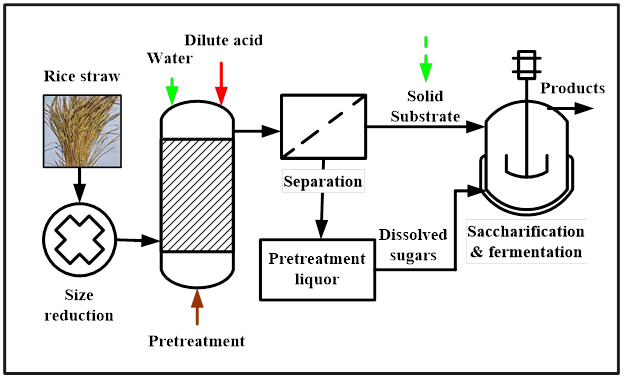
Numerous studies have demonstrated DA pretreatment of different types of biomasses to overcome structural barriers to enzymatic hydrolysis and fermentation to produce value-added chemicals [12], [13]. Specifically, DA pretreatment is more suitable for low lignin-containing agricultural biomass in terms of processibility and overall cost [12], [13]. However, limited studies have focused on identifying the optimum conditions for dilute-acid pretreatment of agricultural waste biomass, particularly under the specific conditions investigated in the present study. Therefore, this study investigated the dilute sulfuric acid pretreatment of waste rice straw to optimize several key parameters, including dilute acid concentration, pretreatment time, pretreatment temperature, and liquid-to-solid ratio (the conceptual biorefinery was shown in the Fig. 1). The diagram illustrated the conversion of rice straw into value-added products through biochemical processing. First, rice straw was size-reduced and subjected to dilute-acid pretreatment to disrupt its lignocellulosic structure. The pretreated material was separated into solid substrate and pretreatment liquor containing dissolved sugars. These streams were then subjected to saccharification and fermentation, converting carbohydrates into fermentable products. Finally, the desired bio-based products were recovered from the fermentation process. The pretreatment and overall process efficiencies were estimated based on the subsequent saccharification and fermentation yield to produce bioethanol, the benchmark fuel. This study also compared the efficiency of dilute acid pretreatment of rice straw with conventional dilute alkali and organosolv pretreatment techniques.
Materials and Methods
Feedstock Preparation
The Rice straw was collected from the local area and dried at room temperature for 5 days. Then the rice straw was cut into a 1-2 cm size for further operations. The rice straw biomass was either used directly or stored in airtight containers for further use. For the subsequent treatment, the rice straw feedstock’s moisture content was determined. The moisture content and solid content were determined by weighing the sample both before and after drying at 105°C until constant weight obtained. The moisture content of the rice straw was 15.10%.
Pretreatment
Dilute sulfuric acid at various concentrations such as 0, 15, 30, 45, 60, 85, 100, and 120 mM was used to pretreat the rice straw due to the strong hydrolysis effect of acid in the aqueous medium. To find optimum parameters, rice straw was also pretreated at various temperatures, like 100, 120, 140, and 160℃ for different time intervals, including 10, 20, 30, 40 and 50 minutes in a stainless-steel reactor with a liquid-to-solid ratio of 3:1, 5:1 and 7:1.
For effective comparison, alkali pretreatment was performed with a 60 mM concentration of NaOH for 30 minutes at 120°C with liquid-to-solid ratio of 5:1. In addition, similar organosolv pretreatment was carried out using 50% of ethanol and 60 mM dilute acid based on the data available in the previous literature.
Chemical composition analysis
The chemical composition of rice straw was determined before and after pretreatment to evaluate the effectiveness of the process. Structural carbohydrates and lignin were analyzed following the standard procedures of the National Renewable Energy Laboratory (NREL) [14]. The grinded and moisture free samples were subjected to two-step acid hydrolysis using 72% H2SO4 at 30℃ for 60 min, followed by dilution to 3.97% H2SO4 and autoclaving at 121℃ for 60 min. After hydrolysis, the slurry was filtered to separate the lignin residue from the liquid fraction containing structural sugars. Lignin content was determined gravimetrically, while the filtrate was used for sugar analysis. The sugar and degradation products present in the pretreatment liquor were quantified by HPLC using an Aminex HPX-87 column. The HPLC analysis was performed using an injection volume of 50 µL. HPLC-grade water, filtered through a 0.2 µm membrane and degassed, was used as the mobile phase at a flow rate of 0.6 mL/min. The column temperature was maintained at 80–85°C, while the detector temperature was kept as close as possible to the column temperature. A refractive index (RI) detector was used for detection, and the total run time was 30 minutes.
Characterization of solid substrate
An FTIR (IR Tracer 100, Shimadzu Japan) with a resolution of 4 cm−1 and 45 scans per sample in the 4000–500 cm−1 range was used to analyze both native and pretreated rice straw [15].
The Scanning electron microscopy (SEM) (Phenom-Workstation\ ThermoFisher: Phenom User Interface version: 2.0.1) is used to produce high-resolution, magnified images of a sample’s surface by scanning it with a focused beam of electrons for visualizing the morphology of raw rice straw and pretreated rice straw [16].
The crystallinity of the substrates was analyzed using X-ray diffraction (XRD) technique with a Bruker D8-Advance diffractometer [17]. Diffraction patterns were recorded over a 2θ range of 10–50° at a scanning speed of 3° min−1 and a step size of 0.020. The XRD machine was operated at 40 kV and 30 mA using Cu-Kα radiation. The crystallinity index (CrI) of the samples was calculated from the diffraction peak intensities-
Where; Iam = amorphous peak intensity at 2θ and Ic = the maximum peak intensity at around 2θ.
Enzymatic Saccharification
Enzymatic saccharification experiments were conducted to assess the efficiency of cellulose to glucose conversion for pretreated substrates for different pretreatment conditions. The enzymatic saccharification was done using Cellic-Ctec2 at 2% solid load and 15 FPU/g-substrate enzyme load. The 1M sodium acetate buffer was added to saccharification chamber to maintain pH fairly constant. An aliquot of 1 mL from each saccharification chamber was collected at 3, 6, 9, 12, 24, and 72 hours (h) to determine substrate digestibility. The cellulose enzyme digestibility (CED) was calculated as the ratio of estimated glucose concentrations to the maximum glucose concentrations obtainable from 100% digested substrates [18].
Simultaneous Saccharification and Fermentation (SSF)
Modified Saccharomyces Cerevisiae yeast was used in this fermentation process to measure the conversion efficiency of bioethanol from fermentable carbohydrates. The medium used to cultivate the yeast was YPD (yeast extract peptone dextrose) which contained glucose (dextrose), peptone, yeast extract, and double-distilled water. The pre-culture time for the yeast was 24 hours in YPD medium, and the amount of yeast being used in the fermentation process was 5 g/L.
The SSF of the pretreated substrate was conducted in 250 mL Erlenmeyer flasks with a working volume of 100 mL and a final substrate loading of 25% (w/v). The pH was adjusted using 5 mL of 1M sodium acetate buffer. Enzymatic hydrolysis and fermentations were carried out using Cellic-Ctec2 (15 FPU/g-substrate) and Saccharomyces Cerevisiae (5 g/L), respectively. The yeast was pre-cultured in YPD medium containing 2% glucose, 1% yeast extract, and 2% peptone at 37°C for 24 h.
The SSF was performed in a fed-batch mode with an initial substrate loading of 15% (w/v) [16]. Pre-hydrolysis was conducted at 50°C and 150rpm for 36 h, after which the activated yeast was added and the temperature was maintained at 37°C. The remaining substrate was then added to achieve a final solid loading of 25% (w/v). Fermentation was continued for a total of 72 h, and samples were collected at 12 h intervals to evaluate saccharification and fermentation efficiencies.
Results and Discussion
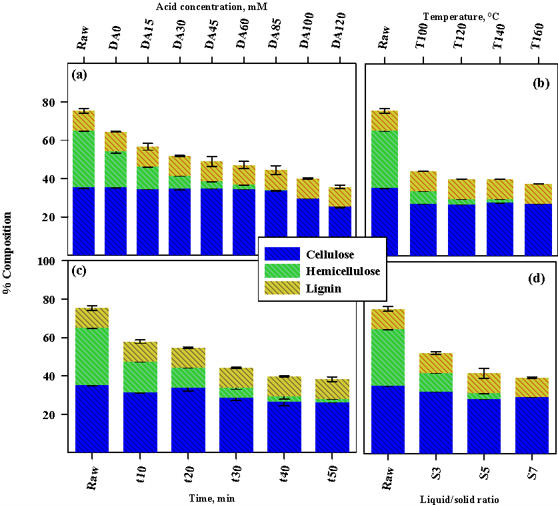
The experimental findings are summarized to evaluate the potential of the proposed rice straw biorefinery. The chemical compositions of raw and pretreated rice straw biomass are demonstrated in the Fig. 2, which show the responses of different pretreatments for fractionating major lignocellulose components. After pretreatments, the substrates are then enzymatically hydrolyzed to building-block sugars, and finally the pretreated substrates are subjected to fermentation to produce bioethanol, the benchmark fuel. The optimization data of dilute acid pretreatment of rice straw using sulfuric acid is discussed below after various composition tests for different acid concentrations, different pretreatment times, different temperatures, and different liquid-solid ratios. The feasibility of diluted acid pretreatment over alkali pretreatment and organosolv pretreatment is also examined using a variety of instrumental techniques.
Compositional analysis of pretreated rice straw
The chemical composition analysis is the key process to determine the true value of substrates for further processing. The raw rice straw biomass contained 35.35% cellulose, 29.64% hemicellulose, 10.39% lignin and some other substances. The pretreatment of rice straw alters the chemical composition and reduces the recalcitrance of rice straw, which results in increasing the enzymatic accessibility of cellulosic fractions (Fig. 2(a-d)). Here in most of the cases, the dilute sulfuric acid pretreatment of the rice straw significantly dissolves hemicellulose from biomass and breaks down into building block sugars. Lignin contents remain almost unchanged due to insolubility of lignin in aqueous acidic solutions [19]. However, cellulose dissolution depends on the pretreatment severity such as high acid concentration, temperature, time, and liquid to solid ratio. The high pretreatment severity favors hemicellulose removal while causing significant loss of cellulose sugars from pretreated substrates.
Characterization of pretreated substrate:
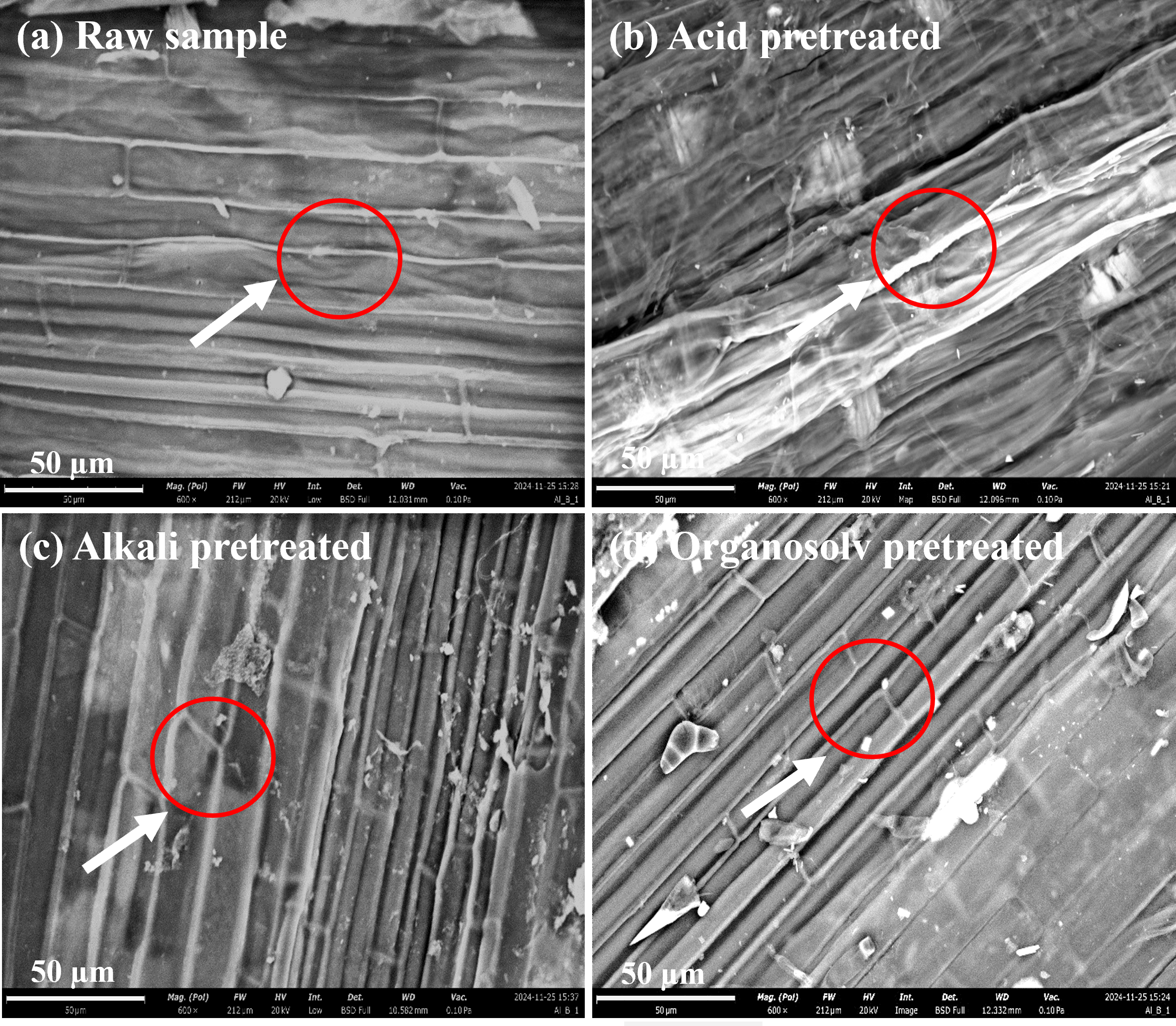
The SEM images of the raw and pretreated rice straw are shown in the Fig. 3 (a-d). The intact topology of untreated rice straw (Fig. 3(a)) exhibits a highly compact, smooth, and rigid surface layer which also confirms the structural recalcitrance of native biomass, which severely restricts initial enzyme access. On the other hand, DA pretreated rice straw (Fig. 3(b)) reveals a uniformly porous and disrupted micro-texture. The structural modification is due to the acid-catalyzed hydrolysis of hemicellulose, which effectively expanded the active surface area [19]. The morphology of alkali-pretreated rice straw (Fig. 3(c)) is driven by base-induced delignification. The alkali dissolved the protective lignin sheath and displays a distinct swelling and splitting of the fiber bundles, leaving a highly loosened network. The synergistic action of the organic solvent and the acid catalyst successfully dissolved both the lignin and hemicellulose fractions, leaving highly exposed cellulosic bundles, thus organosolv pretreated rice straw (Fig. 3(d)) showed extensive fragmentation and structural collapse.
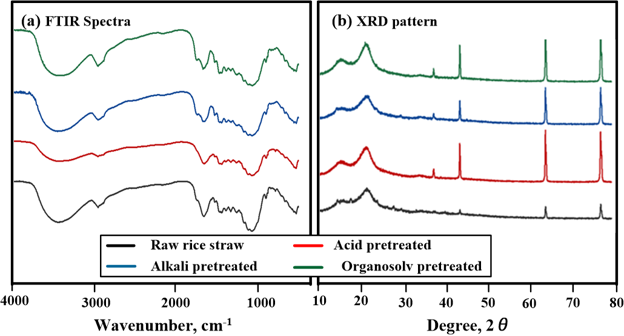
The FTIR spectra indicating the stretching vibrations of hydroxyl O–H groups centered at 3341 cm−1 is assigned to involve intra and intermolecular hydrogen bonding; a region highly responsive to the structural configuration of cellulose (Fig. 4(a)). In the present study, the acid-pretreated biomass exhibited a pronounced attenuation in this region relative to the raw, base, and organosolv treated variants. This reduction in absorbance signifies a partial disruption of the highly ordered hydrogen-bonding network stabilizing the crystalline cellulose domains. Again, a noticeable decline was observed at 2918 cm−1 which is in the aliphatic C–H stretching region within the acid-treated profiles. This spectral shift represents the widespread solubilization and stripping of non-polar surface components, such as aliphatic waxes, from the biomass surface. The most chemical modification occurs near 1635 cm an area that is denoted by the carbonyl C=O stretching vibrations characteristic of the ester and acetyl linkages in hemicellulose. The rapid reduction of this peak in the acid-pretreated spectrum provides an unambiguous evidence of extensive hemicellulose depolymerization and subsequent removal from the solid residue. Another change can be observed in the fingerprint region at 1035 cm−1, which corresponds to the C–O stretching vibrations associated with the β-(1,4)-glycosidic linkages of the cellulose backbone. The marked change and relative decrease in the intensity of this peak after acid pretreatment are primarily attributed to the removal of surrounding amorphous hemicellulose and lignin, which exposes the cellulose-rich glucan structure. This spectral change does not necessarily indicate significant degradation of the cellulose backbone. These spectral transformations are in strong alignment with the findings of Bala and Singh, who documented analogous band migrations during the chemical deconstruction of Saccharum biomass [15]. The FTIR data validates the targeted dissolution of hemicellulosic fractions, the modification of the lignin barrier, and the structural modification of the cellulose at optimized pretreatment conditions [20].
The effect of acid, base, and organosolv pretreatments on the relative crystallinity of rice straw investigated via XRD (Fig. 4(b)), shows the distinct structural variations were observed across the different biomass profiles, signaling shifts in the cellulose crystallinity index. The raw rice straw exhibited characteristic diffraction features at approximately 2θ = 16° and 22°, which can be attributed to the crystalline regions of cellulose I. The broad nature and relatively low intensity of these reflections indicate the semi-crystalline structure of the untreated lignocellulosic biomass, containing both ordered cellulose and amorphous lignin and hemicellulose fractions. Following acid, alkali, and organosolv pretreatments, the intensity and definition of the cellulose-associated peak around 22° increased, indicating an increase in the relative proportion of crystalline cellulose. This enhancement can primarily be attributed to the removal of amorphous hemicellulose and lignin during pretreatment. Among the pretreated samples, the organosolv-treated rice straw exhibited the most pronounced cellulose-associated diffraction peak, suggesting greater enrichment of the crystalline cellulose fraction. Nevertheless, the principal cellulose reflections remained at approximately the same 2θ positions, indicating that the cellulose I structure was largely retained after pretreatment. Several sharp reflections at higher 2θ angles were also observed in all samples, which may be associated with crystalline inorganic/mineral constituents naturally present in rice straw and therefore require phase identification for definitive assignment [17].
Optimization of pretreatment parameters
Our primary goal with this approach is to maintain a high cellulose percentage in substrate while reducing hemicellulose content to increase accessibility of enzymes and other chemicals. Pretreatment with diluted acid was intended to dissolve the majority of the hemicellulose from raw biomass, making the remaining cellulose more available to enzymatic hydrolysis [21], [22]. Hemicellulose removal, lignin removal, and cellulose enzyme digestibility (CED) of the pretreated substrates were determined to show the efficacy of the dilute acid pretreatment system (Fig. 5). In this pretreatment system, the increasing acid concentration (pH), cooking temperature and liquid-to-solid ratios increased hemicellulose dissolution during pretreatment process. On the other hand, the higher acid concentration decreased the pretreatment time and temperature for effective removal of hemicellulose. The main driving force for clearing lignocellulose linkages is the availability of protons which is mainly increased by higher acid concentration.
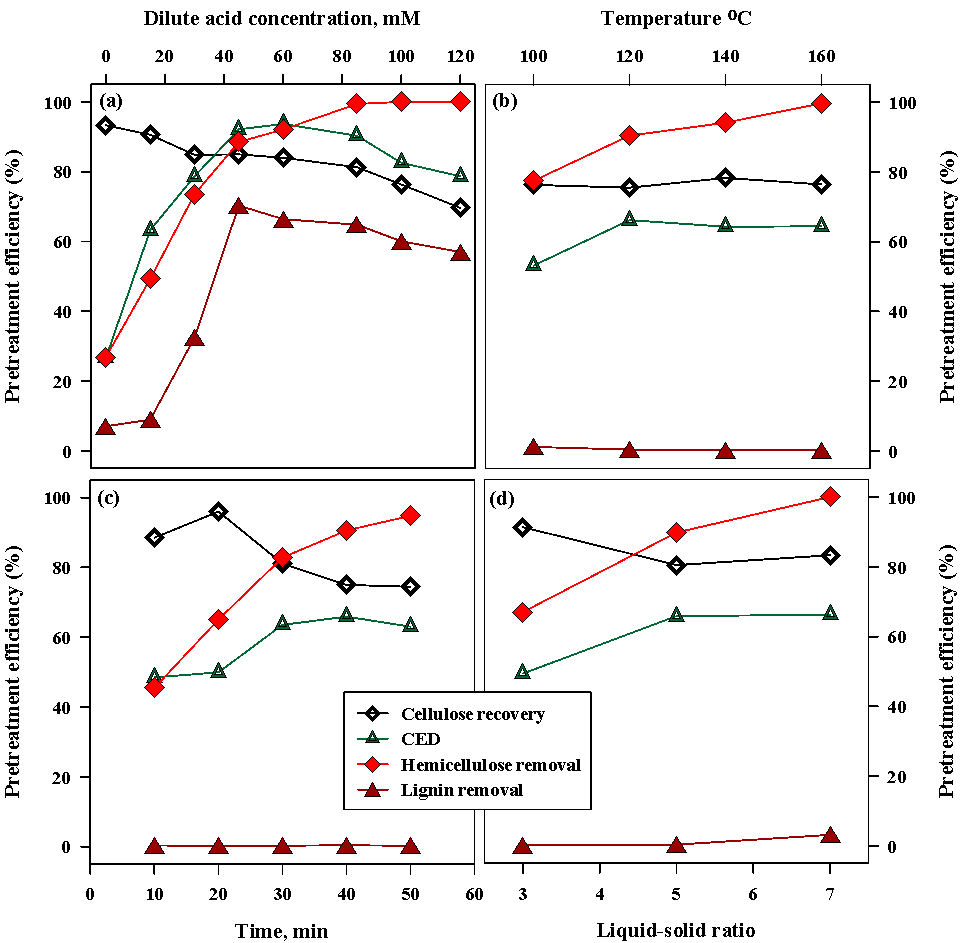
The compositional change of rice straw fractions, which are cellulose, hemicellulose, and lignin, was evaluated as a function of critical process variables like acid concentration, reaction temperature, pretreatment time, and liquid-to-solid (L/S) ratio. The chemical treatment with DA disrupted the native composition to facilitated mass transfer and fractionation of major ingredients. The dilute sulfuric acid pretreatment dissolved almost all hemicellulose and part of cellulose from biomass substrate. The structural carbohydrates underwent progressive hydrolytic degradation as the acid concentration and pretreatment time increased (Fig. 5(a)). The structural breakdown was further enhanced by thermal effects; shifting the pretreatment temperature from 100°C to 160°C, causing about 100% of hemicellulose removal while the cellulose recovery drop to a minimum amount of 76.39% (Fig. 5(b)). This confirms that while DA pretreatment primarily targets the amorphous hemicellulose fractions and it also induces localized hydrolysis of the accessible amorphous regions within the cellulose core.
However, the relative percentage of lignin increased as pretreatment severity increased due to lignin condensation and insolubility of lignin in acidic medium. This pretreatment also performed at shorter (t10min) to more prolonged (t50min) pretreatment times at 120°C. The pretreatment at 120°C for 30 minutes retained about 95.99% of cellulose in substrate while ensuring 90.58% hemicellulose depolymerization (Fig. 5(c)). An increase in the L/S ratio, a systematic drop in cellulose content observed, alongside a rapid stripping of hemicellulose, which completely dissolved at an L/S ratio of 7. This total hemicellulose dissolution indicates maximum hydrolytic efficiency; however, it achieved by significant loss of cellulose content that reached its lowest at this point (Fig. 5(d)). For maximum cellulose retention, pretreatment process requires cross-parameter optimization and among the tested matrices. Here, an L/S ratio of 5 found as the optimal solvent boundary, preserving a higher cellulose fraction at reduced chemical consumption. When combining all variables, DA60T120t30 (60 mM acid concentration, 120°C reaction temperature, and 30 minutes residence time) found as the optimum operating condition for the proposed pretreatment process. Therefore, the DA60T120t30 condition yielded the most favorable balance of highly exposed, clean cellulosic residue optimized for downstream enzymatic saccharification.
The maximum CED profiles were achieved at the dilute acid concentration of 60 mM. Notably, the saccharification for 60 mM and 85 mM experienced similar results, demonstrating that increasing the acid concentration within this specific range yields no statistical difference in cellulose accessibility. Because the terminal cellulose digestibility of the 60 mM pretreatment matched the peak performance of the 85 mM, selecting the lower effective acid concentration yields substantial benefits. Therefore, acid concentration of 60 mM was designated as the definitive optimal concentration. The temperature variations revealed that temperature operates synergistically with acid concentration to dictate the kinetic severity of the pretreatment process. Pretreatment conducted at the lower boundary of 100°C resulted in the lowest observed peak in cellulose digestibility (Fig. 5(b)). At this thermal level, the kinetic energy within the system is insufficient to break the stubborn intra and intermolecular linkages protecting the crystalline core of the cellulose. Consequently, hemicellulose solubilization remains incomplete, leaving the physical barriers around the cellulose fibers largely intact.
The absolute maximum CED was achieved at an optimized pretreatment temperature of 120°C (Fig. 5(b)). At this temperature, the system may provide sufficient energy to maximize the cleavage of α-benzyl ether bonds within the lignin-carbohydrate complexes (LCC) and hydrolyze hemicellulose. This deconstruction expands the internal pore volume of the rice straw which increases cellulase accessibility of pretreated substrate. The further increases in temperature to 140°C and 160°C led to a significant reduction in saccharification performance. This reduction in saccharification efficiency at high temperatures is closely tied to the shifting physical state of the remaining structural polymers. According to Zhang et al., over-pretreatment at temperatures exceeding 130°C alters the structural balance of the substrate by inducing the structural collapse and partial re-crystallization of amorphous cellulose domains, making them inherently more resistant to enzymatic attack [23]. Furthermore, severe thermal energy triggers thermal pseudo-lignin formation and lignin condensation reactions. The condensed lignin migrates and precipitates back onto the exposed cellulose surfaces, acting as a physical barrier that blocks cellulase docking and drives non-productive enzyme adsorption.
The pretreatment time of rice straw significantly affects substrate porosity and surface area availability. Short residence times (e.g., 10 minutes) proved inadequate for disrupting the structural matrix, resulting in a low cellulose digestibility curve that reflects poor enzyme accessibility. Increasing the residence time to 30-40 minutes systematically cleaves the intermolecular hydrogen bonding networks within the cellulose microfibrils, steadily increasing the available surface area.
Beyond the 40-minute mark, the cellulose digestibility began to decrease, indicating a threshold of diminishing returns (Fig. 5(c)). This downward trend is a classic indicator of extended secondary degradation kinetics. Extended exposure to hot acid favors the dehydration of solubilized pentose sugars into furfural, while hexose sugars are degraded into 5-hydroxymethylfurfural (5-HMF). These heterocyclic compounds, along with concurrently generated aliphatic acids, serve as potent chemical inhibitors. In saccharification stage, these compounds alter the structure of cellulolytic enzymes and non-competitively inhibit cellulase activity, lowering overall conversion efficiency. Given that the terminal carbohydrate yields for both parameters are identical, 30 minutes was selected as the optimal pretreatment time.
The liquid-to-solid (L/S) volumetric ratio is a critical process parameter that governs mass transfer resistances, rheological behavior, and chemical distribution within the pretreatment reactor. To evaluate its specific impact on downstream saccharification efficiency, the cellulose enzyme digestibility (CED) kinetics of pretreated rice straw were monitored across varying L/S ratios over time. Despite the higher initial hydrolysis rates for the higher L/S ratios, the terminal data points revealed a distinct threshold of diminishing returns. While the initial hydrolysis rate varied, the final CED curves for both the L/S ratio of 5 and the L/S ratio of 7 converged on similar terminal digestibility (Fig. 5(d)). This stabilization indicates that an L/S ratio of 5 provides sufficient fluid volume to achieve the maximum internal porosity and accessible surface area of the cellulose microfibrils. The addition of more solvents yields no further structural deconstruction. Therefore, an L/S ratio of 5 is selected as the optimal solvent ratio for the dilute acid pretreatment operations. Increasing an L/S ratio of 5 to 7 significantly increases the water footprint of the biorefinery without offering any corresponding increase in carbohydrate yield. In addition, this surplus liquid volume increases operational challenges for product separation and downstream processing. It requires higher energy inputs for expanded reactor volume, larger downstream storage and neutralization infrastructure. These significantly increase the costs associated with evaporation, distillation, and wastewater management.
Simultaneous Saccharification and Fermentation
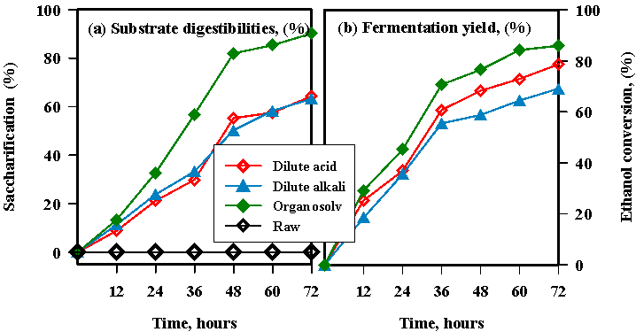
As illustrated in the kinetic profiles (Fig. 6), untreated rice straw exhibits a horizontal baseline which showed no glucose release over the entire saccharification period. The pretreatment performance was evaluated by tracking substrate or cellulose enzyme digestibility as a function of saccharification time (Fig. 6(a)). This extreme resistance to enzymatic cleavage emphasizes the protective nature of the native lignocellulose to enzymes and other chemicals. This is due to the hemicellulose and cross-linked lignin which physically restricts cellulase enzyme access to the cellulose microfibrils [22]. The cellulose enzyme digestibility of 64.28% was achieved for DA pretreated substrate at optimum condition which was higher than alkali pretreated substrate. Because, dilute alkali pretreatment remove part of lignin leaving strong cellulosic fiber which limits the enzyme accessibility during saccharification process. Organosolv pretreatments generally achieve effective delignification and hemicellulose depolymerization compared to DA pretreatments. The effective fractionation of major biomass components favors the high saccharification yields. For these reasons, the fermentation yield for organosolv pretreated substrate was achieved as high as 85.97% (Fig. 6(b)). The previously reported values for cellulose enzyme digestibility of lignocellulosic biomass generally range from approximately 50–80%, depending on the biomass type, pretreatment conditions, enzymatic hydrolysis efficiency, and process parameters. The obtained yield of 64.28% therefore falls within the commonly reported range, indicating that the applied pretreatment and hydrolysis conditions were reasonably effective for glucose recovery. Fermentation is a critical step in the biochemical conversion of rice straw to produce value-added products such as biofuels and biochemicals. The fermentation converts of fermentable sugars present in the pretreated rice straw into useful products through the action of Saccharomyces Cerevisiae yeast [24]. Optimizing process conditions such as pH, temperature, nutrient supply, and inhibitory compounds can significantly improve fermentation efficiency and productivity. The SSF is an efficient process that combines the enzymatic hydrolysis of biomass with fermentation in a single step, enhancing the conversion of substrates like acid-pretreated rice straw into fermentable sugars and subsequently into bioethanol [25]. The SSF of DA pretreated rice straw produced a slightly lower fermentation yield than organosolv-pretreated rice straw, which is nearly 78.70% based on hydrolyzed sugars. However, the processibility of dissolved hemicellulose sugar during pretreatment favors the operation DA pretreatment process in practical biorefinery.
Conclusions
This study successfully optimized acid pretreatment conditions to enhance bioethanol production from rice straw, a promising lignocellulosic biomass. Utilizing a combination of experimental and analytical techniques, we determined that pretreatment with 60 mM sulfuric acid at 120°C for 30 minutes, with a 5:1 liquid-solid ratio, significantly improved enzymatic saccharification. At optimum pretreatment conditions, the substrates yielded a high saccharification and fermentation efficiency of 78.70% at 15 FPU/g substrate; demonstrating a substantial increase in fermentable sugar and ethanol generation. Therefore, the integration of optimized dilute acid pretreatment parameters and efficient fermentation technologies highlights the feasibility of rice straw as a renewable feedstock. This finding will also pave the way for a combined solution of agricultural waste mitigation and energy sustainability. Ultimately, this study may contribute to establish a biorefinery in urban area to valorize waste rice straw and other agricultural wastes.
Declarations
- Author contributions
Materials collection, experiments, data analysis, and manuscript drafting: Md Shahed Shahriar & Mohit Mazumdar; Data collection: Rakib Hasan; Validation & data curation: Shah Md Shahan Shahriar; review and editing: Md Saiful Islam &, Mele Jesmin; Conceptualization, supervision & editing: Md Khairul Islam. All authors have read and agreed to the published version of the manuscript.
- Funding
This work was supported by Funding from the Faculty of Engineering, University of Rajshahi (No:393/5/52/RU/Engg-4/2021-22).
- Data availability
The data that support the findings of this study are available on request from the corresponding author.
- Competing interests
The authors declare no conflicts of interest.
References
- 1.Islam, M. K., Wang, H., Rehman, S., Dong C., Hsu, H. Y., Lin, C. S. K., and Leu, S. Y., (2020). Sustainability metrics of pretreatment processes in a waste derived lignocellulosic biomass biorefinery. Bioresource Technology, 122558: 298.
- 2.Nyasapoh, M. A., Gyamfi, S., Debrah, S. K., Gaber, H., Derkyi, N. S. A., Buah-Kwofie, A., Ameyaw, F., Korang, F. O., Annor, N., Djimasbe, R., Nassar, Y. F., Asante, K., Dotse, S. Q., and Amoah, A., (2026). Energy policies and regulatory pathways for a sustainable transition: a global review. Sustainable Development of Renewable Energy, 2: 653–682.
- 3.Malik, K., Capareda, S. C., Kamboj, B. R., Malik, S., Singh, K, Arya, S., and Bishnoi, D. K., (2024). Biofuels production: A review on sustainable alternatives to traditional fuels and energy sources. Fuels 2024, 5(2): 157-175.
- 4.Nawaz, A., Rehman, A. U., Rehman, A., Ahmad, S., Siddique, K. H. M., and Farroq, M., (2022). Increasing sustainability for rice production systems. Journal of Cereal Science, 103: 103400.
- 5.Harun, S. N., Hanafiah, M. M., and Noor, N. M., (2022). Rice straw utilisation for bioenergy production: A brief overview. Energies (Basel), 15(15): 5542.
- 6.Tolessa, A., (2023). Bioenergy production potential of available biomass residue resources in Ethiopia. Journal of Renewable Energy, 2023(1): 2407300.
- 7.Osman, A. I., Fang, B., Zhang, Y., Liu, Y., Yu, J., Farghali, M., Rashwan, A. K., Chen, Z., Chen, L., Ihara, I., Rooney, D. W. and Yap, P. S., (2024). Life cycle assessment and techno-economic analysis of sustainable bioenergy production: a review. Environmental Chemistry Letters, 22(3): 1115–1154.
- 8.Kumar, M., Ojha, N., and Singh, N., (2022). Atmospheric aerosols from open burning in South and Southeast Asia. Asian atmospheric pollution, 75–96.
- 9.Kachroo, H., Verma, V. K., Doddapaneni, T. R. K. C., Kaushal, P., and Jain, R., (2024). Organic/metallic component analysis of lignocellulosic biomass: A thermochemical-perspective-based study on rice and bamboo waste. Bioresource Technology, 403: 130835.
- 10.Wang, Q., Chen, J., Y., Xiong, Q., Hayashi, J., C., A. J., X., and Zhou, Y., (2025). Insights into environmentally friendly solvent pretreatment of lignocellulosic biomass: Strategies, mechanisms, and future perspectives. Carbohydrate Polymers, 367: 124027.
- 11.Woźniak, A., Kuligowski, K., Świerczek, L., and Cenian, A., (2025). Review of lignocellulosic biomass pretreatment using physical, thermal and chemical methods for higher yields in bioethanol production. Sustainability, 17(1): 287.
- 12.Pasquier, J. D., Paës, G., and Perré, P., (2023). Principal factors affecting the yield of dilute acid pretreatment of lignocellulosic biomass: a critical review. Bioresource Technology, 369: 128439.
- 13.Wood, I. P., Cao, H. G., Tran, L., Cook, N., Ryden, P., Wilson, D. R., Moates, G. R., Collins, S. R. A., Elliston, A. and Waldron, K. W, (2016). Comparison of saccharification and fermentation of steam exploded rice straw and rice husk. Biotechnology for Biofuels, 9: 1–9.
- 14.Sluiter, A., Hames B., Ruiz, R., Scarlata, C., Sluiter, J., Templeton, D., and Crocker D., (2012). Determination of Structural Carbohydrates and Lignin in Biomass. Laboratory Analytical Procedure (LAP)/National Renewable Energy Laboratory, 510-42618.
- 15.Bala, A., and Singh, B. (2019). Development of an environmental-benign process for efficient pretreatment and saccharification of Saccharum biomasses for bioethanol production. Renewable Energy, 130:12-24.
- 16.Islam, M. K., Rehman, S., Guan, J., Lau, C. Y., Tse, H. Y., Yeung, C. S., Leu, S. Y., (2021). Biphasic pretreatment for energy and carbon efficient conversion of lignocellulose into bioenergy and reactive lignin. Applied Energy, 303: 117653.
- 17.Park, S., Baker, J. O., Himmel, M. E., Parilla, P. A., and Johnson, D. K., (2010). Cellulose crystallinity index: Measurement techniques and their impact on interpreting cellulase performance. Biotechnology for Biofuels, 3:10.
- 18.Islam, M. K., Thaemngoen, A., Lau, C. Y., Guan, J., Yeung, C. S., Chaiprapat, S., and Leu, S.Y., (2021). “Staged organosolv pretreatment to increase net energy and reactive lignin yield in whole oil palm tree biorefinery.” Bioresource Technology, 326: 124766.
- 19.Kim, J., Kim, K. S., Lee, J., Park, S. M,. Cho, H., Park, J. C., and Kim, J. S. (2011). Two-stage pretreatment of rice straw using aqueous ammonia and dilute acid. Bioresource Technology, 102: 8992-8999.
- 20.Xu, F., Yu, J., Tesso, T., Dowell, F., and Wang, D., (2013). Qualitative and quantitative analysis of lignocellulosic biomass using infrared techniques: A mini-review. Applied Energy, 104: 801–809.
- 21.Zheng, Y., Lee, C., Yu, C., Cheng, Y., Zhang, R., Jenkins, B. M., and Gheynst, J. S.V., (2013). Dilute acid pretreatment and fermentation of sugar beet pulp to ethanol. Applied Energy, 105: 1-7.
- 22.Wang, Y., Leng, L., Islam, M. K., Liu, F., Lin, C. S. K., and Leu, S., (2019). Substrate-related factors affecting cellulosome-induced hydrolysis for lignocellulose valorization. International Journal of Molecular Sciences, 20(13): 3354.
- 23.Zhang Y., Huang M., Su J., Hu H., Yang M., Huang Z., Chen D., Wu J., and Feng Z.(2019). Overcoming biomass recalcitrance by synergistic pretreatment of mechanical activation and metal salt for enhancing enzymatic conversion of lignocellulose. Biotechnology for Biofuels, 12(12).
- 24.da Silva, A. S., Inoue, H., Endo, T., Yano, S., and Bon, E. P. S., (2010). Milling pretreatment of sugarcane bagasse and straw for enzymatic hydrolysis and ethanol fermentation. Bioresource Technology, 101(19): 7402–7409.
- 25.Karimi, K., Emtiazi, G., and Taherzadeh, M. J., (2006). Ethanol production from dilute-acid pretreated rice straw by simultaneous saccharification and fermentation with Mucor indicus, Rhizopus oryzae, and Saccharomyces cerevisiae. Enzyme and Microbial Technology, 40: 138–144.
Cite this article
Journal
Shahriar MS, Mazumdar M, Hasan R, Shahriar SMS, Islam MS, Jesmin M, Islam MK. Optimization of Dilute Acid Pretreatment of Waste Rice Straw for Enhanced Saccharification and Fermentation Yield. JoSEP. 2026;3(2):222-230. doi: 10.62275/josep.26.1000032.
Cited by (0)
Citing works are not available yet.
About this article
- Received
- 1 July 2026
- Revised
- 21 September 2026
- Accepted
- 25 September 2026
- Published
- 2 November 2026
- Journal
- Journal of Science and Engineering Papers
- Volume / Issue
- 3 / 2
- Pages
- 222-230
- DOI
- 10.62275/josep.26.1000032