 Open Access



 Open access
 Check for updates

Abstract
The extraction behaviour of vanadium (V) from nitric acid solutions was studied using technical grade D2EHPA in kerosene as an extractant. The effects of aqueous pH, the concentration of vanadium (V) and nitrate ion in the aqueous phase, and the concentration of D2EHPA in the organic phase were investigated. The extraction equilibration time was 30 min. Metal ion dependencies appeared non-ideal due to the non-constancy of the aqueous phase acidity and the equilibrium extractant concentration. Two types of extraction mechanisms originated from the study of pH dependency. The study conceded that the extraction of vanadium (V) occurred via ion exchange or chelation type of extraction when the pH(eq) <2.50. On the other hand, the solvated ion-pair extraction mechanism occurs when the pH(eq) was above 2.50. The extractant dependencies showed that vanadium (V) species were extracted by one molecule of D2EHPA. The salting-out effect was observed from the effect of nitrate ion concentration. The effect of various types of diluents on vanadium (V) extraction with technical grade D2EHPA was studied; kerosene appeared to be a suitable diluent. The temperature dependence data revealed that the system was exothermic with the ΔH value of -12.34 kJ/mol. The loading capacity was 6.11 g vanadium (V) per 100 g extractant. The H2SO4 (0.5 mol/L) was the right stripping agent for the extracted species.
Introduction
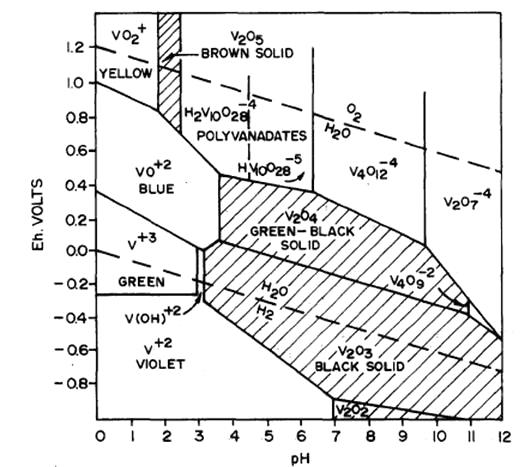
In recent times, Vanadium and its compounds have gathered great prominence due to their increased demands in modern electronics and high-tech products. A steel-grey colored metal is vanadium. It has oxidation states ranging from -1 to +5 [1]. This metal is vastly used as a corrosion-resistant metal. In nature, vanadium is not found in the metallic form. The +3, +4, and +5 are vanadium's most common valence states. According to the oxidation states, Vanadium species show distinct types of color at different pH. The Eh-pH diagram for vanadium-species illustrates the presence of vanadium in solution as divalent (violet up to pH 7.0), trivalent (green up to pH 3.5), tetravalent (blue up to pH ~4), and pentavalent (yellow up to pH ~4.5) ions [2], [3]. This phenomenon has been displayed in Fig. 1. Figure 1 shows the equilibrium Eh-pH diagram for the vanadium-water system. This figure demonstrates five solid substances of Vanadium such as V, V2O2, V2O3, V2O4, and V2O5. A total of 10 aqueous species (V+2, V+3, V(OH)+2, VO+2, V4O9-2, VO2+, H2V10O28-4, HV10O28-5, V4O12-, V2O73-) appear on the diagram at the concentration level of around 1.0 g/L vanadium. The extracellular properties have been found in vanadium's pentavalent form (VO3-). On the other hand, the quadrivalent form (VO2+) of vanadium shows intracellular properties. Hence, these two properties make vanadium accessible for biological research [4]-[6]. Moreover, vanadium has hardness properties and the ability to form an alloy with other metals. Vanadium is mainly used as an additive in the steel industry (i.e., ferrovanadium) [7]-[9]. This alloy produces rust-resistant, spring, high-speed steel apparatus [8], [10]. The low fission neutron cross section properties make vanadium useful for nuclear applications [11]. Presently the vanadium-redox flow batteries demonstrate some promising growth in energy grid storage applications, which opens a new entrance for vanadium use [12], [13]. Due to the existence of various oxidation states, vanadium (V) is used as a catalyst. Vanadium is excavated in China, South Africa, and Russia. The secondary materials for vanadium are petroleum desulfurization waste catalysts, tar sand, ash, etc. [14]. A vanadium slag is formed during the smelting of iron ore containing vanadium pentoxide. This slag is used to recover the vanadium metal. Various types of steps are used to retrieve the vanadium compounds (e.g., acid leaching [15], solvent extraction [16]-[18], etc.). The solvent extraction route is more popular than the other methods. A wide range of extractants can be used as solvent for the extraction of vanadium such as tributyl phosphate (TBP)[19], Cyanex 272[12], Cyanex 301[20], Cyanex 302[21], EHEHPA [22], Aliquat-336[23], [24], EXXSOL D80[25] etc. Analytical grade D2EHPA has been used to extract vanadium (V) from chloride medium [26]. This paper describes the extraction behavior of vanadium (V) by technical grade D2EHPA. Technical grade D2EHPA is five times cheaper than the analytical grade but it contains 2/3 rd portion D2EHPA and 1/3 rd portion of monoethylhexyl ester and is used industrially as the later also has the extracting power. This is why the technical grade D2EHPA has been used in this study.
During processing, V2O5 is formed in the solid state with gangue materials, and it can be readily leached by HNO3 solution. Moreover, VO2+ can be readily oxidized by HNO3. Therefore, the extraction study is carried out in a nitrate medium.
D2EHPA separates and purifies several metal ions (e.g., copper(II), cobalt(II), manganese(II), zinc(II), iron(III), cadmium(II), nickel(II), and rare earths) [27], [28]. However, it is also used as an auxiliary extractant to achieve a synergistic effect with other extractants [29]-[31].
The study shows the ideal extraction conditions such as time, aqueous phase pH, metal ion concentration, extractant concentration, co-existing anion concentration, and temperature. The stripping of the extracted species by various reagents has been carried out. Furthermore, the best diluent for this system has been screened.
Materials and methods
Materials
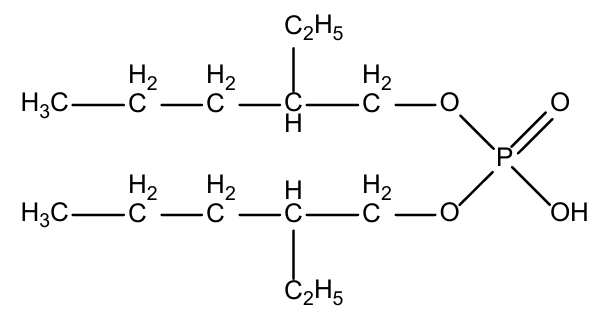
Technical grade D2EHPA was acquired from Fluka, Switzerland. Figure 2 displays the chemical structure of pure D2EHPA. Ammonium metal vanadate (NH4VO3) (99%, Riedel-deHain, Germany) was used as a source of vanadium (V). Kerosene was purchased from the local market. Collected kerosene was redistilled over 473-533 K. The redistilled kerosene was colorless and aliphatic. All the other chemicals were of reagent grade and used without further purification.
Analytical
The aqueous phase vanadium (V) content was estimated spectrophotometrically at 450 nm using T60 Visible Spectrophotometer (PG Instruments Limited, United Kingdom). The H2O2-H2SO4 method was used [32], [33]. Accurately weighed 2.296 g of A. R. ammonium meta-vanadate, on dissolving with water and making up to 1.0 L, gave a standard vanadium (V) solution, in which 1.0 mL contained 1.0 mg vanadium (V). The aqueous phase pH was measured by the edge® dedicated pH/ORP meter (HI2002-01, HANNA INSTRUMENTS, USA). Buffer solution of pH 4 and 7 was used to standardize the pH meter. Moreover, the aqueous phase pH for the experimental purpose was adjusted by anhydrous Na2CO3.
Preparation of aqueous and organic phases
The requisite amount of NH4VO3 was dissolved in 535 mL of 15.44 mol/L HNO3 solution and diluted to 2000 mL to obtain a stock solution containing 10.75 g/L vanadium (V) and 4.14 mol/L HNO3. An aliquot of 25 mL of technical grade D2EHPA was dissolved in redistilled kerosene in a 500 mL volumetric flask and made up to the mark to get a 500 mL stock solution of 5% D2EHPA [34], [35].
Procedure for equilibrium study
An aliquot of the aqueous phase (20 mL) containing vanadium (V) and nitrate ion at definite concentrations and having definite pH was agitated with an equal aliquot of the organic phase containing the extractant in kerosene (taken in a reagent bottle) for a predetermined time (30 min) at temperature 303±1 K. The phase agitation was made effective by a Stuart Flask Shaker (220 V, 50 Hz, UK). The temperature was controlled by putting the agitation flasks in a thermostatic water bath (LAUDA B 4 Stainless Steel Bath, Thomas Scientific, USA). After equilibration, phases were allowed to settle within the water bath and disengaged.
Separated aqueous solutions were subjected to determine equilibrium pH values followed by vanadium (V) concentrations. The vanadium (V) concentration in the organic phase at equilibrium was calculated by difference or mass balance. The extraction or distribution ratio (D) was calculated by dividing the concentration of vanadium (V) in the organic phase by that in the aqueous phase at equilibrium. The extraction ratio, D, was then calculated using the following relation:
Procedure for loading of V(V) in the organic phase
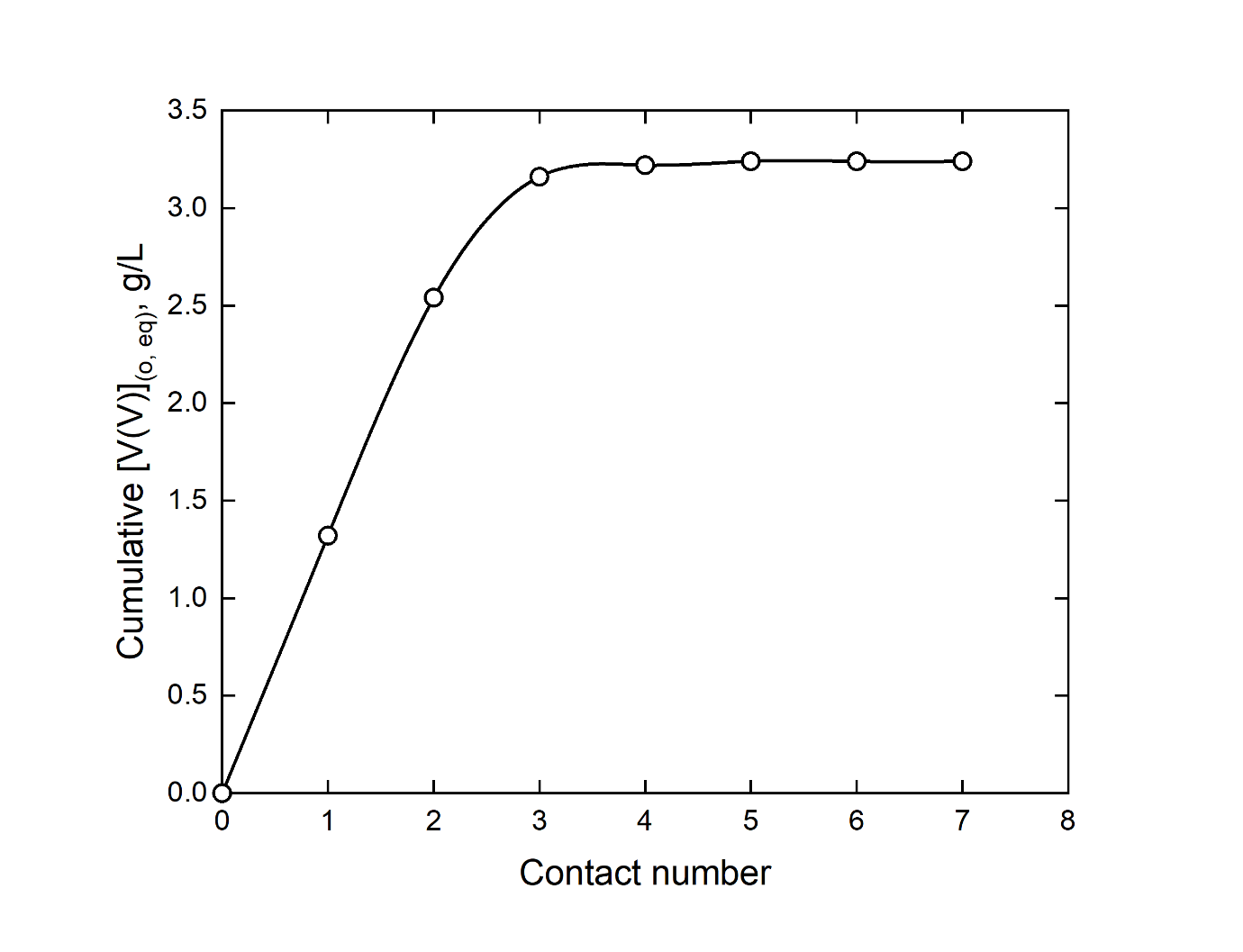
In loading, an aliquot of 100 mL 5% (v/v) technical grade D2EHPA solution dissolved in kerosene was repeatedly equilibrated with 100 mL portions of the fresh aqueous solution containing 1.66 g/L vanadium (V) and 0.20 mol/L nitrate at pH of 2.00 and temperature 303 K. After each equilibration, the separated aqueous phase was analyzed for its vanadium (V) content. The organic phase vanadium (V) concentration was calculated by the difference. The process continued until the organic phase was saturated with vanadium (V).
Procedure for stripping study
The stripping procedure was performed by taking 10 mL of an organic phase containing 3.24 g/L vanadium (V) was equilibrated for 30 min at 303 K with an equal volume of either 0.10 mol/L NH4OH, 0.50 mol/L NH4OH, 0.10 mol/L NH4OH + 0.10 mol/L NH4Cl, 0.90 mol/L NaOH, 0.10 mol/L H2SO4, 0.50 mol/L H2SO4, 1.0 mol/L H2SO4, or 0.50 mol/L HNO3 acid solutions. The stripping ratio was calculated by dividing vanadium (V) concentration in the aqueous phase by that in the organic phase at equilibrium [36].
Results and discussion
Effect of phase contact time on the extraction ratio of vanadium (V)
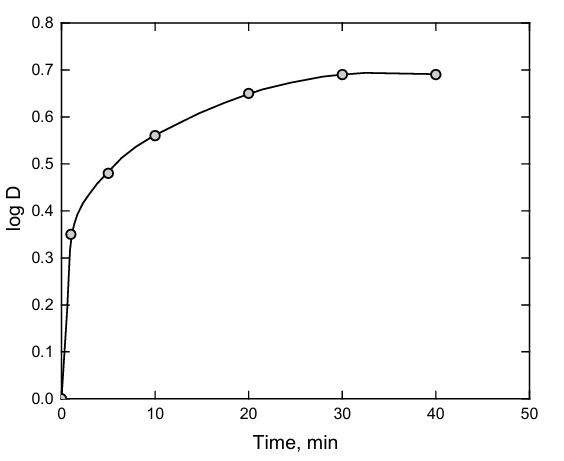
The variation of log D with the variation of the contact time (min) is depicted in Fig. 3. It is found that the concentration ratio of vanadium (V) increases with the increase in phase contact time up to 30 min. With the further increase in the contact time, the value of log D remains unchanged. Therefore, it is concluded that the equilibration time for the current system is about 30 min. In subsequent experiments, a phase contact time of 30 min has been used.
Effect of metal ion concentration on the extraction ratio of vanadium (V)
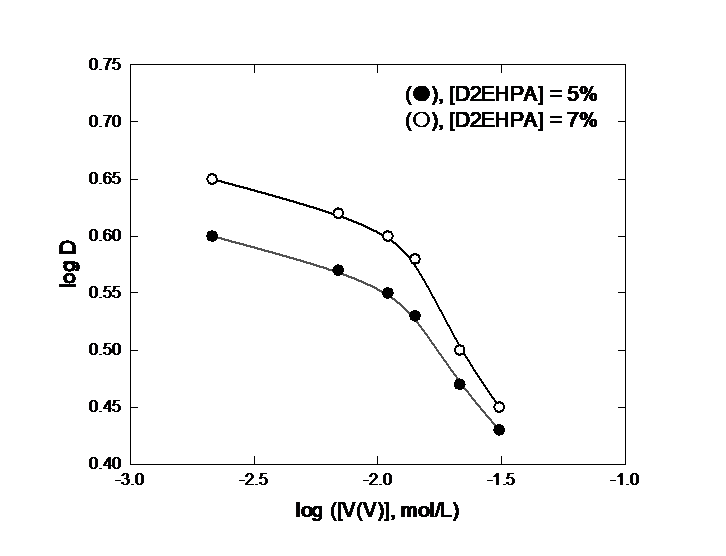
Metal-ion may be polymerized in both aqueous and organic phases, and co-existing anion complex may be formed with increasing metal-ion and ligand concentrations. In such cases, it is expected that the extraction ratio should vary with the metal ion concentration in the aqueous phase. The log D vs. log([V(V)(ini)], mol/L) plots are shown in Fig. 4. It is found that in both cases under investigation, the extraction ratio decreases with the increase in the initial concentration of vanadium (V) in the aqueous phase. The slope of log D vs log([V(V)(ini), mol/L) plots are steeper at higher concentration regions than those at lower concentration region. Therefore, the system appears as non-ideal. The non-ideality, i.e., the decrease in extraction ratio with the increase of vanadium (V) concentration, may be due to the following reasons:
i) Non-constancy of aqueous phase acidity, pH
The equilibrium pH may drop with the increase in the initial vanadium (V) ion concentration in the aqueous phase. This phenomenon is caused by the liberation of H+ during the extraction process (Eq. 2). It can also rise due to the consumption of H+ from the solution to form extractable species (Eq. 3).
In the present case, the dropping down of pH(eq) from pH(ini) (Fig. 4) is noticed, and this indicates the extraction of the metal ion by chelation mechanism [27], [37].
ii) Non-constancy of equilibrium extractant concentration
With the increase in the initial vanadium (V) concentration, more extractants will be consumed to form the extractable complex. As a result, the equilibrium extractant concentration will be decreased with the increase in the initial vanadium (V) concentration in the aqueous phase, and the extraction ratio or percent extraction will be decreased, as indicated by the following equation.
where, D = extraction ratio, Kex = extraction equilibrium constant, pH = equilibrium pH of the aqueous phase, [H2A2](ini) = initial extractant concentration in the organic phase, S = concentration of extractant which is used in forming the metal complex.
Besides these two causes, the decrease in extraction ratio with increasing the initial vanadium (V) concentration may be attributed to the non-ideality of the aqueous phase, i.e., hydrolysis and polymerization of vanadium (V) species in the aqueous phase.
It is known that VO2+ forms V10O26(OH)24- on lowering acidity (increasing pH), and this conversion process is probably facilitated by the increase in VO2+ concentration in the aqueous phase. This conversion might be of the following type:
Effect of aqueous pH on the extraction ratio of vanadium (V)
Invariably, all extraction processes involving either ion-pair formation or ion exchange mechanism depend on the acid concentration or pH of the medium from which the metal ion is extracted [26], [38]. In general, for an ion-pair extraction, the extraction ratio is increased with increasing the concentration of acid (i.e., with decreasing the pH), whereas for liquid cation exchange and chelation system, the extraction ratio is decreased with increasing the concentration of acid (i.e., with decreasing the pH). The extractant, D2EHPA (and the co-existing M2EHPA), is a liquid cation exchanger [19], [39], [40]. When such an extractant extracts a metal ion, a reversible ion-exchange reaction occurs in which the metal ion exchanges the hydrogen ion of the extractant. For a cation exchange system, the slope of log D versus pH or –log [H+] plots represent the number of hydrogen ions (H+) liberated for each metal-ion from the extractant during extraction. So, the extraction equilibrium will depend on the pH, in the aqueous phase, and the extractant concentration in the organic phase.
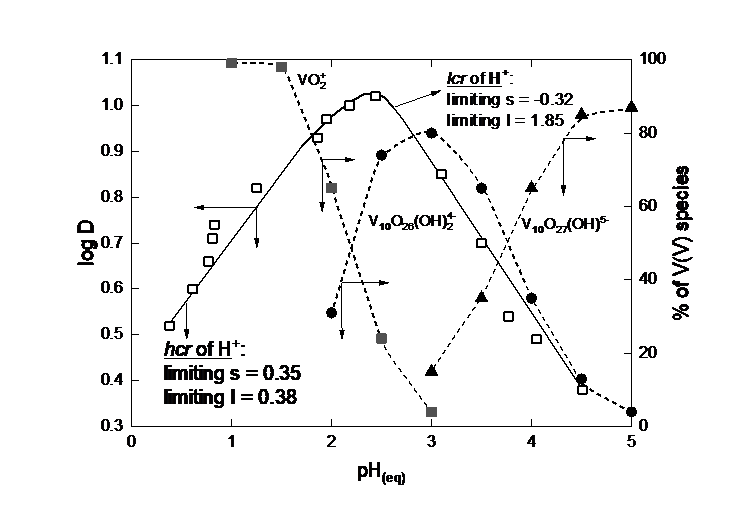
The plot of log D vs. pH(eq) is depicted in Fig. 5. Figure 5 shows that the extraction of vanadium (V) increases with the aqueous equilibrium pH up to ~2.50. This phenomenon is the typical characteristic of ion-exchange or chelation type of extraction. However, vanadium (V) extraction is decreased with the increase of aqueous pH above pH(eq) = 2.50, which indicates the formation of solvated ion pair. The limiting slopes of the two portions of the curve are calculated. For cation exchange reactions, the pH dependency (slope of log D vs. pH(eq) plot) should be positive due to the liberation of H+ by extraction reaction. This slope is 0.35. The negative pH-dependency (negative slope of log D vs. pH(eq) plot) is indicative of the association of H+ with existing vanadium (V) to form the extractable species, and this slope is estimated as -0.32.
According to Zeng and Cheng [41], yellow colored VO2+ exists within pH 1-2, whereas, within pH 2-6.50, orange red V10O28-6 exists. However, it is also reported that with the gradual increase of pH from zero, VO2+ is gradually transformed to VO(OH)3 (to a small extent), V10O26(OH)24-, V10O27(OH)5-, V10O286-, V3O93-, V4O124-, VO2(OH)2- etc. V10O26(OH)24- is virtually doubly protonated V10O286-; whereas V10O27OH5- is single protonated V10O286-. The distribution of these species as a function of pH is also available, as shown in Table 1.
Figure 5 also includes the % of existing vanadium (V) species at various pH values. It is seen that aqueous pH of value up to 1.50 in solution persists to exist VO2+ mainly (98%). Hence, the principal reaction responsible for V(V) extraction in this region follows the ion-exchange reaction.
According to the above reaction, the pH dependence should be 1; but the experimental value is only 0.35. Therefore, it is considered that a parallel reaction product formation is also responsible for V(V) extraction. It will be seen later that [NO3-] enhances extraction. Moreover, it is thought that the ion-pair VO2NO3 is solvated by H2A2 and transferred to the organic phase. The probable equation for solvated ion-pair formation can be depicted as follows:
The reaction in Eq. (7) is independent of [H+]. Therefore, it is concluded that in the higher acidity region, 35% portion of V(V) is extracted following the reaction presented in Eq. (6) and the rest by the reaction shown in Eq. (7). Hence, the overall pH dependence becomes 0.35.
On increasing the pH of the aqueous solution, VO2+ concentration in the system drops abruptly and becomes negligible at pH(eq) 3. Consequently, the concentration of the hydrolysed product V10O26(OH)24- increases proportionally and exists in the highest proportion at pH(eq) 3. The prominent extractable aqueous V(V) species is V10O26(OH)24-. The following type of reaction probably extracts this species:
Moreover, the formation of V10O27(OH)5- starts at pH ~3 and becomes maximum at around pH 5. The extraction of this species is ruled out because the formation of H6V10O28.nH2A2 will require 5 H+, which is less likely supplied by the aqueous solution of high pH. In Eq. (8), 4 H+ are needed for 10 vanadium (V), so the pH dependence would be -0.40. The experimental value is -0.32, so the explanation given above conforms to the experimental results.
The investigated system's pH functionality is exceptionally low, which may be a drawback.
| pH(eq) | % (approximate) | |||||||
|---|---|---|---|---|---|---|---|---|
| VO2+ | VO(OH)3 | V10O26(OH)24- | V10O27OH5- | V10O286- | V3O93- | VO2(OH)2- | V4O124- | |
| 1.0 | 99 | 1 | - | - | - | - | - | - |
| 1.5 | 98 | 2 | - | - | - | - | - | - |
| 2.0 | 65 | 3 | 31 | - | - | - | - | - |
| 2.5 | 24 | 2 | 74 | - | - | - | - | - |
| 3.0 | 4 | 1 | 80 | 15 | - | - | - | - |
| 3.5 | - | - | 65 | 35 | - | - | - | - |
| 4.0 | - | - | 35 | 65 | - | - | - | - |
| 4.5 | - | - | 13 | 85 | 1 | - | - | - |
| 5.0 | - | - | 4 | 87 | 6 | 1 | 2 | - |
| 5.5 | - | - | 2 | 81 | 12 | 2 | 3 | - |
| 6.0 | - | - | - | 57 | 32 | 6 | 4 | 1 |
Effect of extractant concentration on the extraction ratio of vanadium (V):
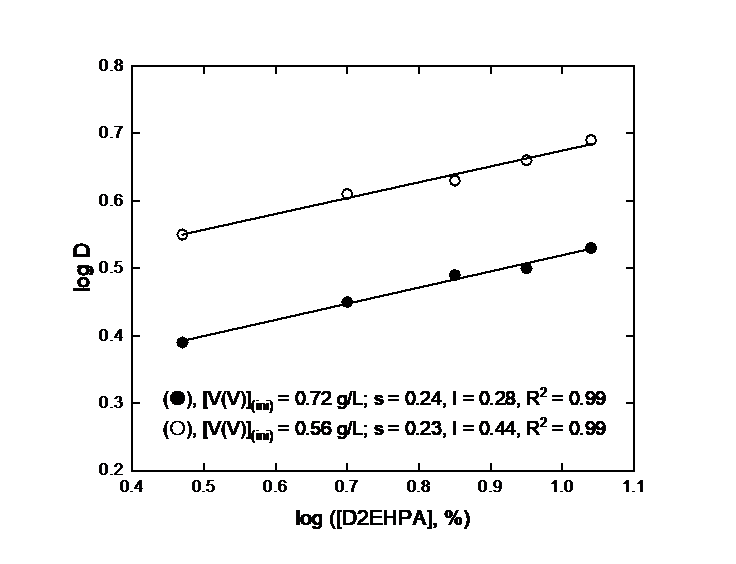
The effect of the extraction ratio of a metal ion on extractant concentration is essential in the solvent extraction study. In all cases, the extraction ratio increases with increasing the extractant concentration. This phenomenon is the expected behavior of the extractant to extract the metal ion. Therefore, the study on the effect of extractant concentration on extraction ratio is valuable in obtaining an extractant's selectivity towards a metal ion. It also helps to explain the extraction mechanism to better understand a particular extraction system. The extractant, D2EHPA, and admixed M2EHPA are liquid cation exchangers. These extractants can form chelate complexes with metal ions. It can extract metal ions in both monomeric and dimeric forms. In almost all extraction reactions, the extraction ratio increases with the extractant concentration increases in the organic phase. The relation log D = log Kex+ z log [D2EHPA](o)-y log [H+] indicates that the slope of log D versus log [D2EHPA] plots should indicate the number of moles of D2EHPA used up per mole of vanadium (V) in forming the extractable species. So, it is the most crucial parameter to investigate the type of extraction reaction that occurs during extraction.
Figure 6 represents the plot of log D vs. log ([D2EHPA], %) for two different metal ion concentrations. In both cases, straight lines are obtained. The slopes of these straight lines are 0.234 and 0.239 for 0.56 g/L and 0.72 g/L vanadium (V) systems, respectively. The results indicate that the more the extractant concentration, the more V(V) extraction. This behavior is normal for any extraction process. The slope values indicate the requirement of one extractant molecule per four vanadium (V) extracted. As the equilibrium pH varies with the variation of extractant concentration, it is necessary to get log D versus log ([D2EHPA], %) plot at constant equilibrium pH values. The positive extractant dependence supports the general phenomenon of an extraction process.
Effect of nitrate ion concentration on the extraction ratio of
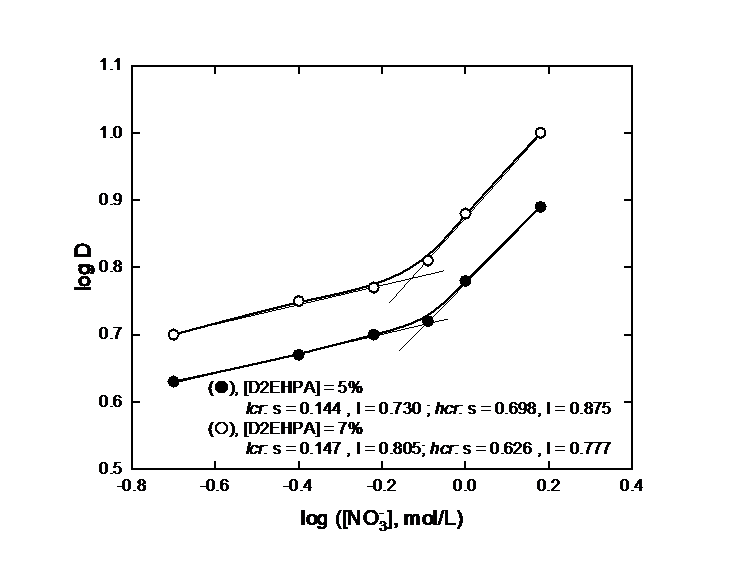
Co-existing anion in the aqueous phase often affects the extraction characteristics of a metal ion by an extractant. In a few cases, it is found that the extraction is independent of co-existing anion concentration. Since the extraction has been carried out from the nitrate medium in the present study, it is necessary to determine the effect of nitrate ion concentration on the extraction characteristics of the current system.
The log D vs. log ([NO3-], mol/L) plot for two different D2EHPA concentration systems is shown in Fig. 7. A curve is obtained instead of a straight line in each case. The extent of variation of extraction ratio with the [NO3-] depends on its concentration region. In both cases, the tangential positive slopes of these curves are increased gradually with the increase in the nitrate ion concentration. The slope approaches zero at lower nitrate ion concentration regions, whereas in the high concentration regions, it gradually increases to about 0.69 at [NO3-] of 1.50 mol/L. The nitrate ion thus exhibits the salting-out effect in the present system.
Effect of temperature on the extraction of V(V)
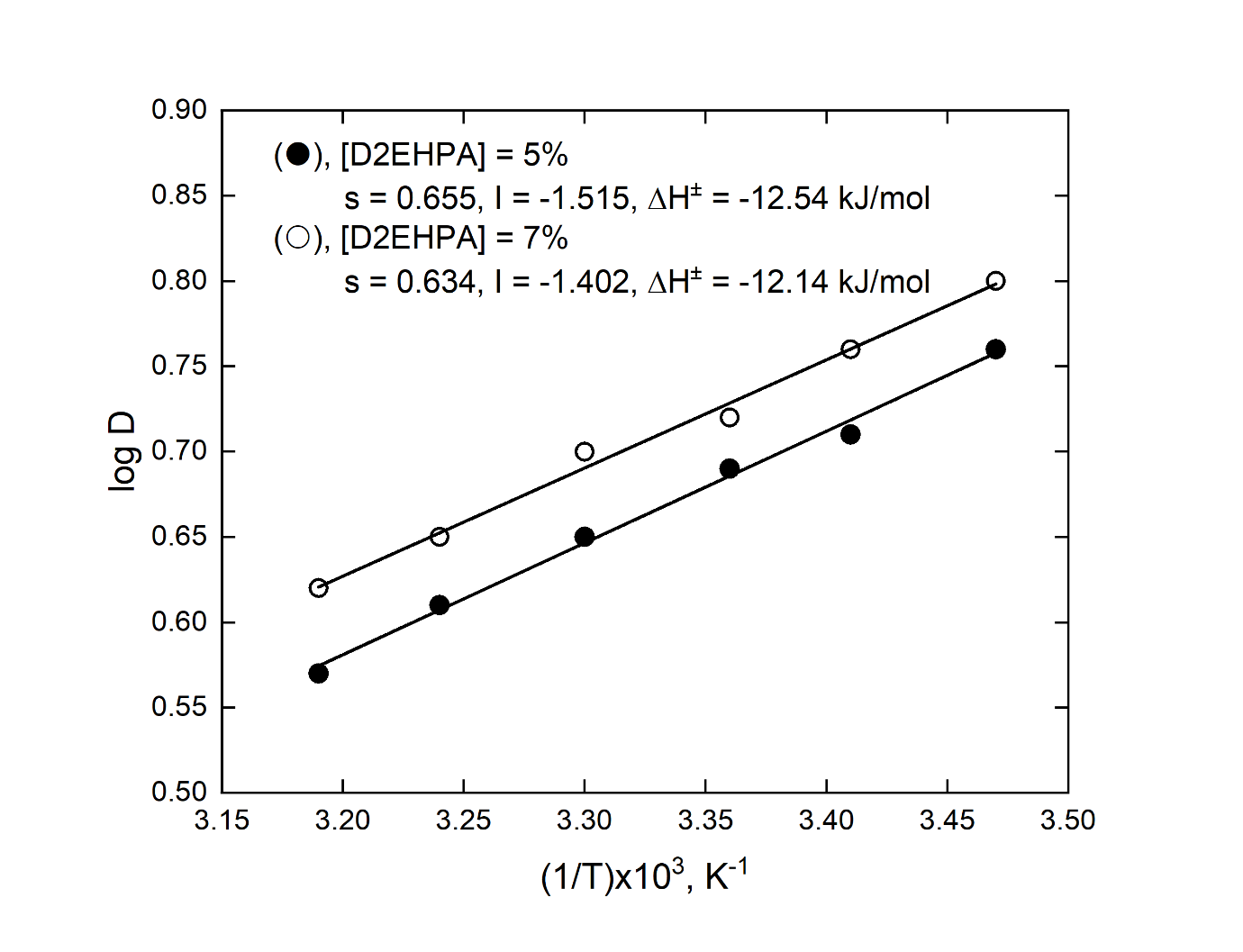
The effect of temperature in the present system has been determined at two different concentrations (5% and 7%). The experimentation related van’t Hoff [42] (log D vs. (1/T), K-1) plots are given in Fig. 8. In both cases; it is found that the extraction ratio is decreased with increasing temperature, and the straight-line relationship holds in the van’t Hoff plots. Slopes of the line are 655.2 and 619.4 for 5% and 7% D2EHPA systems, respectively. From the slopes of the plots, the values of the heat of extraction reaction (ΔH) have been calculated as -12.54 kJ/mol and -12.14 kJ/mol for 5% and 7% D2EHPA systems, respectively. The extraction process is, therefore, exothermic with ΔH value of about -12.34 kJ/mol.
Loading of technical grade D2EHPA solution with V(V):
An aliquot of 100 mL 5% technical grade D2EHPA solution in kerosene has been repeatedly equilibrated with 100 mL of fresh aqueous solution at a pH of 2.00 and a temperature of 303 K. The fresh aqueous solution contains 1.66 g/L vanadium (V) and 0.20 mol/L NO3-. The cumulative vanadium (V) concentration in the organic phase has been plotted against the phase contact number in Fig. 9.
It is observed that the organic phase loading with vanadium (V) is almost ended at the 4th contact. It is seen from the Fig. 9 that the saturation of 5% or 53 g/L D2EHPA solution with vanadium (V) occurs at the 4th contact when the extractant is repeatedly contacted with 1.66 g/L vanadium (V) solution at pH(ini) of 2. The cumulative [vanadium (V)] increases gradually with the contact number and reaches the value of ~3.24 g/L in the organic phase. This result indicates that 53 g technical grade extractant can extract 3.24 g vanadium (V). It suggests a loading capacity of 6.11 g vanadium (V) per 100 g extractant. The loading capacity is low for its industrial implication.
Effect of different diluents
This study has been carried out as the diluent may tremendously affect the metal ion distribution in a solvent extraction process. For this, the extraction ratios have been measured when the same aqueous phase has been extracted by 5% technical grade D2EHPA solutions dissolved in different diluents keeping all other conditions identical. The results are presented in Table 2.
It is observed that the extraction ratio increases in the following order with the variation of diluent: chloroform (CHCl3) (D = 1.02) < n-heptane (C7H16) (D = 1.11) < cyclohexane (cyclo-C6H12) (D = 1.12) < carbon tetrachloride (CCl4) (D = 1.22) < isobutyl methyl ketone (C6H12O) (D = 1.29) < toluene (C7H8) (D = 1.31) < benzene (C6H6) (D = 1.57) < 1, 2-dichloroethane (C2H4Cl2) (D = 1.58) <chlorobenzene (C6H5Cl) (D = 1.73) < xylene (C8H10) (D = 2.81) < kerosene (D = 4.89). The study helps draw the conclusion that kerosene, xylene, and chlorobenzene are suitable diluents for the extraction of vanadium (V) by technical grade D2EHPA. Due to availability, less volatility, low price, and high extraction power for this extraction system, kerosene is preferable.
| Diluent | [V (V)](a,eq), g/L | [V (V)](o,eq), g/L | Extraction ratio, D | % of extraction |
|---|---|---|---|---|
| Kerosene | 0.095 | 0.465 | 4.89 | 83.02 |
| Xylene | 0.147 | 0.413 | 2.81 | 73.75 |
| Chlorobenzene | 0.205 | 0.355 | 1.73 | 63.37 |
| 1,2-dichloroethane | 0.217 | 0.343 | 1.58 | 61.24 |
| Benzene | 0.218 | 0.342 | 1.57 | 61.08 |
| Toluene | 0.242 | 0.318 | 1.31 | 56.71 |
| Isobutyl methyl ketone | 0.245 | 0.315 | 1.29 | 56.33 |
| CCl4 | 0.252 | 0.308 | 1.22 | 54.95 |
| Cyclohexane | 0.264 | 0.296 | 1.12 | 52.83 |
| n-heptane | 0.266 | 0.294 | 1.11 | 52.61 |
| Chloroform | 0.277 | 0.283 | 1.02 | 50.49 |
Stripping of V(V) loaded organic phase by base and acid
The stripping process is studied with 0.10 mol/L NH4OH, 0.50 mol/L NH4OH, 0.10 mol/L NH4OH + 0.10 mol/L NH4Cl, 0.90 mol/L NaOH, 0.10 mol/L H2SO4, 0.50 mol/L H2SO4, 1.0 mol/L H2SO4, 0.50 mol/L HNO3 solution at temperature of 303 K and O/A of 1. The stripping results are given in Table 3.
The stripping percentage is much better with 0.50 mol/L H2SO4 than other stripping agents. Stage-wise stripping has been investigated with an H2SO4 solution of 0.50 mol/L concentration. About 91.35% can be stripped from the loaded organic phase with the repeated five contacts with the new 0.50 mol/L H2SO4 solution.
| Stripping agent | Stage No. |
[V(V)](a, eq), g/L |
% stripping |
|---|---|---|---|
| 0.10 mol/L NH4OH | 1 | 0.743 | 22.96 |
| 0.50 mol/L NH4OH | 1 | 1.162 | 35.82 |
| (0.10 mol/L NH4OH + 0.10 mol/L NH4Cl) |
1 | 0.587 | 18.17 |
| 0.90 mol/L NaOH | 1 | 0.899 | 27.75 |
| 0.10 mol/L H2SO4 | 1 | 1.307 | 40.29 |
| *0.50 mol/L H2SO4 | 1 | 2.26 | 69.79 |
| *0.50 mol/L H2SO4 | 2 | 0.435 | 13.42 |
| *0.50 mol/L H2SO4 | 3 | 0.170 | 5.21 |
| *0.50 mol/L H2SO4 | 4 | 0.059 | 1.85 |
| *0.50 mol/L H2SO4 | 5 | 0.034 | 1.08 |
| Total = 91.35% |
|||
| *1.0 mol/L H2SO4 | 1 | 1.98 | 61.08 |
| 2 | 0.280 | 8.68 | |
| *0.50 mol/L HNO3 | 1 | 1.74 | 53.70 |
| 2 | 0.232 | 7.15 | |
| 3 | 0.049 | 1.48 |
*Organic phases are recycled with fresh aqueous stripping agents.
Conclusion
The extraction of V(V) using technical grade D2EHPA as the extractant in nitrate medium is investigated. The conclusions are:
The equilibration time for the current system is about 30 min.
The study of metal ion dependency shows that the extraction ratio decreases with the increase in the initial concentration of vanadium (V) in the aqueous phase. Moreover, the slope of log D vs log([V(V)(ini), mol/L) plots are steeper at higher concentration regions than those at lower concentration regions. Hence, the system seems non-ideal.
Vanadium (V) extraction increases with the increase of aqueous equilibrium pH of ~2.50. This characteristic is typical for ion exchange or chelation type of extraction. On the other hand, the V(V) extraction is decreased with the increase of aqueous pH above pH(eq) 2.50, which indicates the formation of solvated ion pair. One molecule of extractant is needed to extract four vanadium (V). The nitrate ion causes salting out. The system is exothermic with the ΔH value of about -12.34 kJ/mol.
A loading capacity is 6.11 g vanadium (V) per 100 g extractant. Kerosene is the best diluent for this system. H2SO4 of 0.50 mol/L appears as a better stripping agent than the other. A 5-stage stripping can strip off ~91.35% vanadium (V).
Declarations
- Author contributions
All authors contributed to the study's conception and design. Amzad Hossen performed material preparation, data collection, and analysis. Dr. Aneek Krishna Karmakar wrote the first draft of the manuscript, and all authors commented on previous versions. All authors read and approved the final manuscript.
- Funding
The authors declare that no funds, grants, or other support were received during the preparation of this manuscript. The investigation was not funded by any organization or any sources.
- Data availability
Not applicable
- Competing interests
Not applicable
- Acknowledgments
Amzad Hossen thanks the Ministry of Science and Technology, Bangladesh, for the National Science and Technology Fellowship.
References
- 1.Barceloux, D. G. and Barceloux, D., (1999). Vanadium. Journal of Toxicology: Clinical Toxicology, 37(2): 265-278.
- 2.Pourbaix, M., (1974). Atlas of electrochemical equilibria in aqueous solutions (2nd Edn.). Houston Texas.
- 3.Crans, D. C. and Tracey, A. S., The chemistry of vanadium in aqueous and nonaqueous solution. 1998, ACS Publications.
- 4.Crans, D. C., Yang, L., Jakusch, T., and Kiss, T., (2000). Aqueous chemistry of ammonium (dipicolinato) oxovanadate (V): the first organic vanadium (V) insulin-mimetic compound. Inorganic Chemistry, 39(20): 4409-4416.
- 5.Crans, D. C., (2000). Chemistry and insulin-like properties of vanadium (IV) and vanadium (V) compounds. Journal of inorganic biochemistry, 80(1-2): 123-131.
- 6.Faneca, H., Figueiredo, V., Tomaz, I., Gonçalves, G., Avecilla, F., de Lima, M. P., Geraldes, C. F., Pessoa, J. C., and Castro, M. M. C., (2009). Vanadium compounds as therapeutic agents: some chemical and biochemical studies. Journal of inorganic biochemistry, 103(4): 601-608.
- 7.Loomis, B. and Smith, D., (1992). Vanadium alloys for structural applications in fusion systems: a review of vanadium alloy mechanical and physical properties. Journal of nuclear materials, 191: 84-91.
- 8.Moskalyk, R. and Alfantazi, A., (2003). Processing of vanadium: a review. Minerals engineering, 16(9): 793-805.
- 9.Zeng, L. and Cheng, C. Y., (2009). A literature review of the recovery of molybdenum and vanadium from spent hydrodesulphurisation catalysts: Part I: Metallurgical processes. Hydrometallurgy, 98(1-2): 1-9.
- 10.Baker, T., (2009). Processes, microstructure and properties of vanadium microalloyed steels. Materials Science and Technology, 25(9): 1083-1107.
- 11.Smith, D., Loomis, B., and Diercks, D., (1985). Vanadium-base alloys for fusion reactor applications—a review. Journal of nuclear materials, 135(2-3): 125-139.
- 12.Painuly, A. S., (2015). Separation and recovery of vanadium from spent vanadium pentaoxide catalyst by Cyanex 272. Environmental Systems Research, 4(1): 7.
- 13.Lazenby, H., (2012). High-tech uses for vanadium to drive demand, prices higher. Minning weekly Creamer Media’s, Johannesburg, South Africa.
- 14.Biswas, R. K., Wakihara, M., and Taniguchi, M., (1985). Recovery of vanadium and molybdenum from heavy oil desulphurization waste catalyst. Hydrometallurgy, 14(2): 219-230.
- 15.Haoran, L., Yali, F., Liang, J., Xiaobing, L., and Zhuwei, D., (2008). Vanadium recovery from clay vanadium mineral using an acid leaching method. Rare Metals, 27(2): 116-120.
- 16.Li, X., Wei, C., Deng, Z., Li, M., Li, C., and Fan, G., (2011). Selective solvent extraction of vanadium over iron from a stone coal/black shale acid leach solution by D2EHPA/TBP. Hydrometallurgy, 105(3-4): 359-363.
- 17.Ghosh, N. N. and Siddhanta, G., (1971). Extraction-photometric determination of vanadium(V) with N-m-Nitrobenzoyl-N-phenylhydroxylamine. Fresenius' Zeitschrift für analytische Chemie, 253(3): 207-208.
- 18.Saily, A. and Tandon, S. N., (1998). Liquid – liquid extraction behavior of V(IV) using phosphinic acids as extractants. Fresenius' Journal of Analytical Chemistry, 360(2): 266-270.
- 19.Tavakoli, M. and Dreisinger, D., (2014). Separation of vanadium from iron by solvent extraction using acidic and neutral organophosporus extractants. Hydrometallurgy, 141: 17-23.
- 20.Biswas, R. K. and Karmakar, A. K., (2013). Liquid-liquid extraction of V(IV) from sulphate medium by Cyanex 301 dissolved in kerosene. International Journal of Nonferrous Metallurgy, 2: 21-29.
- 21.Biswas, R. K. and Karmakar, A. K., (2012). Equilibrium of the Extraction of V(IV) in the V(IV)-SO4 2-(H+, Na+)-Cyanex 302-Kerosene System. International Journal of Nonferrous Metallurgy, 1: 23-31.
- 22.Jayadas, S. and Reddy, M. L., (2002). Solvent extraction separation of vanadium (V) from multivalent metal chloride solutions using 2‐ethylhexyl phosphonic acid mono‐2‐ethylhexyl ester. Journal of Chemical Technology & Biotechnology: International Research in Process, Environmental & Clean Technology, 77(10): 1149-1156.
- 23.El-Nadi, Y., Awwad, N., and Nayl, A., (2009). A comparative study of vanadium extraction by Aliquat-336 from acidic and alkaline media with application to spent catalyst. International Journal of Mineral Processing, 92(3-4): 115-120.
- 24.Olazabal, M. A., Orive, M. M., Fernández, L. A., and Madariaga, J. M., (1992). Selective extraction of vanadium(V) from solutions containing molybdenum(VI) by ammonium salts dissolved in toluene. Solvent Extraction and Ion Exchange, 10(4): 623-635.
- 25.Zhang, P., Inoue, K., Yoshizuka, K., and Tsuyama, H., (1996). Solvent extraction of vanadium (IV) from sulfuric acid solution by bis (2, 4, 4-trimethylpentyl) phosphinic acid in EXXSOL D80. Journal of Chemical Engineering of Japan, 29(1): 82-87.
- 26.Hu, G., Chen, D., Wang, L., Liu, J., Zhao, H., Liu, Y., Qi, T., Zhang, C., and Yu, P., (2014). Extraction of vanadium from chloride solution with high concentration of iron by solvent extraction using D2EHPA. Separation and Purification Technology, 125: 59-65.
- 27.Sekine, T., (1977). Solvent extraction chemistry. Fundamentals and applications.
- 28.Yadav, K. K., Singh, D., Anitha, M., Varshney, L., and Singh, H., (2013). Studies on separation of rare earths from aqueous media by polyethersulfone beads containing D2EHPA as extractant. Separation and Purification Technology, 118: 350-358.
- 29.Devi, N., Nathsarma, K., and Chakravortty, V., (1994). Sodium salts of D2EHPA, PC-88A and Cyanex-272 and their mixtures as extractants for cobalt (II). Hydrometallurgy, 34(3): 331-342.
- 30.Zhang, G., Chen, D., Zhao, W., Zhao, H., Wang, L., Wang, W., and Qi, T., (2016). A novel D2EHPA-based synergistic extraction system for the recovery of chromium (III). Chemical Engineering Journal, 302: 233-238.
- 31.Guimarães, A. S. and Mansur, M. B., (2018). Selection of a synergistic solvent extraction system to remove calcium and magnesium from concentrated nickel sulfate solutions. Hydrometallurgy, 175: 250-256.
- 32.Charlot, G., (1964). Colorimetric Determination of Elements, Principles and Methods: By G. Charlot. Elsevier.
- 33.Jeffery, G., Basse, J., and Mendham, J., (1989). Vogel's Text book of quantitative chemical analysis. 5th ed., Longman Group UK Limited.
- 34.Biswas, R. K., Banu, R. A., and Islam, M. N., (2003). Some physico-chemical properties of D2EHPA: Part 2. Distribution, dimerization and acid dissociation constants in n-hexane/1 M (Na+, H+) SO4 2− system, interfacial adsorption and excess properties. Hydrometallurgy, 69(1-3): 157-168.
- 35.Biswas, R. K., Habib, M. A., and Islam, M. N., (2000). Some physicochemical properties of (D2EHPA). 1. Distribution, dimerization, and acid dissociation constants of D2EHPA in a kerosene/0.10 kmol m-3 (Na+, H+) Cl-system and the extraction of Mn (II). Industrial & engineering chemistry research, 39(1): 155-160.
- 36.Biswas, R. K., Karmakar, A. K., and Mottakin, M., (2017). Study of the Solvent Extraction of V(V) from Nitrate Medium by Tri-n-Octylamine Dissolved in Kerosene. JOM, 69(10): 1945-1949.
- 37.Cheraghi, A., Ardakani, M. S., Alamdari, E. K., Fatmesari, D. H., Darvishi, D., and Sadrnezhaad, S. K., (2015). Thermodynamics of vanadium(V) solvent extraction by mixture of D2EHPA and TBP. International Journal of Mineral Processing, 138: 49-54.
- 38.Kurbatova, L. and Kurbatov, D., (2010). Extraction recovery of vanadium (IV) from acid sulfate solutions with di-(2-ethylhexyl) phosphoric acid. Russian Journal of Applied Chemistry, 83(6): 1093-1095.
- 39.Kurbatova, L., Slepukhin, P., Kurbatov, D., and Zabolotskaya, E., (2012). Extraction of vanadium (IV) with Di-2-Ethylhexylphosphoric acid. Phosphorus, Sulfur, and Silicon and the Related Elements, 187(9): 1032-1037.
- 40.Wang, M., Zhang, G., Wang, X., and Zhang, J., (2009). Solvent extraction of vanadium from sulfuric acid solution. Rare Metals, 28(3): 209-211.
- 41.Zeng, L. and Cheng, C. Y., (2009). A literature review of the recovery of molybdenum and vanadium from spent hydrodesulphurisation catalysts: Part I: Metallurgical processes. Hydrometallurgy, 98(1): 1-9.
- 42.Rock, P. A., (1983). Chemical thermodynamics. University Science Books.
Cite this article
Journal
Karmakar AK, Biswas RK, Hossen A. Liquid-liquid extraction equilibrium study of vanadium(V) from nitrate medium by technical grade D2EHPA dissolved in kerosene. JoSEP. 2026;1(2):59-67. doi: 10.62275/josep.24.1000009.
Rights and permissions
© 2026
Cited by (4)
- Parametric Study of Zinc, Cadmium, and Nickel Ion Recovery Using D2EHPA in a Semi-Pilot Liquid–Liquid Extraction Plant
Sid Ahmed Elhabiri, Assia Keniche, Ana-Maria Roșu · Processes · 2026
- Selective cobalt recovery from sulfate solutions using amine-modified Cyanex 272: influence of diluent and thermodynamic behaviour
Lindela Matiti, Godwell Pahla, Nomampondo Magwa · Minerals Engineering · 2026
- Solvent Extraction of Chromium(III) from Sulphate Medium: A Comprehensive Liquid-Liquid Extraction Study Using Cyanex 302
Aneek Krishna Karmakar, Dilip Kumar Sarkar, Md. Mohaimunul Islam · Journal of Science and Engineering Papers · 2026
- Selective separation of vanadium from the high-acidity leaching liquor through chelating extraction by the ketoxime extractant
Xile Tian, Fancheng Meng, Xianglan Zhang · Chinese Journal of Chemical Engineering · 2025
About this article
- Received
- 29 May 2024
- Revised
- 20 June 2024
- Accepted
- 22 June 2024
- Published
- 21 October 2026
- Journal
- Journal of Science and Engineering Papers
- Volume / Issue
- 1 / 2
- Pages
- 59-67
- DOI
- 10.62275/josep.24.1000009