 Open Access



 Open access
 Check for updates


Abstract
Fish is a significant dietary staple rich in essential nutrients but can also be contaminated with harmful substances, like heavy metals, from polluted environments. This study examines the concentration of heavy metals, specifically Cd, Pb, Cr, and Mn, in three fish species (Mozambique tilapia, Labeo bata, and Puntius sarana) collected from the Rajshahi City Corporation area in Bangladesh. The research involved collecting 36 fish samples from four locations within Rajshahi and analyzing them using standard digestion and Atomic Absorption Spectroscopy methods. The concentration ranges detected were 0.0104 to 1.2399 mg/kg for Cd, 0.6711 to 6.051 mg/kg for Pb, 0.0799 to 3.9084 mg/kg for Cr, and 0.1622 to 2.4685 mg/kg for Mn. Notably, 8.33% of samples for Cd, 100% of samples for Pb, 100% for Cr and 0.0% for Mn exceeded the permissible limits set by international guidelines, highlighting potential health risks for consumers. Health risk assessments, including estimated daily intake, target hazard quotient, carcinogenic risk, and hazard index, indicated significant risks associated with consuming these fish. The hazard index of those fish species was observed in the order of Labeo bata>Mozambique tilapia>Puntius sarana. The study emphasizes the importance of regular monitoring and stringent regulatory measures to mitigate the health impacts of heavy metal contamination in fish. The findings suggest that while fish remain a vital nutritional resource, the environmental contamination they are exposed to poses a severe public health concern, necessitating comprehensive strategies for pollution control and food safety.
Introduction
Worldwide environmental pollution is interpreted as a multidimensional international threat to human health as it interferes with the regular operations of the environment [1], [2]. There are numerous varieties of pollution, but one of the predominant to be explored here, especially in emerging nations, is water contamination [3]. Industrial sludge [4], agricultural runoff [5], municipal wastewater [6], oil spills [7], and stormwater runoff [8] are the vital sources of water contamination. Water contaminants include chemical waste [9], heavy metals [10], volatile organic compounds (VOCs) [1], food processing wastes [11], fertilizers and pesticides [12], poisons generated by livestock operations [13] etc. Heavy metal contamination brings about an abundance of toxicities with adverse effects on aquatic faunal communities, it is a significant threat to aquatic environments [14]. They are environmental pollutants as well as food contaminants categorized as substances with densities above 5 g/cm3. Heavy metals mercury (Hg), lead (Pb), nickel (Ni), arsenic (As), zinc (Zn), copper (Cu), tin (Sn) and cadmium (Cd) are among the contaminants from the category of industrial pollutants that are particularly hazardous to aquatic creatures along with human health [15]. These substances participate in a variety of biogeochemical cycles following entering the environment, and eventually, they might get bio-magnified and bio-accumulated into the chain of food from lower levels of trophic status to higher levels of trophic status [16]. Heavy metals are complicated to manage because they are chemically stable molecules and therefore non-biodegradable, exhibit a propensity for accumulating in sediments, and possess an extended period of half-life in the environment. Bio-magnification and bioaccumulation in live tissues, as well as the inability to eliminate organic contaminants by precipitation, oxidation, or bioremediation, prove certain elements of particular concern. These metals are ultimately disposed of in aquatic environments, particularly rivers and the sea. Even minor modifications in the condition of the environment, such as its physical and chemical characteristics, may possess an adverse effect on fish, which are particularly susceptible to these modifications, on their typical physiology [17]. Due to the incredible propensity of their tissue to store contaminants such as heavy metals and other organic compounds, in aquatic ecosystems fish are at the highest level of the trophic pyramid, which are regarded as being strong bio-indicators. Water contamination from a variety of places with heavy metal contaminants inevitably leads to the biological accumulation of carcinogenic metals in fish muscle [18].
Fish is a predominant indispensable food in our everyday diets because of their amazing nutritional attributes (vitamins, high-quality proteins, and essential omega-3 fatty acids) and adequate dietary properties. In response to this, fish manufacturing and consumption are expanding continuously on a worldwide scale. By 2029, it is anticipated that worldwide fish output will increase from one hundred seventy-six Mt in the base period to 200 Mt, according to predictions, the amount of fish consumed worldwide will increase by 16.3%, or 25 Mt, to 180 Mt. [19]. Over the past thirty years, the total quantity of fish produced in Bangladesh has jumped by almost six times (7.54 lakh MT in 1983-1984 to 46.21 lakh MT in 2020-2021). Around 3.57% of the nation's GDP and 26.50% of agricultural GDP in 2020–2021 were provided by the fishing and aquaculture sector [20]. The absorption of heavy metals in their body is more intense throughout several fish organs, including the gill, skin, GIT, digestive tract, muscle, and bones or they could consume these elements directly from the water. Eventually, these metals exhibit carcinogenic and non-carcinogenic impacts on human beings [20]-[24]. The vast majority of the heavy metals that gather in the aquatic system originated from anthropogenic activity, including farming, landfill erosion, embarking and docking, domestic discharges, pharmaceutical waste products and industrial wastes, and some specific natural processes [14], [25], [26]. Metal pollution is also significantly influenced by smelting processes, mineral extraction, and other industrial operations incorporating metal [27]. while producing fish, people use numerous types of fish feeds and water sources. They also serve as a major source of pollution, more particularly heavy metal contamination [28]. Since metalloid compounds frequently form covalent bonds, this characteristic is responsible for their extremely toxic properties. Covalent bonds between heavy metals and organic groups can result in the formation of lipophilic compounds or ions [29], and their lipophilic character, which allows them to pass through the membrane. By interacting with cell organelles, these metallic compounds exhibit harmful consequences [30]. Metal poisoning in humans has been linked to a wide range of health issues, especially damage to the kidneys and skeleton, neuropathy, endocrine disturbance, heart problems, and malignancies [31], [32].
This study focuses on assessing the levels of heavy metal contamination in three commonly consumed fish species, viz. Mozambique tilapia (Oreochromis mossambicus), Labeo bata, and Olive barb (Puntius sarana) sourced from the Rajshahi City Corporation area in Bangladesh. By analyzing the concentrations of Cd, Pb, Cr, and Mn in these fish, this research aims to evaluate the potential health risks posed to consumers. Our findings underscore the necessity for continuous monitoring and stringent regulatory measures to safeguard public health against the dangers of heavy metal exposure through fish consumption. This study not only highlights the pressing issue of heavy metal contamination of fish in Bangladesh but also contributes to the broader discourse on environmental health and food safety globally.
Materials and Methods
Study area and sample collection
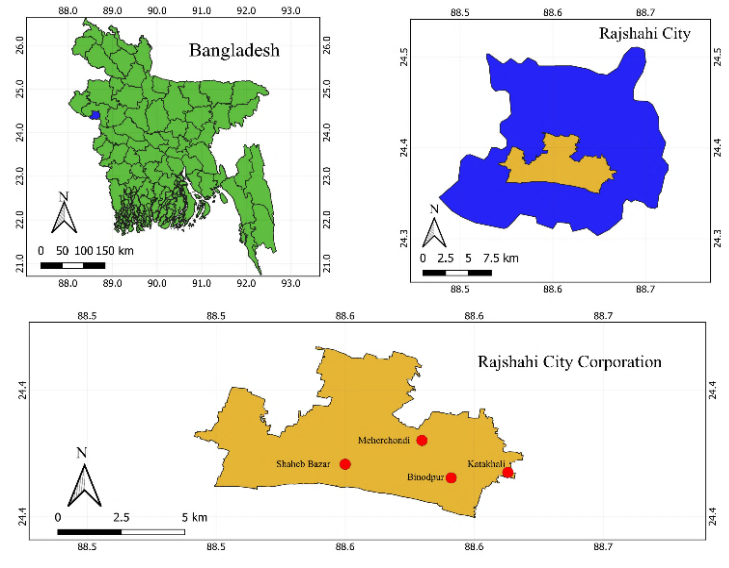
Bangladesh, a country in South Asia, is located above the Bay of Bengal in the northwest region of the Indian subcontinent between latitude 20°34' and longitude 26°38' N and 88°01' and 92°41' E. The research area is spread over four Rajshahi City Corporation (RCC) locations. RCC is positioned around 270 kilometres from the capital of Bangladesh, Dhaka. The research region is bordered by the busy highway connecting Rajshahi with Dhaka and other parts of the nation. The study area is around 4.5 kilometres long. Fish samples from this region were gathered for assessment. The Rajshahi and neighbouring districts are easily accessible by train and the national highway from the study area. Also, well-developed the study area are the communication systems. Therefore, it is not difficult to access this area. The sample identification numbers are given in Table 1. The research area's map, which shows the sample location, is displayed in Fig. 1.
Sample collection and preparation
Three fish species of Mozambique tilapia (Oreochromis mossambicus), Labeo bata, and Olive barb (Puntius sarana) which are highly consumed in the locality were collected from four different places of RCC namely: Binodpur, Meherchondi, Katakhali and Saheb Bazar. 36 individuals of 3 (Three) fish species were gathered and bagged in polythene and transferred to the Environmental and Pollution Studies Laboratory (EPSL), Department of Applied Chemistry and Chemical Engineering, University of Rajshahi, Rajshahi, Bangladesh.
Samples were rinsed with clean water to eliminate any fouling materials or other dirt as soon as they arrived at the lab. The muscle tissue from each sample was then extracted and fragmented using a steam-cleaned knife. The surplus water was then removed from the muscular tissues by air drying them after being cleansed with deionized water. Then 200g of test pieces were homogenised in a food processor and kept at -20 °C. Metal content was given as milligrams per kilogramme of fresh fish's wet weight.
| Geographical location | Fish | Sample identification no. |
|---|---|---|
| Binodpur (24° 22' 4.26'' N, 88° 38' 37.446'' E) | Mozambique tilapia | Bn-M |
| Labeo bata | Bn-B | |
| Puntius sarana | Bn-S | |
| Meherchondi (24° 22' 45.8616'' N, 88° 38' 4.8912'' E) | Mozambique tilapia | Me-M |
| Labeo bata | Me-B | |
| Puntius sarana | Me-S | |
| Katakhali (24° 21' 56.88'' N, 88° 39' 53.352'' E) | Mozambique tilapia | Ka-M |
| Labeo bata | Ka-B | |
| Puntius sarana | Ka-S | |
| Shaheb Bazar (24° 21' 54.5184'' N, 88° 35' 51.3672'' E) | Mozambique tilapia | Sh-M |
| Labeo bata | Sh-B | |
| Puntius sarana | Sh-S |
Sample digestion
For each digestion, 0.4 grams of oven dried powder sample was taken into the platinum crucible. Then, 6 ml 70% HNO3, 2 ml 70% HClO4, and 10 ml 48% HF were introduced. The crucible was then covered with material that reached approximately 9/10 of the top of the lid, and it was heated on a plate at around 200C until the liquid was completely evaporated. After cooling, 10 ml of 6N HCl was added, and then double-distilled water was added to fill the crucible halfway. Once again placed on the hot plate, the crucible was gently cooked for 10 minutes. After complete dissolution, by using a filter paper the solutions were purified. Then it was diluted by adding deionized water and filled up to 100 ml. After that, they were prepared for atomic absorption spectroscopy (AAS) analysis.
Health risk assessment
Estimated daily intake (EDI)
Basically, the assessment of potential threats to human health is being implemented owing to the ingestion of metals detected in food [33]. The daily intake of metals was estimated based on the concentration (mg/kg) of each fish species [34]. The EDI of the intended heavy metals were calculated by following equation (Eq.) 1:
Here, Di is the rate of fish consumption (g/person/day), Mc is the heavy metal content in freshwater fish species (mg/kg) and BW is the body weight of an adult person in kilograms [35]. On average children consume 52.5 g of fish per day, whereas adults consume 55.5 g per day [36]. According to USEPA (2019), the default body weight (BW) of an adult male and female is 70 kg and 64 kg respectively [37].
Non-carcinogenic risk
Non-carcinogenic risks based on the U.S. Environmental Protection Agency (USEPA) was Calculated using the target hazard quotient (THQ) [38]. THQ could be calculated by using the following Eq. 2 [35],
Another simplified formula for estimating the THQ value [39],
Where, EDI is the estimated daily intake that has been calculated earlier. RfD indicates the oral reference dose, for Cd, Pb, Cr and Mn the values are 0.001, 0.0035, 0.003 and 0.14 mg/kg-day [34].
Where, EFR is the frequency of exposure (365 days/year); Ed is the average lifetime exposure of 70 years; FIR stands for the rate of food consumption (g/day); Concentration of heavy metals present in each group of fish species is denoted by C (μg/g); BW stands for average body weight for an adult (60 kg); ATn refers to the average exposure duration for non-carcinogens (365 days/year × number of exposure years) [40], [41].
If the THQ< 1, it indicates the exposure level is less than the RfD. Thus it demonstrates that lifetime adverse consequences from daily exposure at this level are unlikely to have an impact. Whereas if it rises ≥1, that could be an imminent threat to your health. Standard suppositions from the integrated USEPA risk study were used to calculate the dosage [35]. With increase of THQ value, the hazardous risk to the human body increases [42].
Carcinogenic risk (CR)
When someone is exposed to a possible carcinogen, their increased lifetime chance of developing cancer is known as their carcinogenic risk [43]. According to the following equation, the cancer slope factor was used to calculate the CR over a lifetime of heavy metal exposure [44].
Where, CSF stands for cancer slope factor (mg/kg/day), and the other variables have already been established. A lifetime CR of 10−5 was deemed acceptable by the US Environmental Protection Agency [45].
CR can also be determined by multiplying the carcinogenic potency slope value (CSF) of the heavy metal by its EDI [35].
The permissible limit for lifetime exposure to carcinogens was defined at between 10−4 and 10−6 (the risk of acquiring cancer during a lifetime is 1 in 10,000 to 1 in 1,000,000) [46]. When CR levels are greater than 10−5, the likelihood that someone will get cancer is greater than 1 in 100,000 [36], [47].
Hazard index (HI)
The HI was utilized to measure the possible danger associated with combined or interacting effects brought on by the presence of all heavy metals in the fish under study [48]. HI is calculated by adding together each computed THQ value for each of the individual components.
Where, THQi is the target hazard quotient of a single element; n—the number of examined elements (in the present study n = 4) [49].
When the value of HI>1, there might be a concern for potential health effects [43].
Statistical analysis
The SPSS statistical program, version 18, was used to conduct the statistical analysis. Standard deviation (SD) was used to express all values. A level of p < 0.05 was used to indicate significant differences among the samples.
Results and Discussion
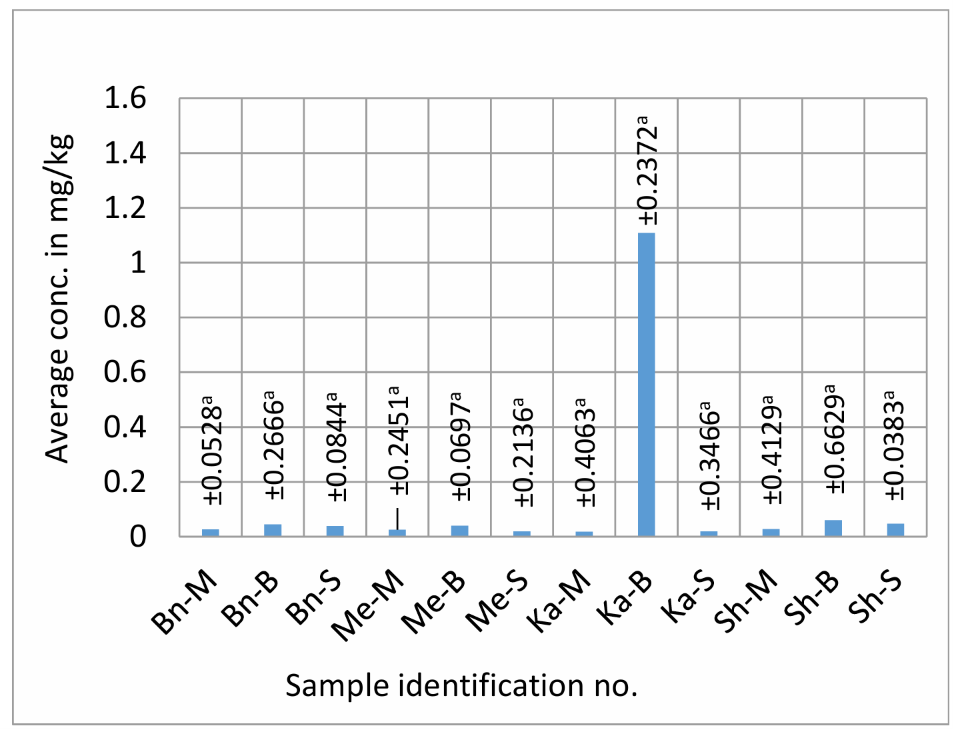
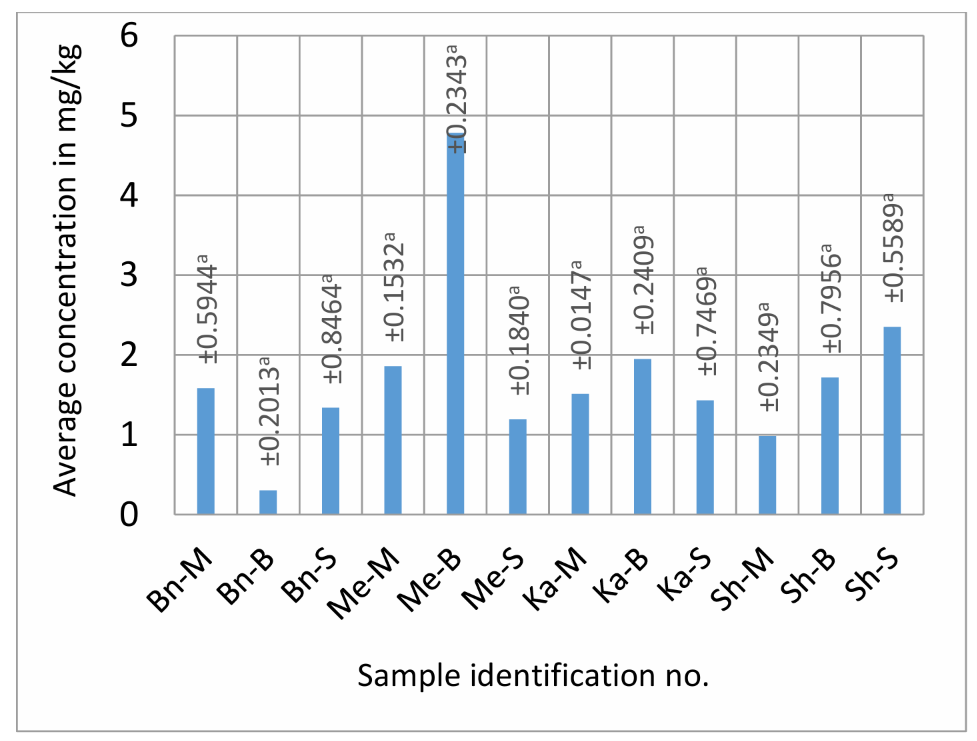
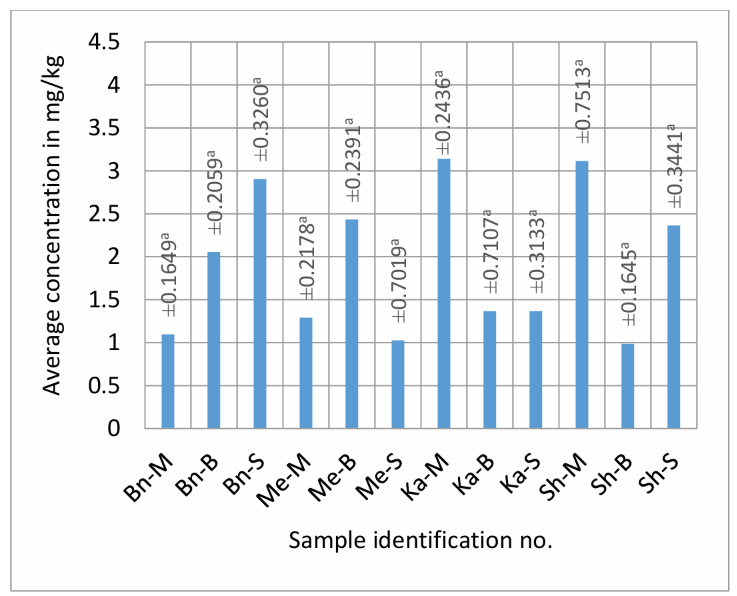
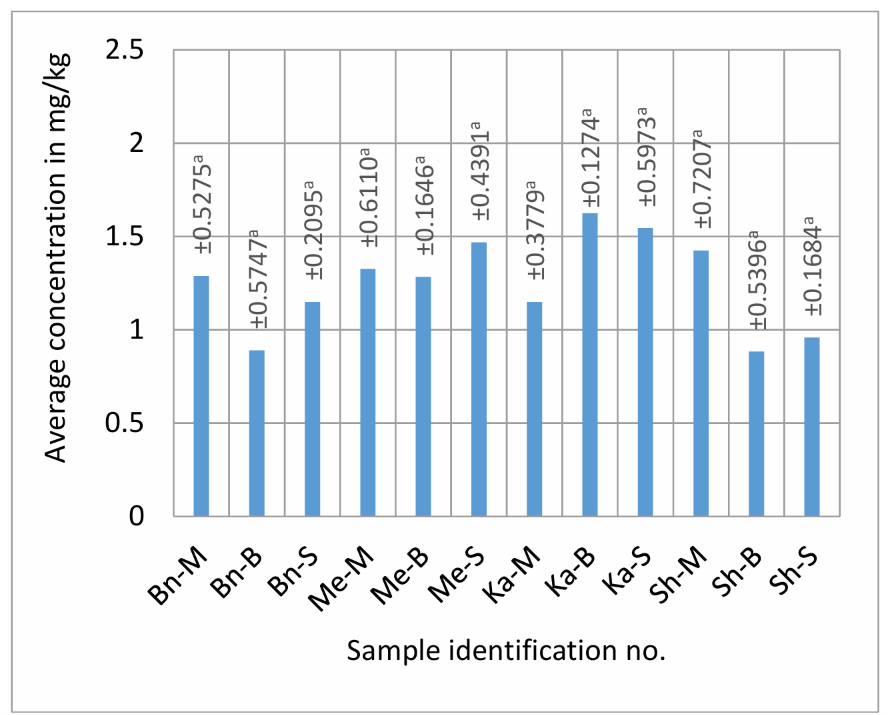
Though fish is one of the major sources of protein and is commonly consumed food by the people of Bangladesh, it is quite an appropriate source to analyze health risk assessment of heavy metals. The concentrations of Cd, Pb, Cr and Mn in the fish samples have been measured shown in Table 2 and graphically presented in Fig. 2, Fig. 3, Fig. 4 & Fig. 5. Every evaluated data set has been compared with the allowable limit (Table 3).
| Sample identification No. | Cd (mg/kg) | Pb (mg/kg) | Cr (mg/kg) | Mn (mg/kg) |
|---|---|---|---|---|
| Bn-M | 0.0261a | 1.5822a | 1.0959a | 1.2883a |
| Bn-B | 0.0447a | 0.3032a | 2.0539a | 0.8897a |
| Bn-S | 0.0389a | 1.3367a | 2.9052a | 1.1487a |
| Me-M | 0.0255a | 1.8582a | 1.2888a | 1.3263a |
| Me-B | 0.0396a | 4.7812a | 2.4321a | 1.2138a |
| Me-S | 0.0191a | 1.1925a | 1.0255a | 1.4680a |
| Ka-M | 0.0181a | 1.5105a | 3.1414a | 1.1490a |
| Ka-B | 1.1083a | 1.9471a | 1.3653a | 1.6245a |
| Ka-S | 0.0197a | 1.4310a | 1.3653a | 1.5444a |
| Sh-M | 0.0279a | 0.9823a | 3.1125a | 1.4243a |
| Sh-B | 0.0598a | 1.7165a | 0.9864a> | 0.8836a> |
| Sh-S | 0.0478a> | 2.3513a> | 2.3633a> | 0.9586a> |
Superscript ‘a’ letter in each column means a significant difference at p<0.05. The SPSS analysis is carried out in IBM SPSS software.
| Organization Name | Name of the metal | Maximum Permissible Limit (mg/kg WW) | Reference |
|---|---|---|---|
| World Health Organization (WHO) | Cd | 0.05 | [50] |
| Pb | 0.3 | ||
| European Union (EU) | Cd | 0.5 | [51] |
| Pb | 0.3 | ||
| Cr | 0.5 | ||
| Mn | 1.0 | ||
| Food and Drug Administration (FDA) | Cd | 0.1 | [52] |
| Pb | 0.15 | ||
| Food and Agriculture Organization (FAO) | Cd | 0.25 | [53] |
| Pb | 0.3 | ||
| Cr | 0.1–1.0 | ||
| Mn | 2.0 |
The World Health Organization (WHO) has established guidelines for the maximum levels of cadmium, lead, chromium, and manganese in fish. According to the WHO, the maximum level of cadmium in fish muscle tissue should not exceed 0.05 mg/kg WW, while the maximum level of lead is 0.3 mg/kg WW. The WHO has not established specific limits for chromium and manganese in fish. [50]. In the European Union (EU), the maximum levels of cadmium, lead, chromium, and manganese in certain fish species are set by Regulation (EC) No 1881/2006. For example, the maximum level of cadmium in certain fish species is 0.5 mg/kg wet weight (WW), while the maximum level of lead is 0.3 mg/kg WW. The maximum levels for chromium and manganese vary depending on the fish species. The maximum level of chromium for all fish species is 0.5 mg/kg WW and 1.0 mg/kg WW for manganese [51], and in the United States, the Food and Drug Administration (FDA) has established maximum levels for cadmium, lead, and mercury in fish. For example, the maximum level of cadmium in fish is 0.1 mg/kg WW for most species, while the maximum level of lead is 0.15 mg/kg WW. The FDA also has not established specific limits for chromium and manganese in fish. [52]. In addition, according to FAO (Food and Agriculture Organization), in Bangladesh, the maximum permissible level of Cd was 0.25 mg/kg, and that for Pb, Cr, Mn was 0.3, 0.1–1.0, 2.0 mg/kg wet weight (WW) respectively [54].
Cd contents in the fish samples ranged from 0.0181 to 1.1083 mg/kg (Table 2). Here the maximum amount (1.1083 mg/kg) of Cd is found in Labeo bata fish (sample no Ka-B) at the Katakhali region, while the minimum amount (0.0181 mg/kg) of this metal is in Mozambique tilapia fish (sample no Ka-M) at the same location. Present results indicate that the Cd concentration in 91.67% of fish samples lies within the safe level (0.25 mg/kg) [53].
Heba et al. (2023) estimated Cd content in muscles of five freshwater fish species from Manzalah Lake (Egypt) and they recorded 1.4 μ/g (wet weight) Cd in C. gariepinus, 1.36μ/g in S. galilaeus, 1.34μ/g in T. zillii, 1.32μ/g in O. niloticus and 1.19μ/g in O. aureus [49]. According to Mielcarek et al. (2020), the levels of Cd in freshwater fish species from Poland, specifically smoked fish products, ranged from 0.02 to 97.0 μg/kg [54]. According to Jarosz-Krzeminska et al. (2021), the muscle of Mozambique tilapia zillii that lives in the Elemi River in Ado-Ekiti has an estimated 60.0 µg/kg of Cd in smoked rainbow trout from a Polish fish farm [55].
The concentrations of Pb in the fish samples varied from 0.3032 to 4.7812 mg/kg (Table 2). The highest content is found in Mozambique tilapia (sample no Me-B) at the Katakhali area, while for lowest content is found at the Binodpur area in Labeo bata fish (sample no Bn-B). But from the following investigation, it has been indicated that Pb concentration in 100% fish samples exceeded the maximum permissible limit for Pb (0.3mg/kg)[53].
Mahjoub et al. (2021) determined heavy metal content in fish muscles from the Mechraâ-Hammadi Dam in Morocco and found Pb content ranged from 0.034–0.074 mg/kg of wet weight in E. Lucius, 0.045–0.087 mg/kg in S. lucioperca, 0.017–0.043 mg/kg in M. salmoides, 0.051–0.115 mg/kg in L. macrochirus and 0.049–0.106 mg/kg in S. erythrophthalmus [56]. Ahmad Razali Ishak et al. (2020) estimated Pb in Mozambique tilapia fish (Oreochromis niloticus) from selected areas in Kuala Lumpur. The highest concentrations of Pb were detected in the gills (0.151 ± 0.12 mg/g) followed by bones (0.108 ± 0.09 mg/g) and the least in muscle tissues (0.078 ± 0.05 mg/g) [57]. Djedjibegovic et al. (2020) estimated Pb content in Blue musse (0.161 ± 0.072 mg/kg wet weight), Black tiger shrimp (90.014 ± 0.008 mg/kg), Atlantic mackerel (0.007 ± 0.005 mg/kg) [58].
Cr concentration in these fish samples is found from 1.0255 to 3.1414 mg/kg (Table 2), where the maximum concentration is sample no Ka-M in Mozambique tilapia at the Katakhali region and the minimal one is sample no Me-S in Puntius sarana at Meherchondi. From the above investigation, 100% of the sample exceeds the permissible limit (1 mg/kg) [53]. Accumulating at a huge amount of Cr may cause carcinogenic effects to the consumers.
Pradip et al. (2019) found the Cr concentration among the most consumable seven fishes (Cirrhinusmrigala, Cirrhinusreba, Catla catla, Lebio rohita, Crossocheiluslatius, Clupisomagarua, and Mystustengara) tissues ranged from 0.28 ± 0.03 to 1.74 ± 0.31 mg/kg in river Ganga [59]. Aminul et al. 2018 quantified the amount of Cr in the six available fish species (Mastacembelus armatus, Channa punctatus, Puntius puntio, Mystusvittatus, Metapenaeus spinulatus and Amblyceps mangois) ranging from 0.006-0.159 mg/kg at Dhaleshwari River, Tangail, Bangladesh [60]. Nyantakyi et al. 2021 found 16.10 ± 0.2 mg/kg Cr concentration in Clarias gariepinus and 57.9 ± 4.2 mg/kg in Sarotherodongalilaeus [61].
Lastly, the content of manganese (Mn) varied from 0.8897 to 1.6245 mg/kg (Table 2), in this case, the maximum content is 1.6245 mg/kg (sample no Ka-B) in Labeo bata at Katakhali region and for minimum one it is 0.8897 mg/kg (sample no Bn-B) in Labeo bata fish at Binodpur. According to this study, 100% of the sample lie in between the permissible limit (2mg/kg) [53]. So, they may not be able to cause toxicity to our health.
Safiur et al. estimated the content of Mn in five commercially important marine fishes (i.e.Sillaginopsispanijus, Trichiuruslepturus, Harpadonnehereus, Rita rita and Coiliadussumieri) ranged from 14.54 to 18.45 mg/ kg (dry weight basis) [62]. Mohammad Belal et al. 2022 estimated heavy metals in 15 types of commonly consumed fish muscles and found 6.637 mg/kg of Mn from the Lower Meghna River and Adjacent Areas of Bangladesh by using the method called Energy Dispersive X-ray Fluorescence (EDXRF) [63]. A Hossain et al. 2016 found 17.842 mg/kg Mn in fish (O. niloticus) flesh and 50.317 mg/kg in fish (A. testudineus) liver in different fish markets of Dhaka city, Bangladesh [64].
For the health risk assessment, the EDI, THQ, CSF, and CR values are tabulated in Table 4. The average THQ and HI values are given in Table 5. The result found that only the Labeo bata fish from two specific regions (Ka-B and Me-B) have THQ values greater than 1, indicating an imminent health threat. The rest of the fishes have a safe range of THQ values that is less than 1, as per USEPA risk study [35].
For the CR value of Cd metal 91.67% of the sample lies between 10−4 to 10−6 except for the sample Ka-B, Which might have significant health impact. Whereas for the metal concentration of Pb 100% of the samples CR value is within the permissible limit of 10−4 to 10−6. But in case of Cr we have a complete opposite scenario where 100% of the samples CR value exceeds the permissible limit ranging from 9.49 × 10⁻⁴ to 1.45 × 10⁻³ which shows significant carcinogenic risk for the consumption of these contaminated fish. As there is no CSF value available for Mn so it is not possible to assess the CR value for this metal.
After investigating all the metals concentration in three fish species we have the value of HI greater than 1 for 100% of the fish species. Where HI for Labeo bata being the highest of 1.4024 and lowest 1.0448 for Puntius sarana. Consumption of these fish species impose a significant hazard threat in human health.
| Metal | Sample No. | EDI | THQ | CSF | CR |
|---|---|---|---|---|---|
| Cd | Bn-M | 2.41E-5 | 0.0241 | 1.3 | 3.13E-5 |
| Bn-B | 4.13E-5 | 0.0413 | 1.3 | 5.37E-5 | |
| Bn-S | 3.59E-5 | 0.0359 | 1.3 | 4.67E-5 | |
| Me-M | 2.35E-5 | 0.0235 | 1.3 | 3.06E-5 | |
| Me-B | 3.66E-5 | 0.0366 | 1.3 | 4.76E-5 | |
| Me-S | 1.76E-5 | 0.0176 | 1.3 | 2.29E-5 | |
| Ka-M | 1.67E-5 | 0.0167 | 1.3 | 2.17E-5 | |
| Ka-B | 1.02E-3 | 1.0251 | 1.3 | 1.33E-3 | |
| Ka-S | 1.82E-5 | 0.0182 | 1.3 | 2.36E-5 | |
| Sh-M | 2.58E-5 | 0.0258 | 1.3 | 3.35E-5 | |
| Sh-B | 5.53E-5 | 0.0553 | 1.3 | 7.19E-5 | |
| Sh-S | 4.42E-5 | 0.0442 | 1.3 | 5.74E-5 | |
| Pb | Bn-M | 1.46E-3 | 0.4181 | 0.0085 | 1.24E-5 |
| Bn-B | 2.80E-4 | 0.0801 | 0.0085 | 2.38E-6 | |
| Bn-S | 1.23E-3 | 0.3532 | 0.0085 | 1.05E-5 | |
| Me-M | 1.71E-3 | 0.4910 | 0.0085 | 1.46E-5 | |
| Me-B | 4.42E-3 | 1.2636 | 0.0085 | 3.75E-5 | |
| Me-S | 1.10E-3 | 0.3151 | 0.0085 | 9.37E-6 | |
| Ka-M | 1.39E-3 | 0.3992 | 0.0085 | 1.18E-5 | |
| Ka-B | 1.80E-3 | 0.5145 | 0.0085 | 1.53E-5 | |
| Ka-S | 1.32E-3 | 0.3781 | 0.0085 | 1.12E-5 | |
| Sh-M | 9.08E-4 | 0.2596 | 0.0085 | 7.72E-6 | |
| Sh-B | 1.58E-3 | 0.4536 | 0.0085 | 1.34E-5 | |
| Sh-S | 2.17E-3 | 0.6214 | 0.0085 | 1.84E-5 | |
| Cr | Bn-M | 1.01E-3 | 0.3379 | 0.5 | 5.06E-4 |
| Bn-B | 1.89E-3 | 0.6332 | 0.5 | 9.49E-4 | |
| Bn-S | 2.68E-3 | 0.8957 | 0.5 | 1.34E-3 | |
| Me-M | 1.19E-3 | 0.3973 | 0.5 | 5.96E-4 | |
| Me-B | 2.24E-3 | 0.7498 | 0.5 | 1.12E-3 | |
| Me-S | 9.48E-4 | 0.3160 | 0.5 | 4.74E-4 | |
| Ka-M | 2.90E-3 | 0.9685 | 0.5 | 1.45E-3 | |
| Ka-B | 1.26E-3 | 0.4209 | 0.5 | 6.31E-4 | |
| Ka-S | 1.26E-3 | 0.4209 | 0.5 | 6.31E-4 | |
| Sh-M | 2.87E-3 | 0.9596 | 0.5 | 1.43E-3 | |
| Sh-B | 9.12E-4 | 0.3041 | 0.5 | 4.56E-4 | |
| Sh-S | 2.18E-3 | 0.7286 | 0.5 | 1.09E-3 | |
| Mn | Bn-M | 1.19E-3 | 0.0085 | _ | _ |
| Bn-B | 8.22E-4 | 0.0058 | _ | _ | |
| Bn-S | 1.06E-3 | 0.0075 | _ | _ | |
| Me-M | 1.22E-3 | 0.0087 | _ | _ | |
| Me-B | 1.18E-3 | 0.0084 | _ | _ | |
| Me-S | 1.35E-3 | 0.0096 | _ | _ | |
| Ka-M | 1.06E-3 | 0.0075 | _ | _ | |
| Ka-B | 1.50E-3 | 0.0107 | _ | _ | |
| Ka-S | 1.42E-3 | 0.0102 | _ | _ | |
| Sh-M | 1.31E-3 | 0.0094 | _ | _ | |
| Sh-B | 8.17E-4 | 0.0058 | _ | _ | |
| Sh-S | 8.86E-4 | 0.0063 | _ | _ |
| Name of the fish | Average value of THQ | HI | |||
|---|---|---|---|---|---|
| Cd | Pb | Cr | Mn | ||
| Mozambique tilapia | 0.0225 | 0.3920 | 0.6658 | 0.0085 | 1.0890 |
| Labeo bata | 0.2896 | 0.5779 | 0.5270 | 0.0077 | 1.4024 |
| Puntius sarana | 0.0290 | 0.4170 | 0.5903 | 0.0084 | 1.0448 |
Conclusion
The study underscores the alarming levels of heavy metal contamination in fish from the Rajshahi City Corporation area, which poses a considerable health risk to the local population. The detected concentrations of Cd, Pb, Cr, and Mn in the fish samples frequently surpassed the limits recommended by global health organizations, highlighting a pressing need for regulatory action. The accumulation order of metals was Pb > Cd > Mn > Cr. The health risk assessments, including the EDI, THQ, CR, and HI, collectively suggest that prolonged consumption of these fish could lead to serious health issues, both carcinogenic and non-carcinogenic. This research calls for urgent intervention to control pollution sources and protect aquatic ecosystems, as well as public health. Enhanced monitoring and strict enforcement of environmental regulations are crucial to reducing the contamination levels in fish and ensuring the safety of food supplies. Additionally, raising awareness among consumers about the potential risks associated with heavy metal exposure from fish is essential. Moving forward, there is a need for integrated approaches combining pollution prevention, fishery management, and public health strategies to address and mitigate the impact of heavy metal contamination in aquatic environments.
Declarations
- Author contributions
The conception and design of the study were collaboratively developed by all authors. The initial draft of the manuscript was written by Sha Md. Shahan Shahriar. Material preparation, sample collection, data analysis, and refinement of the manuscript were collaboratively carried out by MD. Wahad Uz Zaman, Sarwar Hossain, and Sumaiya Dipti. The health risk assessment was meticulously conducted by Mst. Mahmuda Akhtar, Md. Abu Hanif, and Sayed M A Salam. Each author provided valuable feedback on earlier drafts and contributed to refining the final manuscript. All authors have reviewed and approved the final version of this document.
- Funding
The authors declare that no financial support, grants, or funding were provided for the preparation of this manuscript. The research was conducted independently, without backing from any organization or external funding sources.
- Data availability
Not applicable
- Competing interests
Not applicable
References
- 1.Manisalidis, I., Stavropoulou, E., Stavropoulos, A., and Bezirtzoglou, E. (2020). Environmental and health impacts of air pollution: a review. Frontiers in Public Health, 8. https://doi.org/10.3389/fpubh.2020.00014
- 2.Muralikrishna, I. V., & Manickam, V. (2017). Chapter One - Introduction, Editor(s): Muralikrishna, I.V., & Manickam, V. Environmental Management, Butterworth-Heinemann, p 1-4. https://doi.org/10.1016/b978-0-12-811989-1.00001-4
- 3.Shahriar, S. M. S., Munshi, M., Zakir, H. M., Islam, M. J., Mollah, M. M. A., and Salam, S. M. (2023). Assessment of heavy metal pollution in irrigation water of Rajshahi City, Bangladesh. Environmental and Earth Sciences Research Journal, 10(3): 100-110, 2023. https://doi.org/10.18280/eesrj.100303
- 4.Shahriar, S.M.S., Akther, S., Akter, F., Morshed, S., Alam, M. K., Saha, I., Halim M. A., and Hassan M. M. (2014). Concentration of copper and lead in market milk and milk products of Bangladesh. International Letters of Chemistry, Physics and Astronomy. 8: 56-63. https://doi.org/10.56431/p-25obfk
- 5.Mekonnen, M. M., and Hoekstra, A. Y. (2021). Agricultural water pollution: Causes, impacts and management options. Agriculture, Ecosystems & Environment, 307, 107214.
- 6.McAdam, E., and Brook, R. D. (2021). Municipal wastewater treatment and water reuse: Challenges and opportunities. Environmental Science and Pollution Research, 28(20), 24535-24541.
- 7.Brinkman, T. J., and Davis, R. S. (2021). Oil spill impacts on water quality and ecosystem health: A review. Environmental Science and Pollution Research, 28(13), 15807-15822.
- 8.McIntyre, N. R., and Mitchell, G. (2021). Urban stormwater quality: Current knowledge and future challenges. Environmental Science and Pollution Research, 28(11), 12709-12716.
- 9.FN, C., and MF, M. (2017). Factors affecting water pollution: A review. Journal of Ecosystem & Ecography, 07(01). https://doi.org/10.4172/2157-7625.1000225
- 10.Akther, S., Shahan Shahriar, S. M., Rahim Badsha, M., Alam, K. U., Sultana Jothi, J., and Sultana, A. (2022). Levels of three heavy metals in ground water and cereals in Chattogram Division, Bangladesh. Bangladesh Journal of Veterinary and Animal Sciences, 9(2): 44-52. https://doi.org/10.60015/bjvas/v09i2a7
- 11.Khedkar, R., & Singh, K. (2017). Food industry waste: a panacea or pollution hazard? SpringerBriefs in Environmental Science, 35–47. https://doi.org/10.1007/978-3-319-58415-7_3
- 12.Akther, S., Shahriar, S. M. S., Sultana, J., and Alam, M. K. (2016). Analysis of selected metallic impurities in soft drinks marketed in Chittagong. Bangladesh. Journal of Environmental Science and Natural Resource, 8(2), 19-22. https://doi.org/10.3329/jesnr.v8i2.26883
- 13.Li, Z. H., Li, Z. P., Tang, X., Hou, W. H., and Li, P. (2021). Distribution and risk assessment of toxic pollutants in surface water of the Lower Yellow River, China. Water, 13(11), 1582. https://doi.org/10.3390/w13111582
- 14.Shahriar, S. M. S., Zaman, M. W. U., Kulsum, U., Hossain, M. S., Dipti, S., Akhtar, M. M., and Salam, S. M. A. (2024). Assessment of contamination and pollution risks caused by heavy metals in fish pond sediments. Tra Vinh University Journal of Science, 14(2): 1-13, 2024. https://doi.org/10.35382/tvujs.14.2.2024.3768
- 15.Hajrić, D., Smajlović, M., Antunović, B., Smajlović, A., Alagić, D., Tahirović, D., . . . Poljak, V. (2022). Risk assessment of heavy metal exposure via consumption of fish and fish products from the retail market in Bosnia and Herzegovina. Food Control, 133, 108631. https://doi.org/10.1016/j.foodcont.2021.108631
- 16.Shahriar, S. M. S., Munshi, M., Hossain, M. S., Zakir, H. M., and Salam, S. M. A. (2023). Risk assessment of selected heavy metals contamination in rice grains in the Rajshahi City of Bangladesh. Journal of Engineering Science, 14(1), 29–41. https://doi.org/10.3329/jes.v14i1.67633
- 17.Shahjahan, M., Taslima, K., Rahman, M. S., Al-Emran, M., Alam, S. I., and Faggio, C. (2022). Effects of heavy metals on fish physiology – A review. Chemosphere, 300, 134519. https://doi.org/10.1016/j.chemosphere.2022.134519
- 18.Kebede, M. T., and Geleta, L. (2023). Consumer health risk assessment from some heavy metal bioaccumulation in common carp (Cyprinus carpio) from lake Koka, Ethiopia. Heliyon, 9(3), e14560. https://doi.org/10.1016/j.heliyon.2023.e14560
- 19.Ahmed, W., Haque, M. R., Siddique, M. A. B., Akbor, M. A., Hasan, M., and Rahman, M. M. (2023). Is Biofloc fish a safe alternative to conventionally cultivated fish regarding metal bioaccumulation in Bangladesh? Environmental Challenges, 11, 100704. https://doi.org/10.1016/j.envc.2023.100704
- 20.Dhar, P. K., Tonu, N. T., Dey, S. K., Chakrabarty, S., Uddin, M. N., and Haque, M. R. (2022). Health risk assessment and comparative studies on some fish species cultured in traditional and Biofloc fish farms. Biological Trace Element Research, 201(6), 3017–3030. https://doi.org/10.1007/s12011-022-03386-1
- 21.Kawser Ahmed, M., Baki, M. A., Kundu, G. K., Saiful Islam, M., Monirul Islam, M., and Muzammel Hossain, M. (2016). Human health risks from heavy metals in fish of Buriganga river, Bangladesh. SpringerPlus, 5(1). https://doi.org/10.1186/s40064-016-3357-0
- 22.Munyeshury, V., Chaúque, E. F. C., Gulamussen, N. J., Mandlate, J. S., Richards, H., and Adelodun, A. A. (2021). Potential health risks of trace metals in muscle tissue of tilapia and catfish from Mozambican markets. Archives of Agriculture and Environmental Science, 6(4), 508–518. https://doi.org/10.26832/24566632.2021.0604013
- 23.M. Marzouk, H. Shoukry, H. Ali, A., and N. Fayed, A. (2016). Detection of Harmful Residues in Some Fish Species. Egyptian Journal of Chemistry and Environmental Health, 2(2), 363-381.
- 24.Akther, S., Shahriar, S. M. S., Zakir, H. M., and Alam, M. K. (2016). A quantitative analysis of chromium and zinc in water and raw milk in Chittagong, Bangladesh. Journal of Scientific Research, 8(1), 93-100. https://doi.org/10.3329/jsr.v8i1.24776
- 25.Anisha, P., Athira, P. S., Anagha, B., Emmanuel Charles, P., Prabakaran, K., and Rajaram, R. (2023). First report on occurrence of heavy metals in dried fishes from major fishing villages in Kerala coast, Southwest India. Hygiene and Environmental Health Advances, 6, 100051. https://doi.org/10.1016/j.heha.2023.100051
- 26.Shahriar, S. M. S., Islam, M. J., Hanif, M. A., and Salam, S. M. A. (2022). Level of chromium and zinc in groundwater and cows' raw milk in Rajshahi, Bangladesh. International Journal of All Research Education and Scientific Methods, 10(2), 2153-2158.
- 27.Ali, H., Khan, E., and Ilahi, I. (2019). Environmental chemistry and ecotoxicology of hazardous heavy metals: Environmental persistence, toxicity, and bioaccumulation. Journal of Chemistry, 2019, 1–14. https://doi.org/10.1155/2019/6730305
- 28.Haque, M. R., Ali, M. M., Ahmed, W., and Rahman, M. M. (2022). Assessment of metal(loid)s pollution in water and sediment from an urban river in Bangladesh: An ecological and health risk appraisals. Case Studies in Chemical and Environmental Engineering, 6, 100272. https://doi.org/10.1016/j.cscee.2022.100272
- 29.Singh, V., Singh, N., Rai, S. N., Kumar, A., Singh, A. K., Singh, M. P., . . . Mishra, V. (2023). Heavy metal contamination in the aquatic ecosystem: Toxicity and its remediation using eco-friendly approaches. Toxics, 11(2), 147. https://doi.org/10.3390/toxics11020147
- 30.Briffa, J., Sinagra, E., and Blundell, R. (2020). Heavy metal pollution in the environment and their toxicological effects on humans. Heliyon, 6(9), e04691. https://doi.org/10.1016/j.heliyon.2020.e04691
- 31.Fu, Z., and Xi, S. (2019). The effects of heavy metals on human metabolism. Toxicology Mechanisms and Methods, 30(3), 167–176. https://doi.org/10.1080/15376516.2019.1701594
- 32.Mollah, M. M. A., Rabbany M. G., Nurunnabi, M., Shahriar, S. M. S., and Salam, S. M. A. (2022). Health risk assessment of heavy metals through six common spices of Mohanpur upazila of Rajshahi District, Bangladesh. Global Journal of Nutrition & Food Science, 3(5), 1-8.
- 33.Sarker, M. J., Polash, A. U., Islam, M. A., Rima, N. N., and Farhana, T. (2020). Heavy metals concentration in native edible fish at upper Meghna River and its associated tributaries in Bangladesh: a prospective human health concern. SN Applied Sciences, 2(10). https://doi.org/10.1007/s42452-020-03445-z
- 34.Ahmed, W., Haque, M. R., Siddique, M. A. B., Akbor, M. A., Hasan, M., and Rahman, M. M. (2023). Is Biofloc fish a safe alternative to conventionally cultivated fish regarding metal bioaccumulation in Bangladesh? Environmental Challenges, 11, 100704. https://doi.org/10.1016/j.envc.2023.100704
- 35.Shahriar, S. M. S., Hasan, M. M., Akhtar, M. M., Dipti, S., Hossain, M. S., and Salam, S. M. A. (2024). Analysis and health risk assessment of heavy metals in bakery products sold in the local market of Rajshahi City, Bangladesh. Journal of Science and Engineering Papers, 01(01), 01–09. https://doi.org/10.62275/josep.24.1000002
- 36.Traina, A., Bono, G., Bonsignore, M., Falco, F., Giuga, M., Quinci, E. M., . . . Sprovieri, M. (2019). Heavy metals concentrations in some commercially key species from Sicilian coasts (Mediterranean Sea): Potential human health risk estimation. Ecotoxicology and Environmental Safety, 168, 466–478. https://doi.org/10.1016/j.ecoenv.2018.10.056
- 37.U.S. Environmental Protection Agency. (2019). Exposure Factors Handbook: 2019 Edition (Final Report). EPA/600/R-19/081. National Center for Environmental Assessment, Washington Office (NCEA-W), Office of Research and Development, U.S. Environmental Protection Agency, Washington, DC.
- 38.Exposure Assessment Tools by Routes - Ingestion | US EPA. (2024, January 2). Retrieved from https://www.epa.gov/expobox/exposure-assessment-tools-routes-ingestion
- 39.Shahriar, S. M. S., Hossain, M. S., Dipti, S., and Salam, S. M. A. (2024). Heavy metal contamination in soil and vegetables: A review with health risk assessments. Journal of Science and Engineering Papers, 01(01), 40–48. https://doi.org/10.62275/josep.24.1000007
- 40.Rajan, S., and Ishak, N. S. (2017). Estimation of target hazard quotients and potential health risks for metals by consumption of shrimp (Litopenaeus vannamei) in Selangor, Malaysia. Sains Malaysiana, 46(10), 1825–1830. https://doi.org/10.17576/jsm-2017-4610-20
- 41.Regional Screening Levels (RSLs) | US EPA. (2023, November 7). Retrieved from https://www.epa.gov/risk/regional-screening-levels-rsls
- 42.Debipersadh, S., Sibanda, T., Selvarajan, R., & Naidoo, R. (2018). Investigating toxic metal levels in popular edible fishes from the South Durban basin: implications for public health and food security. Environmental Monitoring and Assessment, 190(8). https://doi.org/10.1007/s10661-018-6862-5
- 43.Kawser Ahmed, M., Baki, M. A., Kundu, G. K., Saiful Islam, M., Monirul Islam, M., and Muzammel Hossain, M. (2016). Human health risks from heavy metals in fish of Buriganga river, Bangladesh. SpringerPlus, 5(1). https://doi.org/10.1186/s40064-016-3357-0
- 44.Peng, Q., Nunes, L. M., Greenfield, B. K., Dang, F., and Zhong, H. (2016). Are Chinese consumers at risk due to exposure to metals in crayfish? A bioaccessibility-adjusted probabilistic risk assessment. Environment International, 88, 261–268. https://doi.org/10.1016/j.envint.2015.12.035
- 45.Saha, N., Mollah, M., Alam, M., and Safiur Rahman, M. (2016). Seasonal investigation of heavy metals in marine fishes captured from the Bay of Bengal and the implications for human health risk assessment. Food Control, 70, 110–118. https://doi.org/10.1016/j.foodcont.2016.05.040
- 46.Adegbola, I. P., Aborisade, B. A., and Adetutu, A. (2021). Health risk assessment and heavy metal accumulation in fish species (Clarias gariepinus and Sarotherodon melanotheron) from industrially polluted Ogun and Eleyele Rivers, Nigeria. Toxicology Reports, 8, 1445–1460. https://doi.org/10.1016/j.toxrep.2021.07.007
- 47.Vieira, C., Morais, S., Ramos, S., Delerue-Matos, C., and Oliveira, M. (2011). Mercury, cadmium, lead and arsenic levels in three pelagic fish species from the Atlantic Ocean: Intra- and inter-specific variability and human health risks for consumption. Food and Chemical Toxicology, 49(4), 923–932. https://doi.org/10.1016/j.fct.2010.12.016
- 48.Naji, A., Khan, F. R., and Hashemi, S. H. (2016). Potential human health risk assessment of trace metals via the consumption of marine fish in Persian Gulf. Marine Pollution Bulletin, 109(1), 667–671. https://doi.org/10.1016/j.marpolbul.2016.05.002
- 49.Abdel-Kader, H. H., and Mourad, M. H. (2022). Estimation of Cadmium in Muscles of Five Freshwater Fish Species from Manzalah Lake, and Possible Human Risk Assessment of Fish Consumption (Egypt). Biological Trace Element Research, 201(2), 937–945. https://doi.org/10.1007/s12011-022-03188-5
- 50.Guidelines for drinking-water quality, 4th edition. (2011, June 27). Retrieved from https://www.who.int/publications/i/item/9789241548151
- 51.COMMISSION REGULATION (EC) No 1881/2006. (2006, December 19). Retrieved from https://eur-lex.europa.eu/legal-content/EN/TXT/PDF/?uri=CELEX:32006R1881
- 52.Nutrition, C. F. F. S. A. A. (2024, March 5). Fish and fishery products hazards and controls. Retrieved from https://www.fda.gov/food/seafood-guidance-documents-regulatory-information/fish-and-fishery-products-hazards-and-controls
- 53.MOFL (2014) Bangladesh Gazette, Bangladesh Ministry of Fisheries and Livestock, SRO no. 233/Ayen
- 54.Mielcarek, K., Puścion-Jakubik, A., Gromkowska-Kępka, K. J., Soroczyńska, J., Naliwajko, S. K., Markiewicz-Żukowska, R., . . . Socha, K. (2020). Proximal composition and nutritive value of raw, smoked and pickled freshwater fish. Foods, 9(12), 1879. https://doi.org/10.3390/foods9121879
- 55.Jarosz‐Krzemińska, E., Mikołajczyk, N., and Adamiec, E. (2020). Content of toxic metals and As in marine and freshwater fish species available for sale in EU supermarkets and health risk associated with its consumption. Journal of the Science of Food and Agriculture, 101(7), 2818–2827. https://doi.org/10.1002/jsfa.10911
- 56.Mahjoub, M., Fadlaoui, S., El Maadoudi, M., and Smiri, Y. (2021). Mercury, lead, and cadmium in the muscles of five fish species from the Mechraâ-Hammadi dam in Morocco and health risks for their consumers. Journal of Toxicology, 2021, 1–10. https://doi.org/10.1155/2021/8865869
- 57.Ishak, A. R., Zuhdi, M. S. M., and Aziz, M. Y. (2020). Determination of lead and cadmium in tilapia fish (Oreochromis niloticus) from selected areas in Kuala Lumpur. Egyptian Journal of Aquatic Research, 46(3), 221–225. https://doi.org/10.1016/j.ejar.2020.06.001
- 58.Djedjibegovic, J., Marjanovic, A., Tahirovic, D., Caklovica, K., Turalic, A., Lugusic, A., . . . Caklovica, F. (2020). Heavy metals in commercial fish and seafood products and risk assessment in adult population in Bosnia and Herzegovina. Scientific Reports, 10(1). https://doi.org/10.1038/s41598-020-70205-9
- 59.Maurya, P. K., Malik, D., Yadav, K. K., Kumar, A., Kumar, S., and Kamyab, H. (2019). Bioaccumulation and potential sources of heavy metal contamination in fish species in River Ganga basin: Possible human health risks evaluation. Toxicology Reports, 6, 472–481. https://doi.org/10.1016/j.toxrep.2019.05.012
- 60.Ahsan, M.A., Siddique, M.A., Munni, M.A., Akbor, M.A., Bithi, U.H., and Mia, M.Y. (2018). Analysis of major heavy metals in the available fish species of the Dhaleshwari River, Tangail, Bangladesh. International Journal of Fisheries and Aquatic Studies, 6, 349-354.
- 61.Nyantakyi, A. J., Wiafe, S., Akoto, O., and Fei-Baffoe, B. (2021). Heavy metal concentrations in fish from river Tano in Ghana and the health risks posed to consumers. Journal of Environmental and Public Health, 2021, 1–11. https://doi.org/10.1155/2021/5834720
- 62.Safiur Rahman, M., Solaiman Hossain, M., Ahmed, M. K., Akther, S., Jolly, Y. N., Akhter, S., . . . Choudhury, T. R. (2019). Assessment of heavy metals contamination in selected tropical marine fish species in Bangladesh and their impact on human health. Environmental Nanotechnology, Monitoring & Management, 11, 100210. https://doi.org/10.1016/j.enmm.2019.100210
- 63.Hossain, M. B., Tanjin, F., Rahman, M. S., Yu, J., Akhter, S., Noman, M. A., and Sun, J. (2022). Metals bioaccumulation in 15 commonly consumed fishes from the lower Meghna River and adjacent areas of Bangladesh and associated human health hazards. Toxics, 10(3), 139. https://doi.org/10.3390/toxics10030139
- 64.Hossain, A., Rahman, M., Saha, B., Moniruzzaman, M., & Begum, M.K. (2016). Heavy metal concentration and its toxicity assessment in some market fishes of Dhaka city. International Journal of Fisheries and Aquatic Studies, 4, 523-527.
Cite this article
Journal
Shahriar SMS, Zaman MWU, Hossain MS, Dipti S, Akhtar MM, Hanif MA, Salam SMA. Evaluation of Heavy Metal Levels in Fish and Their Potential Health Risks to Humans. JoSEP. 2026;1(2):49-58. doi: 10.62275/josep.24.1000008.
Cited by (4)
- Assessment of heavy metal contamination and associated risks in fish feed and pond-cultured fish
Tafsir Hasan, Md Tasif Amir Sufal, Sha Md. Shahan Shahriar · Food Control · 2025
- Heavy metal contamination in fruits and human health risk assessment in northwestern Bangladesh
Md. Niratul Islam, Sha Md. Shahan Shahriar, Md. Rasel Amin · Journal of Food Composition and Analysis · 2025
- Heavy metal contamination in Pangas Catfish of farm ponds aquaculture in different locations in Bangladesh: A risk assessment study
Md. Mazedul Haque Sachchu, Mehedi Hasan, Md. Kamrul Hossain · Food Chemistry Advances · 2025
- Assessment of Heavy Metal Content in Chicken Eggs and Evaluating Associated Health Risks
Sha Md. Shahan Shahriar, M. F. Rabby, M. M. Akhtar · Journal of Scientific Research · 2025
About this article
- Received
- 23 May 2024
- Revised
- 14 June 2024
- Accepted
- 17 June 2024
- Published
- 19 October 2026
- Journal
- Journal of Science and Engineering Papers
- Volume / Issue
- 1 / 2
- Pages
- 49-58
- DOI
- 10.62275/josep.24.1000008