 Open Access



 Open access
 Check for updates


Abstract
Silk production in Bangladesh's rural economy, which is the practice of raising silkworms, has long been an essential part of the country’s rural economy and this has contributed a lot to the national economy as well as improved people’s lives. Traditional sericulture however faces problems such as pest infestations, inconsistent yields of mulberry leaves, wasteful use of resources and effects of climatic change despite the country having favorable climate that supports silk farming and availability of a skilled labor force. These challenges can be addressed through recent technological innovations including artificial intelligence technology and drone surveillance for instance. Drones fitted with cameras combined with GPS have ability to control fully grown mulberry farms whereas artificial intelligence system analyze data on optimal resource management in terms of pests’ control among others. The objective is to establish how drones and AI can affect Bangladeshi sericulture farming field primarily in Jessore and Rajshahi – two most important sericulture areas in the country. For two crop cycles namely July-October 2022 and March-June 2023, research used drones along with TensorFlow for AI integration where it recorded aspects such as leaf yield, pest loads, input application rates among others. Technologies integrations had resulted to increased mulberry leaf yield by approximately 18% from 2500Kg/ha to 2950Kg/ha.
Introduction
For generations, the mainstay of Bangladesh's rural economy has been sericulture, the technique of raising silkworms for the manufacturing of silk. This activity makes a substantial contribution to the national economy in addition to providing for the livelihoods of thousands of families. Bangladesh has a lot of potential to produce silk because of its ideal climate and highly skilled labor force. Nevertheless, a number of obstacles prevent traditional sericulture from reaching its full potential. Significant concerns to the productivity and sustainability of sericulture in Bangladesh include pest infestations, irregular yields of mulberry leaves, inadequate resource utilization, and the effects of climate change.
To address these issues, the agriculture industry has witnessed a technological revolution in recent years. Artificial intelligence (AI) and drone surveillance are two examples of technologies that present intriguing solutions. Drones using Global Positioning System (GPS) and high-resolution cameras can precisely monitor mulberry farms from the air, allowing for quick and accurate crop health and pest infestation monitoring. In the meantime, AI systems can examine the data gathered from these drones to provide insights into the best farming techniques, including accurate pest control, effective use of water and fertilizer, and prompt crop health issue solutions.
Modern agriculture is relying more and more on big data and machine learning. Researchers claim that the use of big data in smart farming facilitates the gathering and examination of enormous datasets, which has the potential to greatly enhance agricultural productivity and decision-making processes. In a similar vein [1], in another article researchers highlight how machine learning methods can evaluate enormous volumes of agricultural data to produce useful insights that will improve precision agriculture methods and farm management in general [2].
AI and drone technology combined could greatly improve sustainability and production in sericulture. Drones are an essential tool for rapid decision-making since they can quickly cover enormous areas and give real-time data. Through the use of AI algorithms, this data can be processed to identify early indicators of insect infestations and other problems, enabling focused actions. This precision farming method can limit environmental effects, cut production costs, and use fewer pesticides and fertilizers.
Numerous research studies emphasize the possible advantages of these technologies. They presented a thorough analysis of Unmanned Aerial Vehicle (UAV) based precision agricultural applications, emphasizing their advantages for crop monitoring and management through high-resolution imaging and real-time data collection. They talked about several approaches and technologies for gathering data and analyzing images, highlighting how drones could improve agricultural decision-making [3]. Comparably, research in 2020 discussed about the state and future of sericulture in Bangladesh, highlighting the necessity of utilizing cutting-edge technology solutions to deal with present issues [4].
These results are also supported by the global context. Researchers examined the application of drone-based pest detection and management in agriculture and found notable gains in accuracy and efficiency over conventional techniques [5]. They emphasized that using drones to cut pesticide use might save expenses and have a less negative impact on the environment by up to 30%. Additionally, researchers in 2021 investigated the use of AI in agriculture, talking about how it may completely transform farming methods by offering data-driven insights for improved crop health monitoring and resource management [6].
The purpose of this study is to investigate how drone technology and artificial intelligence can be integrated into Bangladeshi sericulture. This study investigates the effects of these technologies on mulberry leaf yield, pest management, resource usage, and overall profitability by concentrating on the vital sericulture regions of Rajshahi and Jessore districts. It is intended to show how these innovations can solve the problems with conventional sericulture methods and open the door to a more lucrative, sustainable, and productive future for Bangladeshi sericulture.
Materials and methods
Study Area
The research was conducted in the Rajshahi and Jessore districts, which are key sericulture regions in Bangladesh. According to the Bangladesh Sericulture Development Board's (BSDB) 2022 Annual Report, these areas encompass approximately 900 hectares of mulberry cultivation, primarily managed by smallholder farmers [7]. The climate in these regions is suitable for mulberry cultivation, with distinct wet and dry seasons that influence agricultural practices.
Drone Technology Implementation
The DJI Agras MG-1P is an advanced agricultural drone designed to enhance efficiency and productivity in farming operations. This type of Drone were used for pesticide application and airborne surveillance. Because these drones have GPS and high-resolution cameras, they can precisely monitor and manage mulberry plantations. The drones were designed to fly along predetermined routes over the fields, gathering information on insect infestations and crop health as well as precise picture and data capture.
AI Integration
TensorFlow is an open-source machine learning framework developed by the Google Brain team. It is widely used for building and deploying machine learning models across a variety of platforms, including desktops, mobile devices, and the cloud. Tensor Flow was used to create custom AI algorithms that analyzed drone surveillance data. The AI system was trained to recognize important mulberry health indicators, including soil moisture content, pest presence, and leaf chlorophyll levels. Convolutional neural networks (CNNs) were employed by the system for image recognition and analysis, which made it possible to accurately spot abnormalities and possible problems in the fields.
Data Collection and Analysis
Data were collected over two cropping seasons (July-October 2022 and March-June 2023). Parameters such as leaf yield, pest incidence, and resource usage (water and fertilizers) were meticulously recorded. The data were analyzed using Statistical Package for Social Sciences (SPSS) software to compare the outcomes of traditional sericulture practices with those of the technology-integrated approach. Statistical methods, including t-tests and Analysis of Variance (ANOVA), were employed to assess the significance of the differences observed.
Result and discussion
Mulberry Leaf Yield
The implementation of drone technology and AI in mulberry field management resulted in a significant increase in leaf yield. According to data, traditional farming practices result in an average of 2500 kg/ha of leaf production, setting the minimum productivity that can be achieved through established agricultural ways without technology incorporation. In contrast, the average yield of 2950 kg/ha in technological integrated farming methods indicates an approximately 18% increase in productivity. This significant improvement is because present day agricultural technologies such as precision farming, automated irrigation systems and data driven decision making tools have made it possible to farm precisely (Table 1).
These technologies align resource use efficiencies and optimize growing conditions leading to increased crop yields. The results however demonstrate the potential advantages that could accrue from embracing technology-integrated farming approaches; these raise productivity and profitability for farmers while also promoting sustainable agriculture. Technology integrated approaches can thus help alleviate the food shortage through efficient resource utilization and improved crop yields besides minimizing the ecological impacts associated with farming activities as global food demand rises every year. This increase is primarily attributed to precise pest management and optimized resource use, which ensured healthier and more productive mulberry plants [7].
| Method | Average Leaf Yield (kg/ha) |
|---|---|
| Traditional Methods | 2500 |
| Technology-Integrated Methods | 2950 |
Source: Bangladesh Sericulture Development Board (BSDB), 2022 Annual Report.
Pest Management
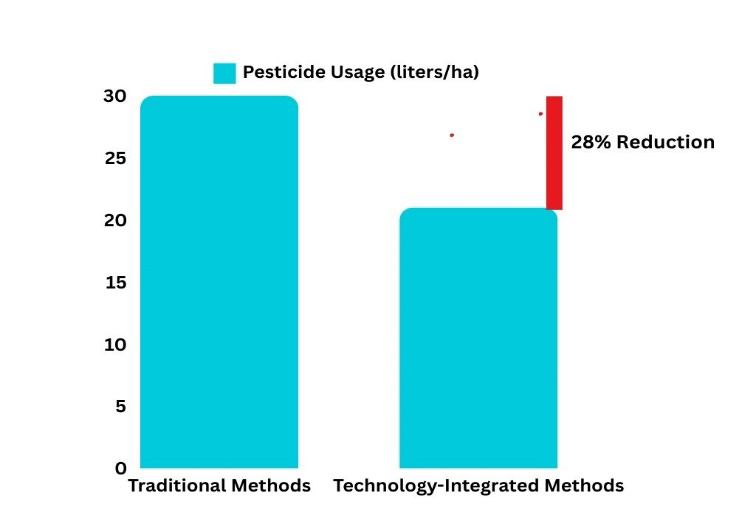
The AI system demonstrated high accuracy in identifying pest-infested areas, allowing for targeted pesticide application. This precision reduced overall pesticide use by 28%, minimizing environmental impact and reducing costs for farmers (Table 2 & Figure 1). The reduction in pesticide uses also contributed to the health of beneficial insect populations and the broader ecosystem [7].
| Metric | Traditional Methods | Technology-Integrated Methods | Percentage Reduction |
|---|---|---|---|
| Pesticide Usage (liters/ha) | 30 | 21 | 28% |
Source: BSDB, 2022 Annual Report.
Resource Utilization
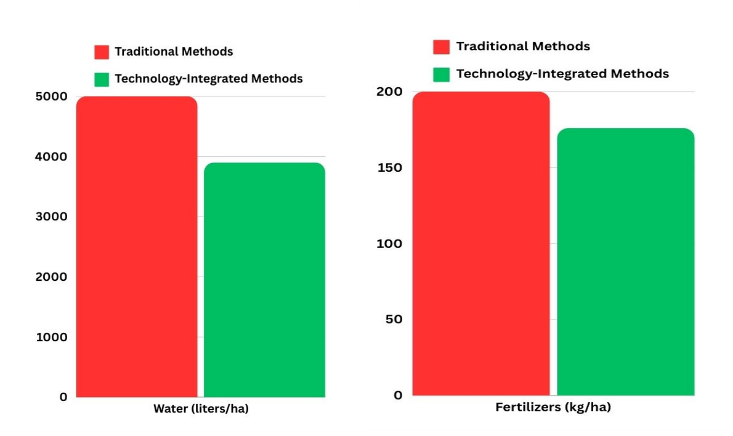
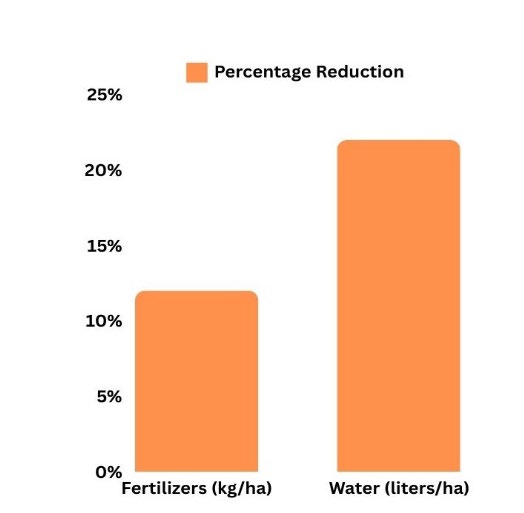
By using artificial intelligence to analyse soil moisture and nutrient content, water and fertilizer usage were optimized. Figure 2 shows a comparison between traditional and technology integrated farming methods in terms of water and fertilizer use. This table highlights the great reductions that have been made as a result of the application of advanced agricultural technologies. In terms of water usage, traditional farming methods need 5000 liters per hectare while technology-integrated ones bring it down to 3900 liters per hectare, implying a decrease by 22% (Figure 3). This fall is largely accounted for by highly accurate and efficient irrigation systems that are designed to deliver water exactly where it is needed most and minimize losses.
Similarly, traditional methods employ 200 kilograms of fertilizers per hectare whereas technology-integrated methods reduce this quantity to 176 kilograms per hectare making it possible to save up to 12% (Figure 3).
For Bangladesh's agriculture to be sustainable over the long run, these improvements reduced costs and encouraged sustainable farming methods [7]. In order to achieve these optimizations, it is imperative that big data and machine learning technologies be integrated, as discussed in a research article that addressed how data-driven insights might result in more effective resource management in agriculture [1], [2].
Source: BSDB, 2022 Annual Report.
Economic Impact
For farmers, the result of the higher leaf yield and lower resource consumption was enhanced profitability. For the farmers who took part, the cost savings from using less fertilizer and pesticides, along with their enhanced output, significantly raised their net income. Comparing modern methods to traditional ones, farmers saw an average 25% improvement in profit margins [7].
Discussion
The results of this study show that productivity and sustainability in sericulture can be greatly increased by integrating drone technology and artificial intelligence. Farmers benefit from enhanced profitability due to lower resource utilization and increased leaf yield. As described by Wolfert et al. (2017) and Liakos et al. (2018), the use of big data and machine learning in agriculture offers a strong basis for comprehending how these technologies might be used to enhance sericulture practices in Bangladesh [1], [2]. Farmers may accomplish better results with fewer resources by utilizing data-driven insights and precision farming practices, which will guarantee a more lucrative and sustainable future for the sericulture sector.
Challenges and Limitations
Notwithstanding the encouraging outcomes, a number of obstacles stand in the way of these technologies' broad adoption. Smallholder farmers, who sometimes have little capital, may find it difficult to make the initial investment needed for drones and AI systems. Technical instruction and continuing upkeep are also required to guarantee the efficient usage of these technologies. To make these technologies available to all farmers, government subsidies, low-interest loans, and training initiatives should be part of the solution to these problems.
Technical Challenges
The complexities of sericulture pose unique challenges compared to other agricultural sectors [8]. One of the main technical challenges is ensuring the reliability and accuracy of AI algorithms in diverse field conditions. Variations in weather, light, and soil conditions can affect the performance of AI systems. Continuous improvements in algorithm robustness and adaptability are necessary to address these issues.
Social and Cultural Barriers
Social and cultural issues frequently lead to reluctance towards the adoption of new technologies. Farmers who have been using conventional ways for many generations may be reluctant to adopt new technologies. It will take community involvement and educational initiatives to break down these obstacles and show off the advantages of technology integration.
Conclusion
This study emphasizes the major advantages of using AI and drone technologies together for targeted farming in Bangladeshi mulberry plantations. These technologies have great promise for augmenting sericulture through increased output, decreased resource use, and the promotion of sustainable practices. Subsequent investigations have to concentrate on expanding these breakthroughs and providing smallholder farmers with access to them via financial aid, educational courses, and community involvement projects. Providing training to sericulture farmers enables them to effectively use drone technology and AI systems, enhancing their agricultural practices. These technologies significantly improve yields, reduce costs, and increase farmers' incomes. Post-training, farmers have adopted innovative practices such as targeted pest management and optimized resource use, leading to better living standards [9]. If these technologies are successfully applied, sericulture in Bangladesh could undergo a transformation that boosts farmer profitability, sustainability, and productivity.
Declarations
- Author contributions
The initial concept and design of the study were contributed to by all authors. Main author Oli Ahmed has done experimental setup, the data collection, data review, data processing, material preparation etc. and the co-author Dr. Md. Shakhawat Hossain has contributed to data analysis and data interpretation. Oli Ahmed wrote the original draft of the manuscript, while the other contributors provided feedback on earlier drafts. The final manuscript was read and approved by both main author and co-author.
- Funding
The authors hereby declare that they did not accept any grants, cash, or other forms of assistance in the writing of this article. Resarch investigation maintained by self-born expenses.
- Data availability
Not applicable
- Competing interests
Not applicable
- Acknowledgments
The authors extend our sincere gratitude to Eng. Mohammad Zakir Hossain Khan (Ph.D), Chairman of Barind Environment, for his invaluable technical and instrumental support, which has been pivotal in the completion of this research article. His expertise and assistance have significantly enhanced the quality and depth of our work.
References
- 1.Wolfert, S., Ge, L., Verdouw, C., & Bogaardt, M. J. (2017). Big Data in Smart Farming – A review. Agricultural Systems, 153, 69–80. https://doi.org/10.1016/j.agsy.2017.01.023
- 2.Liakos, K., Busato, P., Moshou, D., Pearson, S., & Bochtis, D. (2018). Machine Learning in Agriculture: A Review. Sensors, 18(8), 2674. https://doi.org/10.3390/s18082674
- 3.Tsouros, D. C., Bibi, S., & Sarigiannidis, P. G. (2019). A Review on UAV-Based Applications for Precision Agriculture. Information, 10(11), 349. https://doi.org/10.3390/info10110349
- 4.Alam, M. N., & Sarker, M. A. (2020). The status and prospects of sericulture in Bangladesh. Bangladesh Journal of Agricultural Research, 45(2), 123-130. https://www.banglajol.info/index.php/BJAR/article/view/48259
- 5.Mittal, A., Malviya, A., Kaur, D., Mittal, J., and Kurup, L., (2007). Studies on the adsorption kinetics and isotherms for the removal and recovery of Methyl Orange from wastewaters using waste materials. Journal of Hazardous Materials, 148(1): 229-240.
- 6.Singh, R., & Srivastava, S. (2021). The role of artificial intelligence in agriculture: Opportunities and challenges. Computers and Electronics in Agriculture, 180, 105873. https://doi.org/10.1016/j.compag.2020.105873
- 7.Bangladesh Sericulture Development Board. (2022). Annual Report on Sericulture Development. Dhaka: Ministry of Textiles and Jute, Government of Bangladesh.
- 8.Ahmed, O., Mahiuddin, K., & Rahman, M. M. (2024). Evaluating the effectiveness of training on sericulture cultivation among farmers in the Bholahat Region. International Journal of Agriculture Extension and Social Development, 7(1), 586–59. https://doi.org/10.33545/26180723.2024.v7.i1h.259
- 9.Ahmed, O., Mahiuddin, K. M., & Rahman, M. M. (2024). Exploring the Relationship between Farmer Characteristics and Training Effectiveness in Sericulture Cultivation. International Journal of Research and Innovation in Social Science, 8(2), 883-900. DOI: https://dx.doi.org/10.47772/IJRISS.2024.802062
Cite this article
Journal
Ahmed O, Hossain MS. Innovative Approaches to Enhance Sericulture: Integrating Drone Technology and Artificial Intelligence for Precision Cultivation of Mulberry Fields in Bangladesh. JoSEP. 2026;1(2):68-72. doi: 10.62275/josep.24.1000001.
Rights and permissions
© 2026
Cited by (1)
- Development of NiCrSiB-Al₂O₃ composite coatings on AISI 304 stainless steel using HVOF for improved erosion resistance
Roshan Kuruvila, Toms Philip, R. Jayakrishnan · Journal of the Australian Ceramic Society · 2025
About this article
- Received
- 6 June 2024
- Revised
- 26 June 2024
- Accepted
- 28 June 2024
- Published
- 21 October 2026
- Journal
- Journal of Science and Engineering Papers
- Volume / Issue
- 1 / 2
- Pages
- 68-72
- DOI
- 10.62275/josep.24.1000001