 Open Access



 Open access
 Check for updates


Abstract
This study is devoted to the development of lightweight Aluminum alloy to reduce energy consumption and environment pollution in automobile sector. Aluminum alloy shows impressive strength though they are lightweight. The effect of Cu on Al-5.5Zn-2.5Mg-xCu alloy has been studied and improvement in mechanical properties within a range has been observed. The optical microstructure confirmed the formation of Cu enriched brittle phase by solid solution strengthening and it accelerates the hardness and tensile strength. After certain limit strength followed the opposite trend so the material can be used as high strength material when the Cu content will be in a certain limit. In automobile sector vehicle parts made with this alloy material has less weight than commonly used steel. The total weight reduction of a vehicle will reduce the energy consumption which will ultimately eliminate the emission of environment pollutant gas.
Introduction
Energy consumption by automobile vehicle is increasing in an alarming rate nowadays. By consuming huge amount of energy automobile vehicle emits CO2 gas which is a great threat to the environment. To reduce the fuel consumption and CO2 emission the fuel economy has to be maintained by automobile sector. One possible way can be weight reduction of automobile vehicle by using light-weight materials. According to statistics, for every 10% reduction in weight, fuel consumption can be reduced by 6% to 8% [1]. It is a challenge to maintain light weight along with enhanced mechanical property. Conventional Aluminum metal doesn’t cover the all of the desired properties so enhanced Aluminum alloy is effective solution for light weight body parts for automobile vehicle as it possesses low density and high strength to weight ratio. The alloy composition associated with heat treatment of the alloy plays a great role to obtain desirable high strength and light weight material for car body parts. For a car body frame, engine blocks, wheels, pistons, cylinder head sufficient strength with high strength to weight ratio has to be obtained. To demonstrate this kind of Aluminum alloy microstructure and mechanical properties were studied previously and the study stated that in Al-10Zn-2.6Mg-xCu the tensile and yield strength increases up to 1 wt% Cu [2]. Again some studies show that Al-6.7Zn-2.25Mg-xCu alloy has very limited change in tensile and yield strength with Cu content change from 1.5-2.5 wt% [3]. Previous study revealed that some of these intermetallic phases like η(MgZn2), θ(Al2Cu) might be present during synthesis and affects the mechanical properties. Our present work focuses on the development of a light weight car body material with high strength. 7xxx series Aluminum alloy has been studied into our present work and Cu content has been varied with constant Zn and Mg content.
Materials and methods
Synthesis
The Al-5.5-2.5Mg-xCu alloy was prepared from pure Al, Zn, Mg ingot and Cu wire by steel mould casting. These elements were melted into a graphite crucible with the help of induction furnace at 950°C and poured into steel mould. Oxide formation on the open surface of the casting was restricted by the argon gas supply during melting and after pouring into steel mould. After melting the as cast samples were homogenized 12 hours at 500°C to obtain solid solution strengthening. Three alloy composition was prepared by varying Cu content from 3-6 wt% and examined these combinations to compare with each other.
Characterization
To identify the phase present in the homogenized sample X-ray diffraction method was used. Microstructure of the alloy was visualized by optical microscope. Wet polishing prior to abrasive polishing was performed before inspection of visual surface and proper etching solution was used to get visual representation of grain and solute atom. Tensile test was conducted with UTM with round cylinder sample and maintaining the ASTM E8/E8M standard. After tensile test the elongation of each sample was measured by initial and final gauge length. Hardness was measured with vicker’s hardness tester and impact loading test was conducted by charpy V notch tester with 45 degree grooved sample.
Result and discussion
Microstructure
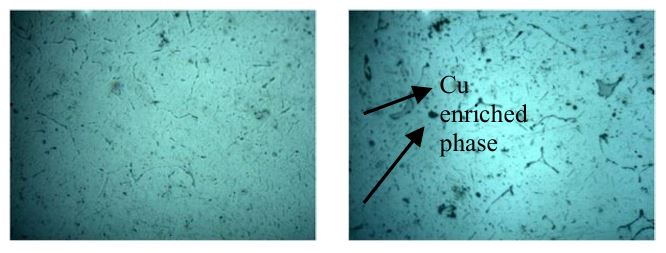
To see the microstructure when NaOH etchant was used, only Al matrix with Mg flakes and Cu enriched intermetallic precipitation was seen. But to see the dendritic structure keller’s solution was used and the microstructure in Figure 2 shows the distribution of dendritic Al matrices in cast alloys and the primary phase is distributed in grain and grain boundary. Cu enriched brittle intermetallic phase is increased with increasing Cu content.
X-ray DIffraction
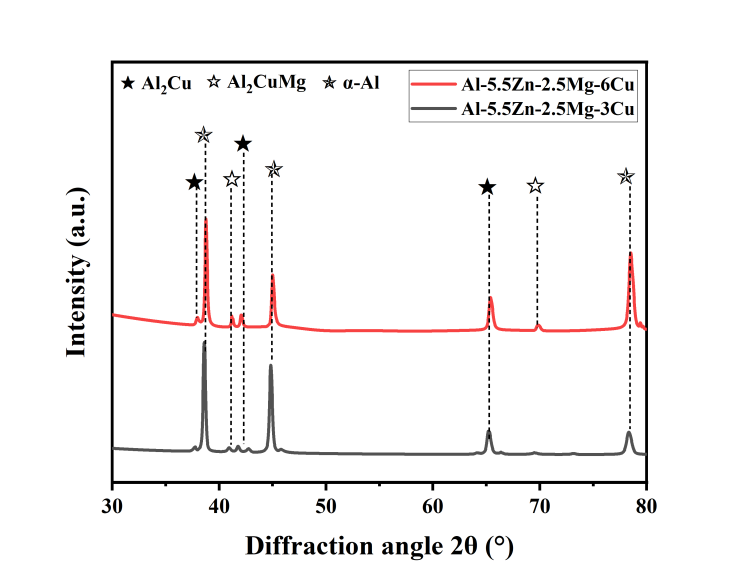
Generally η (MgZn2), T (Al2Mg3Zn3), S (Al2CuMg), and θ (Al2Cu) primary phases are present in a typical Al-Zn-Mg-Cu alloy associated with other intermetallic phases [4]. From Figure 1 the X-ray diffraction of cast sample shows the diffraction peaks of θ (Al2Cu) and S (Al2CuMg) phases because of the huge amount of Cu content in those samples.
Density
The density of the elements from Table 1 shows that the synthesized alloy compound will be light weight comparative to steel with same dimensions.
| Element | Melting Temperature (°C) | Density (g/cc) | Element used in casting (%) |
|---|---|---|---|
| Aluminum ingot | 660 | 2.70 | Bal. |
| Magnesium ingot | 650 | 1.74 | 2.5 |
| Copper wire | 1085 | 8.96 | X (x=3, 4.5, 6) |
| Zinc ingot | 419 | 7.13 | 5.5 |
Mechanical Properties
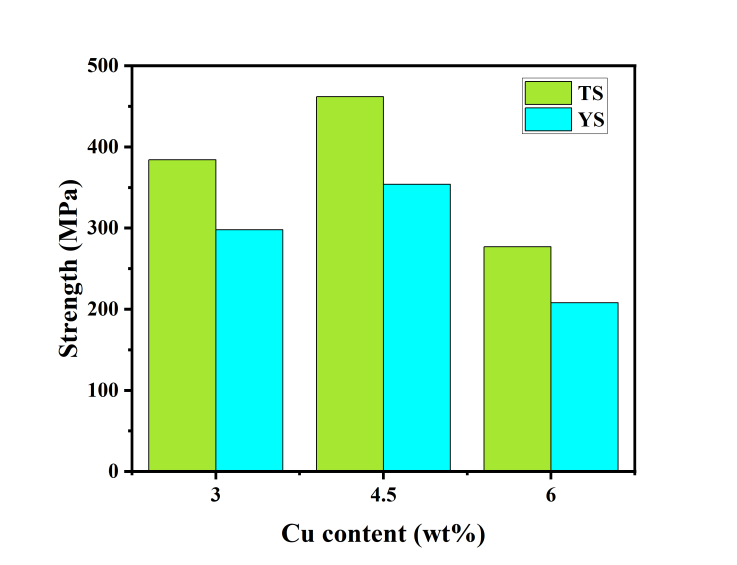
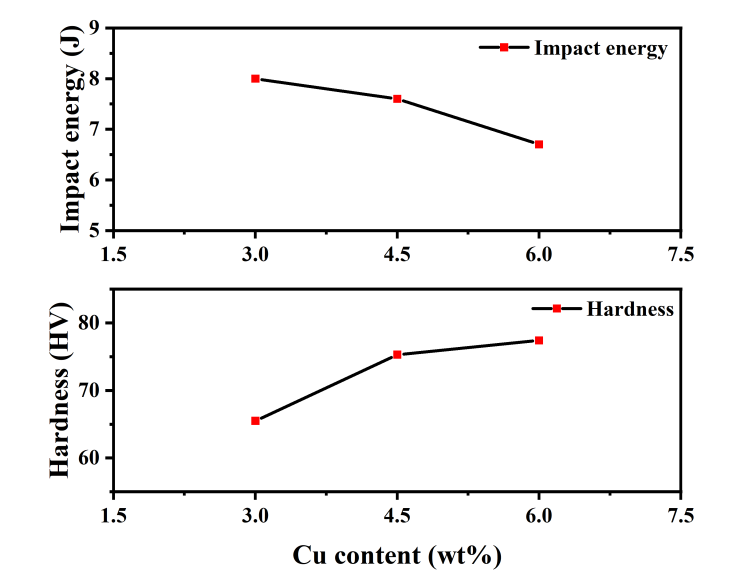
Solid solution strengthening can be seen in Cu enriched phase as Cu precipitates into Al matrix is clearly evident from microstructure. By increasing Cu content solid solution strengthening accelerates into Al matrix [6]. This solid solution strengthening hinders the dislocation movement and increases the tensile and yield strength up to 3 wt% Cu content Figure 3. But high copper enriched phase was susceptible to crack so tensile and yield strength decreases upon further increasing Cu content. Figure 4 shows that when Cu content increases Cu enriched brittle phases Al2Cu and Al2CuMg increases so the hardness was also increased[5]. With increasing Cu content ductility was decreased because of solid solution strengthening of Cu enriched intermetallic. But impact energy has the reverse trend because brittle phase can take a small amount of impact load before fracture.
Conclusion
.In this present work, the mechanical behaviour of Al-5.5-2.5Mg-xCu was studied and the findings showed that tensile strength and yield strength increased up to 4.5 wt% Cu content but further increasing Cu content these properties deteriorates. The hardness value was increased when the Cu content was increased but impact energy follows opposite trend. Increasing Cu can enhance the mechanical properties when the Cu content is less than 4.5% and the product will show the light weight property. So, vehicle parts made with this type of alloy might replace the typical steel body parts of car because with same dimensions the Al-Zn-Mg-Cu alloy reduces the total weight of a car without changing the strength of car body part. The reduction of total weight will reduce the fuel combustion rate. Al alloy has descent corrosion resistance so because of the durability of Al alloy body parts of vehicle made by Al alloy doesn’t need continuous replacement. So, the replacement cost can be minimized. Thus, energy consumption can be reduced by this engineering light weight alloy and emission of CO2 gas will be limited. By reducing environmental impact Al-5.5Zn-2.5Mg-xCu material can be used as a sustainable energy saving material.
Ethical Approval
The piece of work that was submitted is an original contribution to the area, and it has not been published anywhere else. The findings are provided in a manner that is transparent, truthful, and free of any fabrication, falsification, or inappropriate alteration of the data.
Consent of Participate
The presented work constitutes experimental research conducted in the foundry laboratory. This research does not involve any human subjects or biological organisms.
Consent to Publish
No consent to publish is to be shared.
Declarations
- Author contributions
All authors participated in the conception and design of the study. Material preparation, data collection, and analysis were conducted by S M Khalid Hossain and Syed Nahid Ahmed. S M Khalid Hossain authored the initial draft of the manuscript, and all contributors provided feedback on earlier iterations of the document. All writers reviewed and endorsed the final manuscript.
- Funding
The entirety of this article was completed with the support of our undergraduate thesis grant by the Department of MME, BUET.
- Data availability
Not applicable
- Competing interests
Not applicable
- Acknowledgments
I would like to express my sincere gratitude to all those who have contributed to the success of this research. First and foremost, I would like to thank my thesis supervisor and lab assistants who helped us in foundry lab during our thesis.
References
- 1.J. Sun, (2018). Research on Situation and Application Prospect of Automotive Body Sheets Al-Mg-Si Based (6000series) Alloy. IOP Conf. Ser.: Mater. Sci. Eng., 452: 022082.
- 2.Y. Zhao, H. Li, Y. Liu, and Y. Huang, (2022). The microstructures and mechanical properties of a highly alloyed Al-Zn-Mg-Cu alloy: The role of Cu concentration. Journal of Materials Research and Technology, 18: 122–137.
- 3.J. A. Wagner and R. N. Shenoy, (1991). The effect of copper, chromium, and zirconium on the microstructure and mechanical properties of Al-Zn-Mg-Cu alloys. Metall Trans A, 22(11): 2809–2818.
- 4.D. K. Xu, P. A. Rometsch, and N. Birbilis, (2012). Improved solution treatment for an as-rolled Al–Zn–Mg–Cu alloy. Part I. Characterisation of constituent particles and overheating. Materials Science and Engineering: A, 534: 234–243.
- 5.P. Dai et al., (2020). High temperature tensile properties, fracture behaviors and nanoscale precipitate variation of an Al–Zn–Mg–Cu alloy. Progress in Natural Science: Materials International, 30(1): 63–73.
- 6.Y. Zhao et al., (2023). Effects of Mg/Zn ratio and pre-aging on microstructure and mechanical properties of Al–Mg–Zn–Cu alloys. Journal of Materials Research and Technology, 27: 1874–1885.
Cite this article
Journal
Hossain SMK, Ahmed SN. Lightweight Aluminum Alloy for Energy Saving Green Vehicle. JoSEP. 2026;2(1):109-112. doi: 10.62275/josep.25.1000017.
Rights and permissions
© 2026
Cited by (0)
Citing works are not available yet.
About this article
- Received
- 30 September 2024
- Revised
- 6 November 2024
- Accepted
- 12 November 2024
- Published
- 22 October 2026
- Journal
- Journal of Science and Engineering Papers
- Volume / Issue
- 2 / 1
- Pages
- 109-112
- DOI
- 10.62275/josep.25.1000017