Open Access





 5 articles
 Pages 96–117
 0 downloads
 Cover story
Biosynthesis of zero-dimensional TiO 2 nanostructures for potential photocatalytic applications
R. Mahmud, A. Al Moyeen, A. Al Mamun, M. Islam +2 more
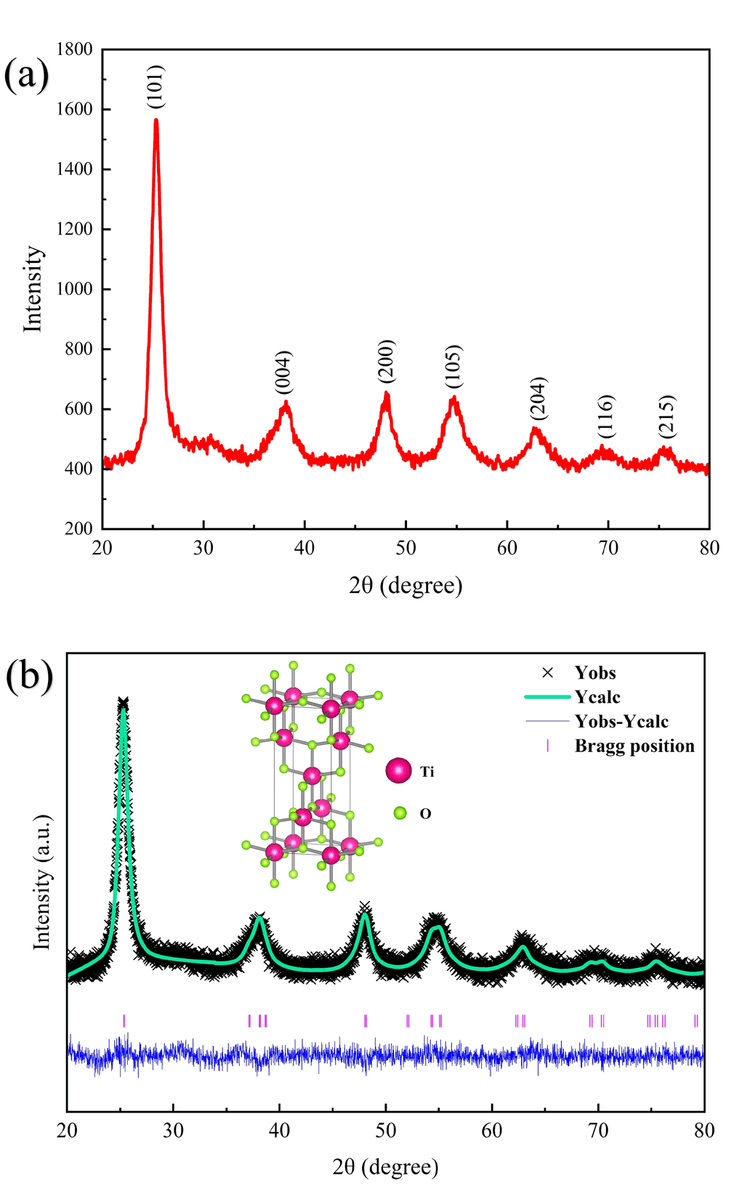
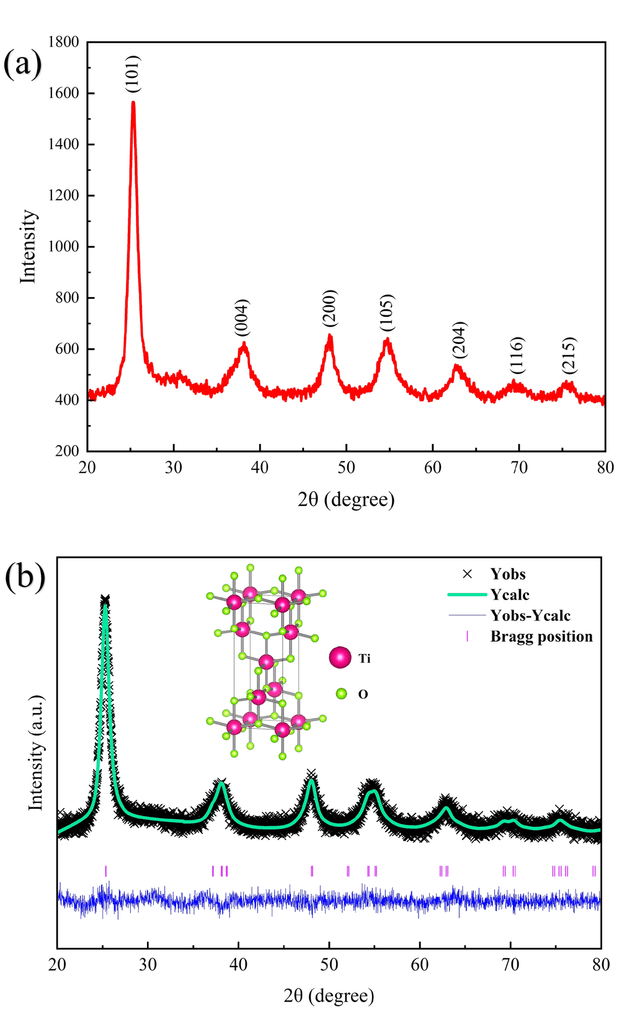
This study introduces a sustainable approach to synthesize zero-dimensional TiO 2 nanostructures using Allium sativum (garlic) clove extract as a biogenic capping and reducing agent. The synthesized particles were dried at 80 ºC for 24 hours and calcined at 450 ºC for 2 hours. X-ray diffractometer (XRD), Field Emission Scanning Electron Microscopy (FESEM), UV-vis spectroscopy, and photocatalytic activity analysis were used to characterize the synthesized nanoparticles. The XRD pattern revealed the prevalence of the tetragonal anatase phase in the synthesized nanostructures, with an average crystallite size of 6.45 nm. The Williamson-Hall plot method was employed to evaluate the type of strain induced in the synthesized particles, and the crystallinity of TiO 2 nanostructures was estimated to be 74.91%. The Rietveld analysis calculated the lattice parameters, cell volume, and other relevant parameters. FESEM image showed spherical nanostructures with an average size of 45.08 nm. UV-vis spectroscopy indicated an optically active region at ~361 nm, and the direct bandgap, calculated using the Tauc plot, was 3.28 eV. The photocatalytic efficiency of TiO 2 for methylene blue degradation reached 86.23% within 90 minutes, showing its potential for environmental remediation.
J. Sci. Eng. Pap. 2026, 2(1), 96-100 · doi:10.62275/josep.25.1000014 · Published 21 Oct 2026
 1 views
 0 downloads