 Open Access



 Open access
 Check for updates


Abstract
Diseases caused by pathogenic microbes affect humans, animals, and plants, reducing agricultural productivity and leading to health crises. Numerous studies have recently explored potential solutions to address these challenges. In this study, we propose a simple cost-effective approach involving carbon quantum dots (CQDs)-based metal complexes, which demonstrate enhanced bactericidal activity against pathogenic bacteria. The incorporation of CQDs with metals such as silver (Ag), copper (Cu), zinc (Zn), iron (Fe), nickel (Ni), and manganese (Mn) significantly enhances the antibacterial activity of the metals through mechanisms such as oxidative stress generation, membrane rupture, and interference with bacterial metabolic activities. CQDs were synthesized using hydrothermal methods from green sources, and their metal complexes were prepared via a covalent coordination reaction. The properties of the synthesized CQDs and their metal complexes were analyzed using FTIR, SEM, and EDX to confirm their successful formation. The antimicrobial efficacy of these compounds was evaluated against two pathogenic bacteria, including Gram-positive strains (Staphylococcus aureus) and Gram-negative strains (Escherichia coli). The integration of metal centers into the CQDs' backbone markedly enhanced bactericidal effectiveness across all tested cases. Notably, CQDs-metal complexes exhibited the highest bactericidal effects, attributed to the intrinsic activity of metal ions. Among the CQDs-metal complexes, CQD-Ag exhibited the highest MIC/MBC of 78.5/220 µg/mL against S. aureus and 500/670 µg/mL against E. Coli. These findings underscore the critical role of the coordinated bond between metal centers and CQD ligands in determining the antibacterial efficacy of these complexes. The remarkable bactericidal activity demonstrated by these metal complexes highlights their potential for diverse applications, including resisting agricultural diseases, developing soft and tough tissue adhesives for biomedical use, and enhancing safety in the food industry.
Introduction
Carbon Quantum Dot (CQDs) is a carbon-based nanoscale material, interesting physicochemical properties have gained a lot of attention since then. CQDs are mostly prepared through hydrothermal, solvothermal, and microwave-assisted processes from numerous carbon-based precursors. They are highly soluble in water, highly photoluminescent, and quite biocompatible, allowing them much versatility in applications. CQDs are well-known for a number of properties as an effective fluorescent probe because of their adjustable emission and photostability [1]. CQDs also have excellent antioxidant and antibacterial properties applicable in various biomedicine fields, such as: biosensing, bioimaging, drug delivery, and tissue engineering [2]. On account of their chelating property for metal ions, they can be applied for environmental remediation, especially to detect and eliminate heavy metal pollutants from water bodies. This assumption can bring forth a clear alternative for developing new materials with multifunctional properties in the wake of strengthening concern with environmental pollution and antibiotic-resistant bacterial infections [3]. Graphene oxide (GO) exhibits promising antimicrobial activity; however, it has a propensity to aggregate in the aqueous phase and has lower biocompatibility [4]. On the other hand CQDs and CQD-based metal complexes provide excellent antimicrobial activity, superior biocompatibility and safety [5].
According to the World Health Organization (WHO), untreatable antibiotic-resistant bacterial infections have raised serious concerns regarding global health and have triggered the immediate need for the development of an alternative antimicrobial treatment. The decreased effectiveness of antibiotics is perhaps due to the ability of bacteria to develop resistance mechanisms through genetic alterations, biofilm formation, and enzymatic degradation [6]. This is what inspired scientists to research antimicrobial treatments based on nanomaterials. Among the different ones, there are emerging as promising substitutes owing to their unique physicochemical characteristics, which comprise strong photoluminescence, biocompatibility, and chemical stability [7].
Owing to their capacity in the production of ROS and their interference with other intracellular metabolic pathways, CQDs are well known to exhibit inherent antibacterial properties [8]. One way, however, to greatly increase their antibacterial activity is by functionalization with the metal ions or metal-based complexes, such as Ag⁺, Cu²⁺, and Zn²⁺ [9]. The antibacterial actions of these metal ions are well established: inducing oxidative stress, inhibiting key enzymes, and damaging bacterial DNA, creating a synergistic system when combined with CQDs to promote bacterial eradication and minimize the development of resistance [10].
The combination of CQDs and metal complexes provides various advantages: improved antibacterial activity, reduced mammalian cytotoxicity, and reduced environmental impact [11]. These hybrid materials have been investigated for diverse applications such as wound dressing, antimicrobial coating, targeted drug delivery, and purification of water [12]. With the very urgent need for new antibacterial pharmaceuticals, CQD-based metal complexes provide an alternative and efficient route to targeting multidrug-resistant microorganisms [13]. The present work is designed to investigate the synthesis, mechanism of action, and biological applications of CQD-based metal complexes, focusing on their prospect as next-generation antimicrobial nanomaterials [14].
Materials and methods
Materials
This research requires a carbon source (mango peels) for CQDs synthesis and metal precursors (AgNO3, CuCl2, ZnCl2, FeCl3, NiCl2, MnCl2) for metal incorporation. Additional chemicals include ethanol for purification, NH3 for pH adjustment, HCl, and NaOH for reaction facilitation. Antibacterial testing is conducted against Staphylococcus aureus, and Escherichia coli, using nutrient broth, LB broth, and MHA.
Sample preparation
Preparation of carbon quantum dots (CQDs)
Initially, mango peels were rinsed with water and sun-dried for around 7 days. The dried mango peel will then be stored in an oven at 100 °C for 6 hours. Dried mango peels were crushed using a dry grinder. The mango peel samples were hydrothermally processed in a Teflon-lined autoclave at 180 °C for 12 hours. The autoclave was allowed to cool to room temperature before the sample was collected and washed with dichloromethane to eliminate any unreacted organic moieties. The resulting aqueous solution was transferred to methanol, centrifuged at 10,000 rpm for 30 minutes to separate the solvent from the water-soluble CQDs, and then dried at 100 °C.
Preparation of CQDs transition metal complexes
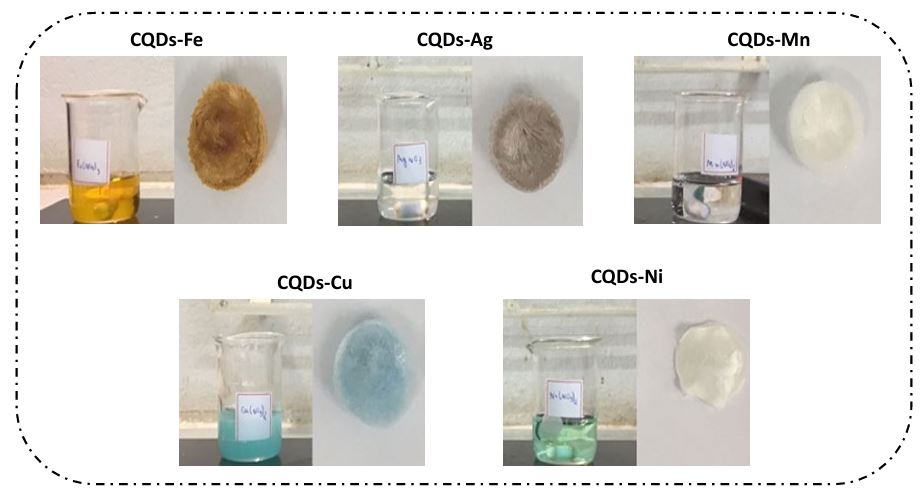
The complexes were prepared using a molar ratio of 1 mol of CQDs to 1.5 mol of metal. Initially, the metal salts were taken into a round-bottom flask to make the solution, which was maintained by stirring for a further 30 min. Then the CQDs solution was added to the solution, which was maintained by stirring for a further 2 h. After this process, the solution was poured into hydrated cellulose membranes for dialysis, which were kept for 24 h. The dialysis water was changed every 5 h for metal ions not attached to the CQDs. At the end of this process, the solution of the complexes was lyophilized. The digital images of the CQDs-metal complexes are shown in Fig. 1.
Characterization
The synthesized samples with different functional groups were analyzed by a Fourier Transform Infrared (FTIR) spectrophotometer, 3000 Hyperion Microscope Vertex 80. FTIR analysis was carried out using KBr-pressed pellets over the 4000–500 cm−1 spectral range, with spectra collected at a resolution of 1 cm−1 to investigate the functional groups present in the samples. Scanning electron microscopy (SEM) was employed to investigate the surface morphology of the synthesized metal–CQDs using a ZEISS EVO 18 microscope. The elemental composition of the samples was determined by energy-dispersive X-ray spectroscopy (EDS) integrated with the same ZEISS EVO 18 system.
Theory
Synthesis mechanism of CQDs with metal ions
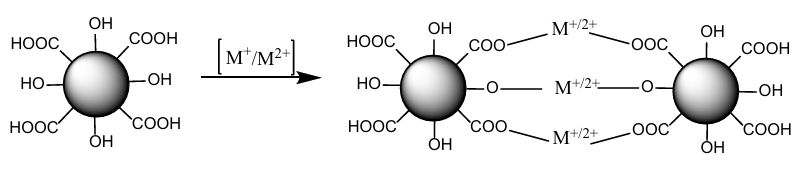
The synthesis of different carbon quantum dots (CQDs)-based metal complexes is explained owing to the interaction of CQDs with several metal ions (M⁺/M²⁺). Fig. 2 shows the synthesis mechanism of CQDs with metal ions. In the first instance, CQDs possess functional groups like hydroxyl (-OH) and carboxyl (-COOH), which present them with the capability of binding metal ions quite efficiently. After the introduction of different metal ions such as Ag⁺, Cu²⁺, Zn²⁺, Fe³⁺, Ni²⁺, and Mn²⁺, the above functional groups coordinated with respective metal species, forming strong coordination bonds. The subsequent linking of CQDs via metal ions led to enhanced antibacterial efficacy conferred by CQDs.
Proposed antibacterial mechanism of CQDs-metal complexes
The antibacterial mechanism of CQDs-metal complexes must be a synergy of several aspects. The positive charge of the metal-loaded CQDs engenders electrostatic interactions with the bacterial membranes, hence facilitating the CQD binding on the bacterial surface. Once tightly bound, metal ions interfere with the integrity of the membrane, followed by an increase in permeability, thereby allowing leakage of intracellular constituents [15]. The generation of reactive oxygen species (ROS), leading to oxidative stress and destruction of nucleic acids, proteins, and lipids in the bacteria, reinforces the impact. The action of the metal ions will also interfere with another vital enzyme that is needed by the bacterial cell hence causing metabolic inhibition that will lead to cell death.
As a synergistic mechanism, this will greatly act together to render the CQDs with enhanced antibacterial actions through exploitation of their unique nanostructure and the cytotoxic potential of the metal ions, thus marking a very promising path for its application in the biomedical and antimicrobial fields [16].
Results and Discussion
FTIR analysis
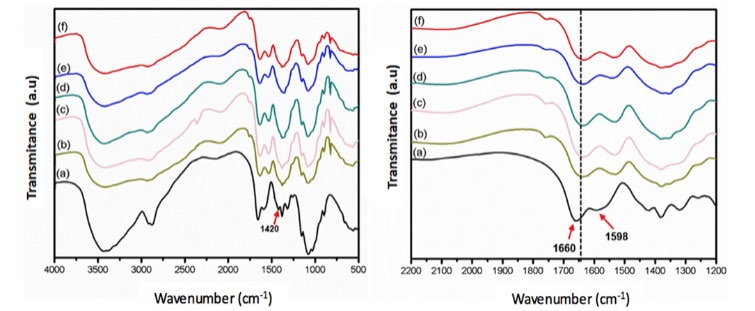
To show how metal coordination alters the structure, FTIR spectroscopy was used to examine the functional groups in metal complexes and carbon quantum dots (CQDs). The presence of significant variations in the absorption bands in the FTIR spectra, as shown in Figure 3, suggests the presence of metal-ligand interactions.
A shift in significant vibrational bands in the FTIR spectra shows that CQDs effectively coordinate with Zn, Ni, Cu, Fe, and Mn. Any structural changes caused by metals are seen by the peaks at 1660 cm−1 (C=O stretching) and 1598 cm−1 (C=C stretching). The great change at 1420 cm−1 (C-N stretching) suggests that there is a substantial interaction between the metal and the ligand through groups that include oxygen and nitrogen. These spectrum modifications indicate the enhanced stability and functional properties of CQD-metal complexes [17]. Antibacterial efficacy is increased due to the changes' promotion of ROS production and bacterial membrane breakdown. This means that FTIR studies can confirm that metal-functionalized CQDs are safe to employ in environmental and biological science.
SEM results
SEM images of CQD composites display various changes in morphology arising from metal doping, as shown in Fig. 4. The pure CQD sample displays aggregate-like, almost spherical morphology with a comparatively smooth surface; this is expected for nanoscale dimensions and graphitic nature [18]. On addition of silver (Ag), the surface morphology displays sharp-edged, sheet-like features, indicating interaction of Ag ions with the CQD matrix.
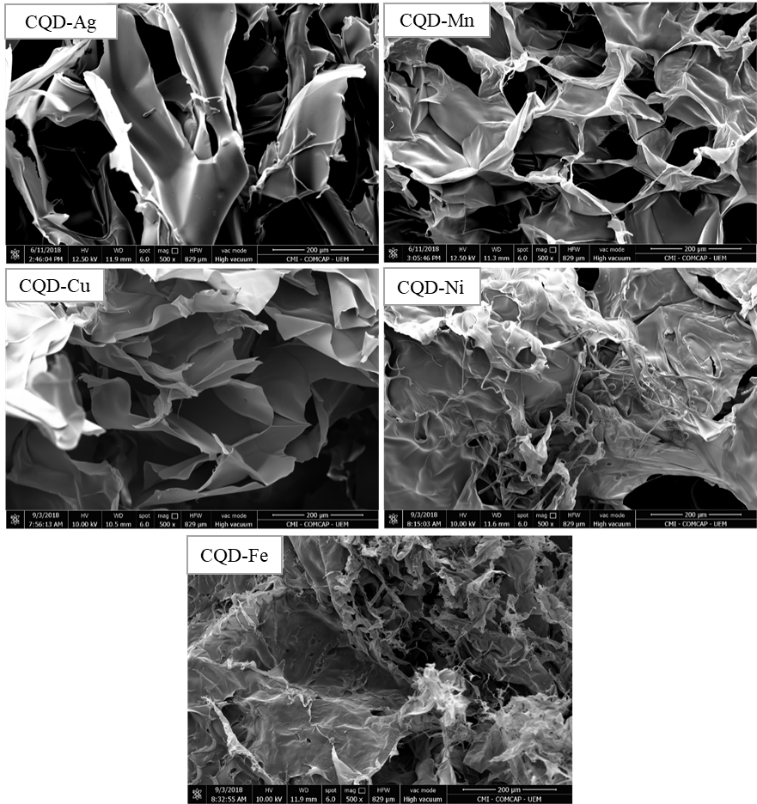
The Mn doping shows wrinkling and crumpling, which imply that Mn ions modify the regular CQD structure by disordering and increasing surface roughness. The incorporation of Cu transforms CQDs into highly folded and dense structures, signifying a high packing density coupled with low levels of porosity. The Ni-doped sample shows fibrous interlinkages, which implies that coupling of Ni ions with the CQD will confer high mechanical strength upon the composite. Fe doping exhibits a rough irregular surface with high porosity, which contributes to enhanced adsorption and catalytic activity. Studies on these metals highlight the possibilities that metal doping has in tailoring CQD structure, porosity, surface roughness, and overall morphology, which in turn define potential applications for the material in catalysis, adsorption, and biocompatibility.
EDS results
The results of EDS spectroscopy corroborate the doping of carbon quantum dots with various metals (Ag-Mn-Cu-Ni-Fe) in addition to a control sample of pure CQDs. Carbon (C) and oxygen (O) show strong peaks across all the samples, indicating the type of CQDs with the possibility of O-containing functional groups. Gold peaks are seen across all spectra possibly arising due to gold coating for EDS analysis. Fig. 5 depicts EDS images for CQDs and CQDs-metal complexes. CQDs-Ag shows peaks of Ag that can be considered for the enhancement of fluorescence and antibacterial properties.
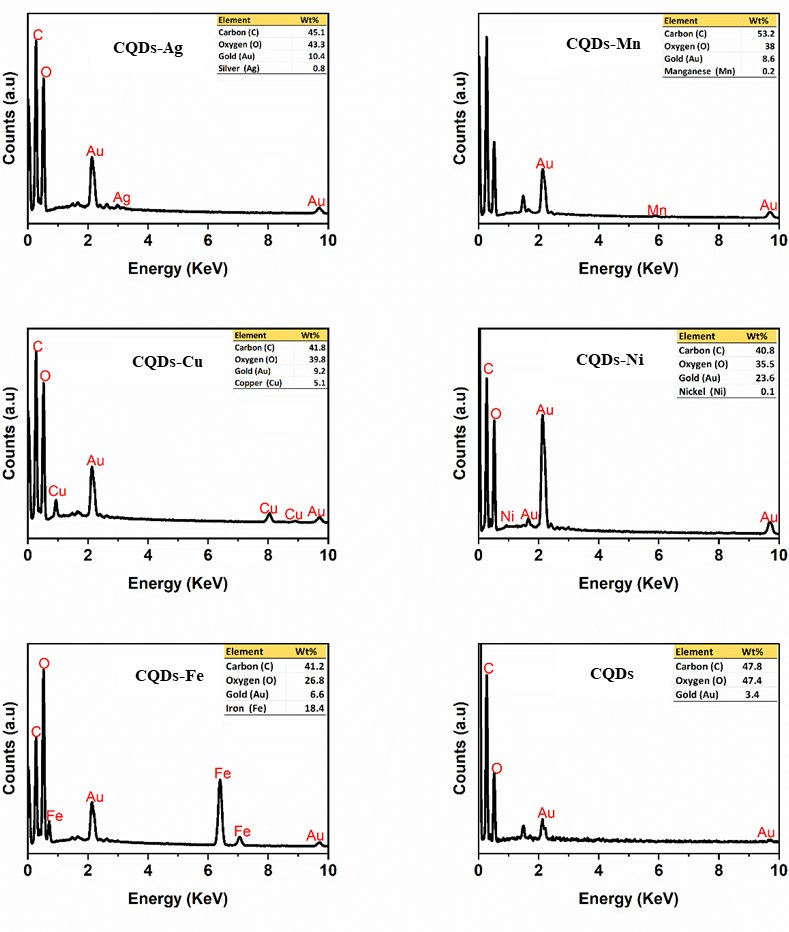
Peaks of Mn in CQDs-Mn confirm the incorporation of manganese, whose presence can change magnetic and optical properties. The presence of Cu in CQDs-Cu gives credence to the possible application for catalytic and antibacterial properties, while Ni in CQDs-Ni may be considered for electrochemical sensing. In CQDs-Fe, a significant presence of Fe (~18.4% Wt) is clearly visible, which suggests it could have been strongly doped and is therefore of interest for magnetic and biomedical applications. We will take the lack of the appearance of any other metal peaks in the undoped CQDs sample as a control. These results confirm the incorporation of the metals and suggest that doping can, henceforth, modify the properties of CQDs in terms of prospective applications in catalysis, sensing, and biomedicine.
Antimicrobial effectiveness test
For each CQD-metal combination, Table 1 shows the results for the minimum bactericidal concentration (MBC) and minimum inhibitory concentration (MIC). According to the data in the table, the CQD-Ni, CQD-Ag, and CQD-Mn complexes outperform the CQD-Cu and CQD-Fe complexes in terms of bactericidal efficacy. One reason why different kinds of bacteria produce varied outcomes is that some, like gram-negative bacteria, have an outer membrane, while others do not. That one allows the bactericidal chemical to penetrate the cell by rupturing its membrane.
| Materials | Staphylococcus aureus | Escherichia coli | ||
|---|---|---|---|---|
| MIC (µg/mL) | MBC (µg/mL) | MIC (µg/mL) | MBC (µg/mL) | |
| CQD | >1000.0 | N/A | >1000.0 | N/A |
| CQD-Ni | 135.0 | 280.0 | 620.0 | 1000.0 |
| CQD-Mn | 149.0 | 650.0 | >1000.0 | >1000.0 |
| CQD-Ag | 78.5 | 220.0 | 500.0 | 670.0 |
| CQD-Cu | 800.0 | 1100.0 | >1000.0 | N/A |
| CQD-Fe | 1150.0 | >1100.0 | >1000.0 | >1000.0 |
From antimicrobial testing, CQD-Ag exhibited the highest antimicrobial activity, requiring the lowest concentrations to inhibit both Staphylococcus aureus and Escherichia coli. Specifically, CQD-Ag exhibited a MIC/MBC of 78.5/220 µg/mL against S. aureus and 500/670 µg/mL against E. coli, which are significantly lower than those of CQD-Ni (135/280 and 620/1000 µg/mL) and CQD-Mn (149/650 and >1000/>1000 µg /mL), while CQD-Cu and CQD-Fe required concentrations of at least 800-1150 µg/mL. This notable efficacy at low doses of CQD-Ag is linked to the synergistic interaction between Ag and CQDs, where the CQD matrix allows for even dispersion and controlled release of Ag⁺ ions, promoting strong interactions with thiol-containing proteins and bacterial DNA. A key part of these CQDs' antibacterial effectiveness is their ability to generate ROS and physically harm the bacterial cell membrane. We noticed a much stronger reaction in S. aureus than in E. coli. This difference occurs because the LPS-rich outer membrane of Gram-negative bacteria creates a substantial permeability barrier. This barrier raises the necessary inhibitory concentrations (MIC/MBC). The primary reason for these CQDs' antibacterial activity is their ability to produce ROS and damage the bacterial cell membrane. We also observed a much higher reaction in S. aureus than in E. coli because the LPS-rich outer membrane of Gram-negative bacteria creates a significant permeability barrier that raises necessary inhibitory concentrations (MIC/MBC). Of all the metal-doped systems we examined, the CQD-Ag modification was without a doubt the best, yielding superior results at a quarter of the concentration required by the others.
Conclusion
This study shows that the CQD-metal complexes have an enhanced antibacterial activity against pathogenic bacteria. The incorporation of transition metals, such as Ag, Cu, Zn, Fe, Ni, and Mn, enhanced the bactericidal activity of CQDs through the ROS generation, membrane rupture, and metabolic interference. Successful metal coordination and structural modifications were also confirmed by FTIR, SEM, and EDS analyses. Superior antibacterial activity was observed for metal-functionalized CQDs in antibacterial testing against bacteria. When combined with CQDs, even metals with weak intrinsic antimicrobial properties showed improved activity, for which the role of metal–ligand interactions is crucial. CQD-metal complexes, with strong antimicrobial properties, biocompatibility, and multifunctionality, have potential for biomedical applications, biomedical use, and enhancing safety in the food industry. For their application in combating antibiotic resistance, they can be considered as a viable alternative to conventional antibiotics. Future work should include optimizing synthesis, evaluating cytotoxicity, and scaling up production.
Ethical Approval
This work is an original contribution and has not been published previously in any form or language. The results are presented clearly, honestly, and without fabrication, falsification, or inappropriate data manipulation.
Consent of Participate
This study involved only laboratory-based experimental work. No human participants, animals, or living tissues were involved; therefore, consent to participate was not required.
Consent to Publish
The authors approve the publication of identifiable information in this journal or article, including photographs and text.
Declarations
- Author contributions
All authors contributed to the study conception and design. Material preparation, data collection and analysis were performed by Md. Dipu Malitha. All authors read and approved the final manuscript.
- Funding
This research was funded by the University of Rajshahi through a university research project.
- Data availability
Not applicable
- Competing interests
Not applicable
- Acknowledgments
The authors gratefully acknowledge the experimental support of this study by The Nanomaterials and Pharmaceuticals Research Lab in the Department of Applied Chemistry and Chemical Engineering, University of Rajshahi, Rajshahi-6205, Bangladesh.
References
- 1.Malitha, M. D., Molla, M. T. H., Bashar, M. A., Chandra, D., and Ahsan, M. S., (2024). Fabrication of a reusable carbon quantum dots (CQDs) modified nanocomposite with enhanced visible light photocatalytic activity. Scientific Reports, 14(1): 17976.
- 2.Pechnikova, N. A., Domvri, K., Porpodis, K., Istomina, M. S., Iaremenko, A. V., and Yaremenko, A. V., (2024). Carbon Quantum Dots in Biomedical Applications: Advances, Challenges, and Future Prospects. Aggregate: e707.
- 3.Abd Elkodous, M., Olojede, S. O., Sahoo, S., and Kumar, R., (2023). Recent advances in modification of novel carbon-based composites: Synthesis, properties, and biotechnological/biomedical applications. Chemico-Biological Interactions, 379: 110517.
- 4.Evseev, Z. I., Tarasova, L. A., Vasilieva, F. D., Egorova, M. N., Dmitriev, P. S., Akhremenko, Y. A., and Smagulova, S. A., (2024). Comparison of Antimicrobial Properties of Graphene Oxide-Based Materials, Carbon Dots, and Their Combinations Deposited on Cotton Fabrics. International Journal of Molecular Sciences, 25(10): 5328.
- 5.Liu, T., Pang, Q., Mai, K., He, X., Xu, L., Zhou, F., and Liu, Y., (2022). Silver nanoparticle@ carbon quantum dot composite as an antibacterial agent. RSC Advances, 12(16): 9621-9627.
- 6.Ventola, C. L., (2015). The antibiotic resistance crisis: part 1: causes and threats. Pharmacy and Therapeutics, 40(4): 277.
- 7.Zhuo, S., Gao, L., Zhang, P., Du, J., and Zhu, C., (2018). Living cell imaging and sensing of hydrogen sulfide using high-efficiency fluorescent Cu-doped carbon quantum dots. New Journal of Chemistry, 42(24): 19659-19664.
- 8.Liu, Y., Wang, Y., Song, S., and Zhang, H., (2021). Cancer therapeutic strategies based on metal ions. Chemical Science, 12(37): 12234-12247.
- 9.Hong, L., Luo, S.-H., Yu, C.-H., Xie, Y., Xia, M.-Y., Chen, G.-Y., and Peng, Q., (2019). Functional nanomaterials and their potential applications in antibacterial therapy. Pharmaceutical Nanotechnology, 7(2): 129-146.
- 10.Makvandi, P., Wang, C. y., Zare, E. N., Borzacchiello, A., Niu, L. n., and Tay, F. R., (2020). Metal ‐ based nanomaterials in biomedical applications: antimicrobial activity and cytotoxicity aspects. Advanced Functional Materials, 30(22): 1910021.
- 11.Xu, C., Liu, C., Chen, K., Zeng, P., Chan, E. W. C., and Chen, S., (2022). Otilonium bromide boosts antimicrobial activities of colistin against Gram-negative pathogens and their persisters. Communications Biology, 5(1): 613.
- 12.Liu, X., Xu, H., Zhang, M., and Yu, D.-G., (2021). Electrospun medicated nanofibers for wound healing. Membranes, 11(10): 770.
- 13.Lin, F., Wang, Z., and Wu, F.-G., (2022). Carbon dots for killing microorganisms: An update since 2019. Pharmaceuticals, 15(10): 1236.
- 14.John, B. K., Abraham, T., and Mathew, B., (2022). A review on characterization techniques for carbon quantum dots and their applications in agrochemical residue detection. Journal of Fluorescence, 32(2): 449-471.
- 15.Rajendiran, K., Zhao, Z., Pei, D.-S., and Fu, A., (2019). Antimicrobial activity and mechanism of functionalized quantum dots. Polymers, 11(10): 1670.
- 16.Zhao, C., Wang, X., Yu, L., Wu, L., Hao, X., Liu, Q., Lin, L., Huang, Z., Ruan, Z., and Weng, S., (2022). Quaternized carbon quantum dots with broad-spectrum antibacterial activity for the treatment of wounds infected with mixed bacteria. Acta Biomaterialia, 138: 528-544.
- 17.Xin, Q., Shah, H., Nawaz, A., Xie, W., Akram, M. Z., Batool, A., Tian, L., Jan, S. U., Boddula, R., and Guo, B., (2019). Antibacterial carbon ‐ based nanomaterials. Advanced Materials, 31(45): 1804838.
- 18.Dong, X., Liang, W., Meziani, M. J., Sun, Y.-P., and Yang, L., (2020). Carbon dots as potent antimicrobial agents. Theranostics, 10(2): 671.
Cite this article
Journal
Malitha MD, Molla MTH, Biswas P, Sabbir Ahmed M, Mondal A, Chowdhury A, Mondol AK, Alom A, Hassib MA, Ahsan MS. Enhanced antibacterial efficacy of carbon quantum dots-based metal complexes: a simple strategy against pathogenic microbes. JoSEP. 2026;3(1):153-158. doi: 10.62275/josep.26.1000024.
Rights and permissions
© 2026
Cited by (0)
Citing works are not available yet.
About this article
- Received
- 23 December 2025
- Revised
- 6 January 2026
- Accepted
- 7 January 2026
- Published
- 22 October 2026
- Journal
- Journal of Science and Engineering Papers
- Volume / Issue
- 3 / 1
- Pages
- 153-158
- DOI
- 10.62275/josep.26.1000024