


 JoSEPVolume 4 · Issue 1
1
Jan 2027January 2027 · 3 articles
 Open AccesseISSN 3094-1182 · pISSN 3079-8175
eISSN 3094-1182 · pISSN 3079-8175
Open AccessVolume 4 of JoSEP: 1 issue published in January 2027.
 1 issue
 3 articles
 12 views
 8 downloadsJoSEPVolume 4 · Issue 1
Jan 2027January 2027 · 3 articles

S. Pias
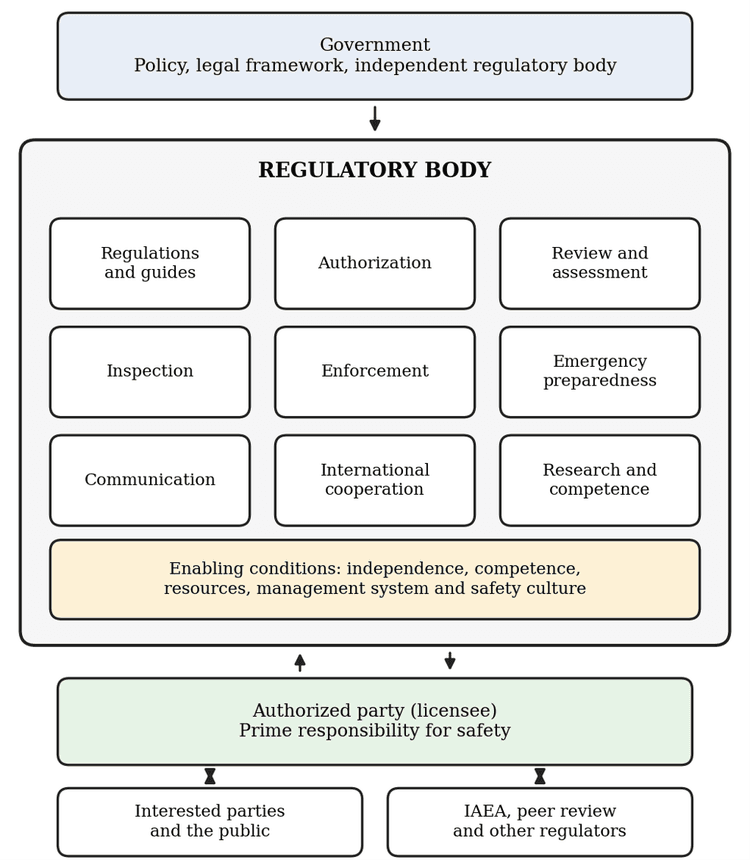
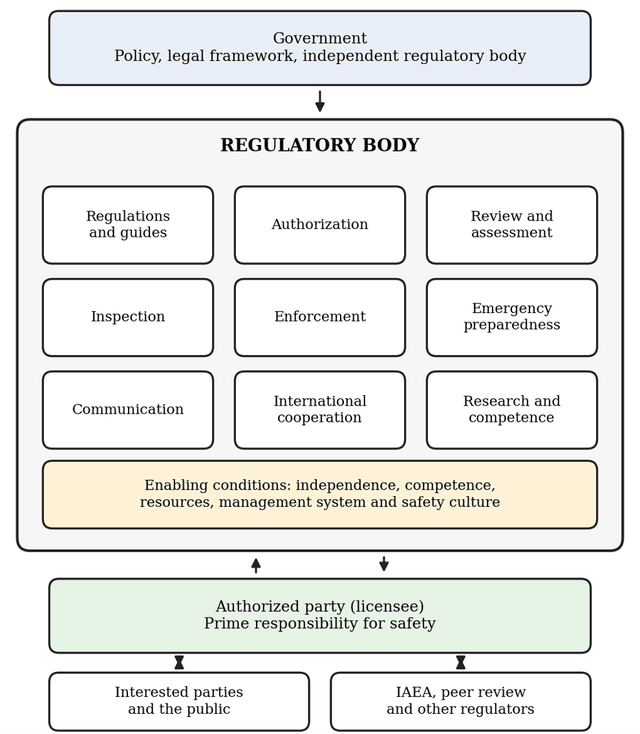
A nuclear regulatory body is the instrument through which a State makes sure that nuclear energy and radiation are used without unacceptable risk to people, society and the environment. This narrative review sets out what such a body is expected to do and what it needs in order to do it. Sources, search dates and selection criteria are described in Section 2. It draws on the safety standards of the International Atomic Energy Agency (IAEA), the Convention on Nuclear Safety, the legislation that created the regulators of Bangladesh, Pakistan and India, and the published reports of IAEA Integrated Regulatory Review Service (IRRS) missions to the three countries. Nine functions are discussed: regulations and guides, authorization, review and assessment, inspection, enforcement, emergency preparedness, communication with interested parties, international cooperation, and research and competence management. Four conditions decide whether these functions work in practice: effective independence, competence, resources, and a management system with a sound safety culture. The Bangladesh Atomic Energy Regulatory Authority (BAERA) is examined as a newcomer regulator that has moved through site, construction and commissioning licensing of the Rooppur Nuclear Power Plant (fuel loading began in April 2026 and first criticality was reached in October 2026), and is compared with Pakistan and India on common criteria. Findings of the 2022 IRRS mission to Bangladesh are treated as a 2022 baseline, not as a description of present conditions. Recurring challenges are summarized and seven recommendations are offered, each linked to an identified gap, a lead institution and an indicator of progress. The functions themselves are well defined internationally; the harder task is sustaining the conditions behind them.
J. Sci. Eng. Pap. 2026, 4(1), 255-267 · doi:10.62275/josep.27.1000036 · Published 18 Nov 2026
D. Sikder, M. Islam, M. Mia, Q. Shah +3 more
The groundwater systems near nuclear power plants (NPPs) are critical pathways for possible radionuclide migration, both during normal operation and during accidental events. This review gathers the existing scientific literature on the radiological consequences, monitoring techniques and hydrogeological modeling difficulties of groundwater protection in the context of NPP operation. Important radionuclides of concern, such as cesium-137 ( 137 Cs), strontium-90 ( 90 Sr) and tritium ( 3 H) are described and their analytical detection limits are set under regulations. subsurface transport modeling by 3D finite difference methods and assessment of groundwater vulnerability using DRASTIC model. In addition, the Water Quality Index of the Canadian Council of Ministers of the Environment (CCME WQI) is examined for use in assessing the hydro-geochemical stability in the vicinity of operating sites. The field-based evidence on tritium dynamics, assessment of public doses and ambient radiation baselines are presented in the case studies from Sanmen NPP, Rooppur NPP, Zaporizhzhia NPP and Krško NPP. Finally, this review addressed some of the engineered mitigation challenges, such as the application of a permeable reactive barrier using clay mineral adsorbents (saponite, sepiolite, bentonite) and provide suggestions for future integrated monitoring networks.
J. Sci. Eng. Pap. 2026, 4(1), 239-244 · doi:10.62275/josep.27.1000034 · Published 17 Nov 2026
D. Sikder, M. Islam, M. Mia, Q. Shah +3 more
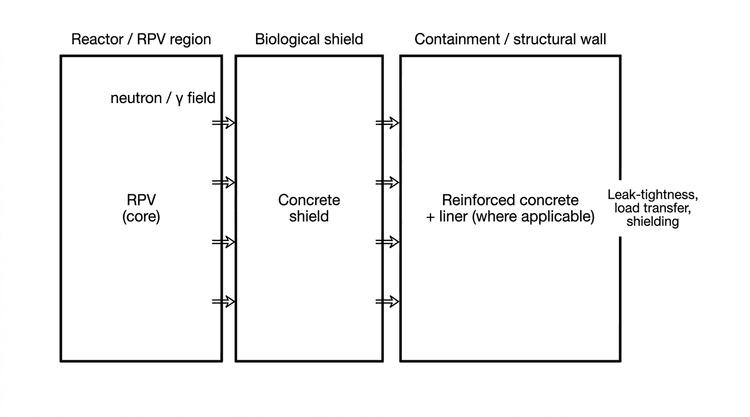
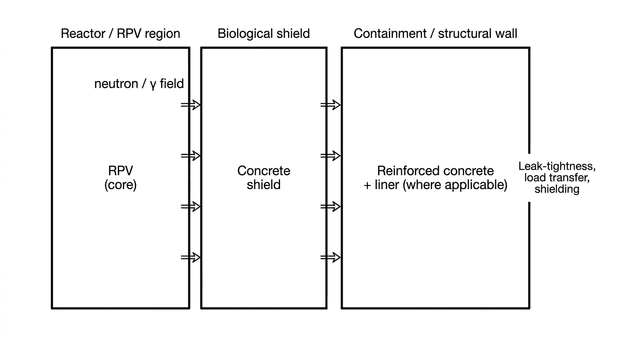
In nuclear power plants (NPPs), reinforced concrete structures play a vital role as safety-related assets, serving as a structural support, leak-tight enclosure and biological radiation shielding. These structures are physically and chemically degraded in extended operating lifespans (60 to 80+ years) in strong thermal, neutron and gamma radiation fields. This review aims at presenting a multi-physical rigorous synthesis of concrete aging mechanisms. The main effects of fast neutrons are atomic displacement, crystalline disorder (metamictization) and Radiation-Induced Volumetric Expansion (RIVE) of mineral aggregates, while the main effects of gamma rays are pore-water radiolysis, C-S-H degradation and matrix drying shrinkage. This causes localized tensile stresses and extensive microcracking at the Interfacial Transition Zone (ITZ). At the macrostructural level, the paper summarizes the degradation analysis of reinforced concrete panels under multi-axial loading using the Modified Compression Field Theory (MCFT) that shows a capacity loss of up to 62% at high fast neutron fluences (2.0 × 10 21 n/cm 2 ) for heavily reinforced panels (ρ > 1.88%) and a clear failure mode transition from ductile steel yielding to brittle concrete crushing. Moreover, mitigation strategies such as advanced shielding aggregates (magnetite) and nano-engineered hybrids (1.5% nano-alumina and 0.1% carbon nanotubes) are assessed. This study presens a risk-informed, probabilistic ageing management program (AMP) that combines advanced non-destructive testing (NDT) to ensure nuclear safety around the world, reconciling laboratory models with the empirical field data from decommissioned biological shields (JPDR) and CANDU containments.
J. Sci. Eng. Pap. 2026, 4(1), 245-254 · doi:10.62275/josep.27.1000035 · Published 17 Nov 2026
Showing 1–3 of 3 articlesShowing 1–3 of 3 articles
 6 views
 4 downloads