


 JoSEPVolume 1 · Issue 2
Issue 2
May 2024May 2024 · 6 articles
 Open AccesseISSN 3094-1182 · pISSN 3079-8175
eISSN 3094-1182 · pISSN 3079-8175
Open AccessThe first volume of JoSEP: 2 issues published between January 2024 and May 2024.
 2 issues
 12 articles
 61 views
 2 downloadsJoSEPVolume 1 · Issue 2
May 2024May 2024 · 6 articles
 JoSEPVolume 1 · Issue 1
Jan 2024January 2024 · 6 articles

S. Shahriar, M. Hasan, M. Akhtar, S. Dipti +2 more
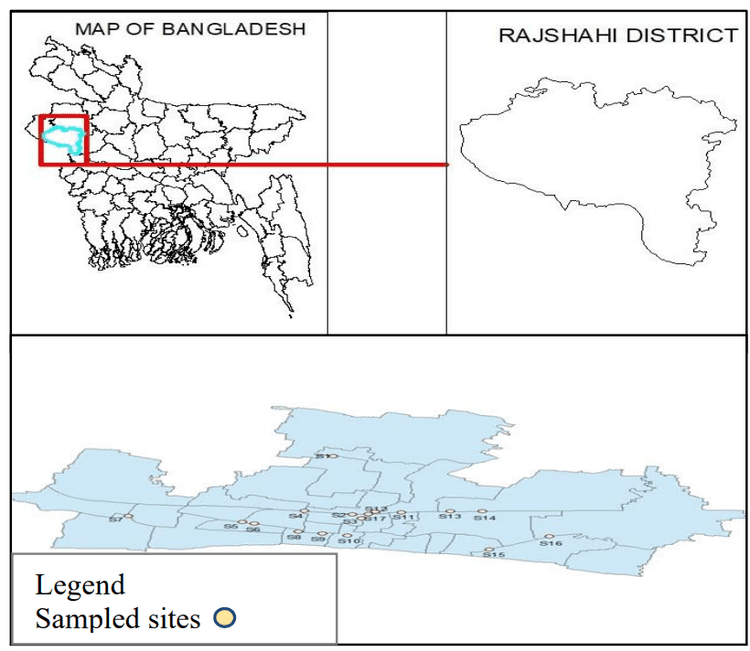
All age groups are fond of bakery items, although middle-class and lower-class people in Bangladesh are especially prominent. However, this food product's ingredients, manufacturing process, and packaging all have the potential for heavy metal contamination. As a result, the mean concentrations of Cr, Mn, Cu, Ni, Cd and Pb in 18 different brands of local bakery items, while others were from well-known brands readily available in Rajshahi City, were evaluated using an atomic absorption spectrometer. The concentrations of Cr, Mn, Cu, Ni, Cd, and Pb were 0.34–1.66, 0.29–1.70, 0.19–1.27, ND–7.04, ND–0.38, and ND–1.33 mg/kg, respectively. The order of the metal content was Ni> Mn> Cr> Pb> Cu> Cd, with their polluted values. According to the results, some cereals and cereal-based food product samples included levels of Ni, Pb, & Cd that were greater than the permissible range recommended by the World Health Organization. Fewer samples typically exceed the acceptable limit than all of them. The metals' estimated daily intake levels did not exceed the permitted intake thresholds. On the other hand, the amounts of healthy nutritive metals like Mn and Cu that were ingested from that foodstuff were relatively small and barely met the daily demands for these nutrients. As a whole, the heavy metals' estimated target hazard quotients were < 1, indicating that people who regularly use these goods on a daily basis shouldn't have any health concerns.
J. Sci. Eng. Pap. 2026, 1(1), 1-9 · doi:10.62275/josep.24.1000002 · Published 12 Oct 2026
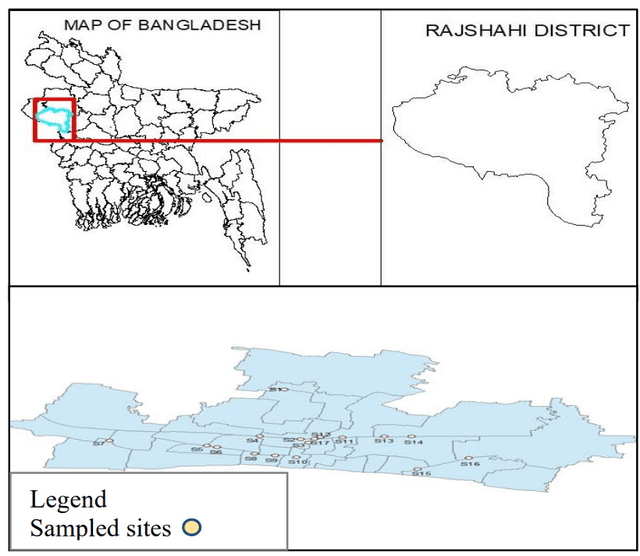
M. Malek, M. Ahmed, S. Kabir
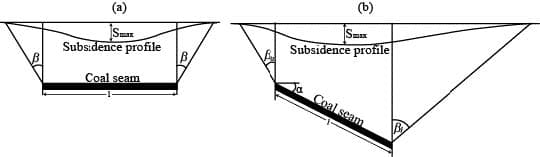
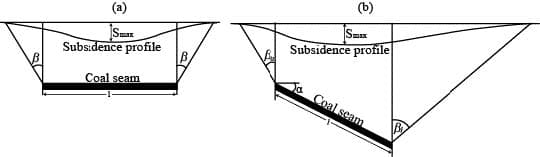
Mining-induced subsidence, a typical consequence of underground mining, can cause environmental and structural problems in the mine area. Predicting surface subsidence for inclined and deep seams has been less emphasized than horizontal seams, mainly due to the complexities of extracting such coal seams. The prediction of surface subsidence and the dynamics of subsidence in down-cut slicing panels is more complex and crucial in practice. This study presents a novel profile function method for forecasting surface subsidence resulting from downward slicing panels in the inclined coal seam mining of the Barapukuria coal mine. The calculated maximum subsidence depth is 10.23 meters whereas the measured maximum water depth of the subsided lake of the Barapukuria coal mine is 10.5 meters. The results indicate a strong correlation between the predicted and the measured values.
J. Sci. Eng. Pap. 2026, 1(2), 81-89 · doi:10.62275/josep.24.1000012 · Published 22 Oct 2026
S. Shahriar, M. Zaman, M. Hossain, S. Dipti +3 more
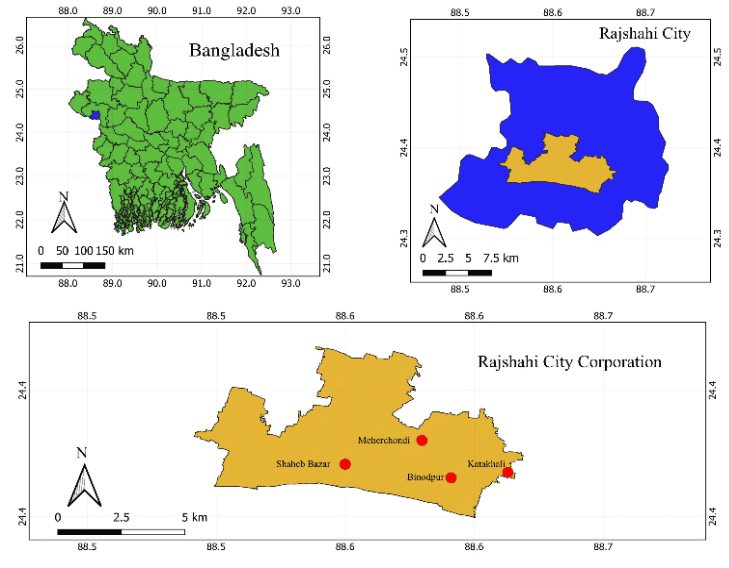
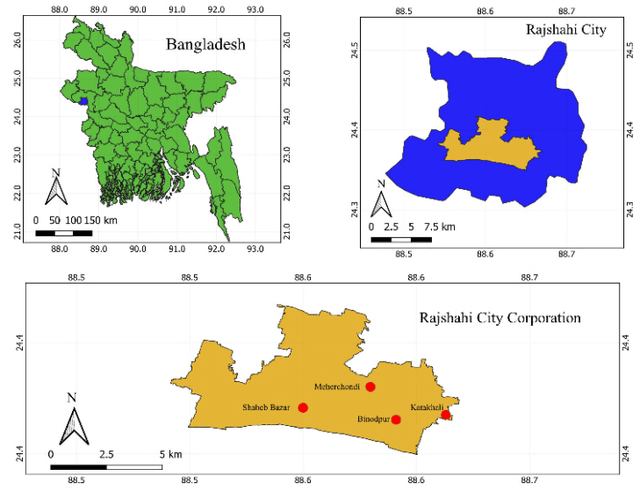
Fish is a significant dietary staple rich in essential nutrients but can also be contaminated with harmful substances, like heavy metals, from polluted environments. This study examines the concentration of heavy metals, specifically Cd, Pb, Cr, and Mn, in three fish species ( Mozambique tilapia , Labeo bata , and Puntius sarana ) collected from the Rajshahi City Corporation area in Bangladesh. The research involved collecting 36 fish samples from four locations within Rajshahi and analyzing them using standard digestion and Atomic Absorption Spectroscopy methods. The concentration ranges detected were 0.0104 to 1.2399 mg/kg for Cd, 0.6711 to 6.051 mg/kg for Pb, 0.0799 to 3.9084 mg/kg for Cr, and 0.1622 to 2.4685 mg/kg for Mn. Notably, 8.33% of samples for Cd, 100% of samples for Pb, 100% for Cr and 0.0% for Mn exceeded the permissible limits set by international guidelines, highlighting potential health risks for consumers. Health risk assessments, including estimated daily intake, target hazard quotient, carcinogenic risk, and hazard index, indicated significant risks associated with consuming these fish. The hazard index of those fish species was observed in the order of Labeo bata > Mozambique tilapia > Puntius sarana . The study emphasizes the importance of regular monitoring and stringent regulatory measures to mitigate the health impacts of heavy metal contamination in fish. The findings suggest that while fish remain a vital nutritional resource, the environmental contamination they are exposed to poses a severe public health concern, necessitating comprehensive strategies for pollution control and food safety.
J. Sci. Eng. Pap. 2026, 1(2), 49-58 · doi:10.62275/josep.24.1000008 · Published 19 Oct 2026
M. Karim, M. Sajeeb, S. Chandra, S. Dipti
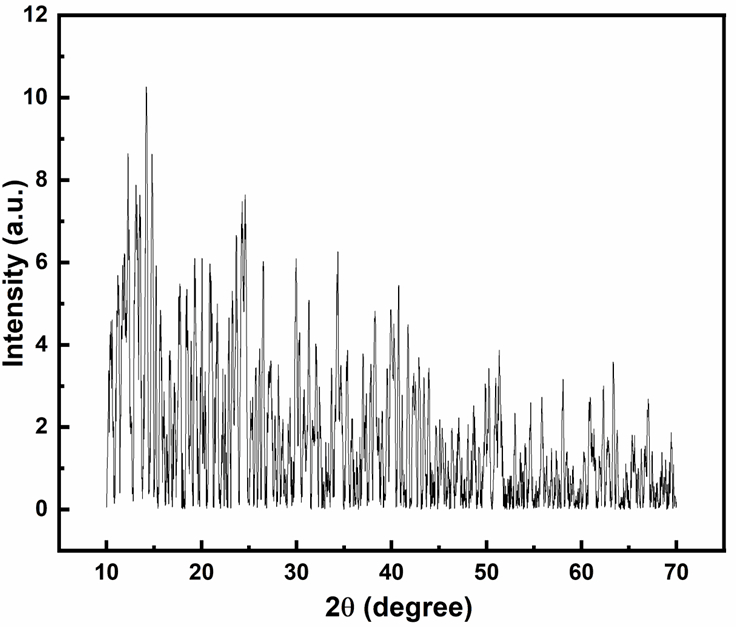
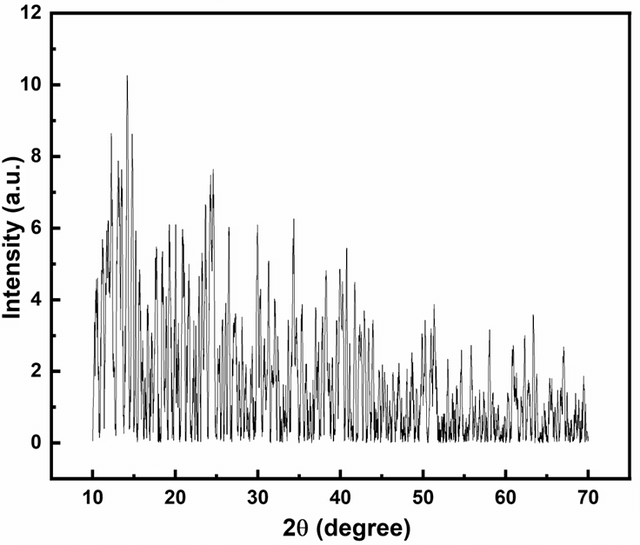
The adsorption process investigates the adsorption kinetic of ciprofloxacin onto banana peels-based activated carbon (BPAC) with a batch process. The pyrolysis method prepared the banana peel-based activated carbon (BPAC). XRD investigated the crystallinity of the BPAC. The effect of shaking time, pH, concentration of BPAC, concentration of ciprofloxacin in aqueous solution, and time duration. The maximum removal percentage of ciprofloxacin from its aqueous solution was 98.7 %. In the kinetic study, the pseudo-first and second-order linear and non-linear equations were fitted with experimental data using the origin LAB program. The pseudo-first-order linear equation R 2 values have an R 2 of 0.9103. In contrast, the R 2 values of the linear equations about pseudo-second-order of types I, II, III, and IV are 0.9982, 0.9968, 0.9986, and 0.9886, respectively. Considering the R 2 values, linear pseudo-second-order types III & IV are preferable for ciprofloxacin elimination from its aqueous solution.
J. Sci. Eng. Pap. 2026, 1(2), 73-80 · doi:10.62275/josep.24.1000011 · Published 21 Oct 2026
S. Shahriar, M. Hossain, S. Dipti, S. Salam
Since the dawn of time, plant-based foodstuffs have been an indispensable component of human nutrition. This hasn't evolved, but the heavy metal contamination of soil and edible vegetable portions is currently a global grave threat to the environment. One of the predominant components contributing to agricultural contamination includes heavy metals. Anthropogenic activities and rapid industrialization can introduce dangerous and invisible heavy metals throughout the soil, water, air, and plants, among other environmental components. In addition to being critical for plants to flourish consistently, heavy metals also play substantial functions in basic nucleic acid metabolisms, electron transfer, redox reactions, and as direct participants in several enzymes. It is crucial that these vital metals be present in growth media at a certain concentration, yet an excess of them might have detrimental consequences ranging from deadly ailments. The article reviewed the existing understanding of how those released toxic heavy metals penetrate the food chain, biomagnify into cells when they are consumed as vegetables, and cause potentially catastrophic consequences to health. These harmful metals have a significantly higher propensity to bioaccumulate and turn deadly in human beings.
J. Sci. Eng. Pap. 2024, 1(1), 40-48 · doi:10.62275/josep.24.1000007 · Published 18 Jan 2024
Showing 1–5 of 12 articlesShowing 1–3 of 12 articles
 25 views
 1 downloads